Imagine an employee in your organization walking into the office, grabbing a cup of coffee, and opening their email inbox to find an urgent message from the CEO demanding a wire transfer for a critical vendor.
Eager to prove their efficiency, they rush to process it. But a split second after clicking the link, their screen flashes red. They fell for a trap you, the security team, set.
What’s the reward? A mandatory, unskippable 45-minute compliance video from 2018, a sternly worded email from your team, and a permanent strike on their HR record.
The ‘gotcha’ method is simple: If you punish people for clicking bad links, they’ll eventually stop clicking them.
Punishing employees for falling victim to sophisticated social engineering in 2026 doesn't make an organization safer. It just teaches your workforce to hide their mistakes, suppress their suspicions, and view the security team as the enemy.
To build a defensible organization, abandon the blame game. Shift toward a “just culture, (opens in new tab)” a framework that replaces punitive threats with a modern human risk management (HRM) strategy, effectively turning your employees from your biggest liability into your most valuable threat sensors.
Psychology of the digital dunce cap
When a company relies on a punitive security awareness training (SAT) model, they inadvertently create a culture of profound anxiety.
Let's look at the actual psychological fallout of the ‘three-strikes-and-you're-fired' approach to phishing simulations. If an employee knows that clicking the wrong link will result in public shaming, a meeting with their manager, or a negative performance review, their primary objective shifts from protecting the company to protecting their job.
This creates a blind spot for the CISO and entire security team.
- Cover-up: If an employee clicks a malicious link in a punitive environment, their first instinct isn’t to pick up the phone and call the help desk. Their first instinct is to quietly close the browser, delete the email, and pray nobody notices.
- Silent dwell time: When mistakes are driven underground, the attacker's dwell time increases exponentially. A breach that could have been contained in 4 minutes if the employee immediately reported it now sits active on the network for 4 days while the security team remains completely oblivious.
- Trust deficit: Security cannot function in a vacuum. If the workforce views the SOC as corporate hall monitors waiting to hand out demerits, they will never proactively engage with security policies or ask clarifying questions when they feel unsure about a process.
Social engineering is a cybercriminal’s professional sport
The other massive problem with blaming the employee is that it ignores reality. The modern threat landscape is anything but a fair fight.
You’re not dealing with poorly translated emails from foreign princes asking for iTunes gift cards anymore. You’re dealing with highly organized, well-funded cyber syndicates that operate with the efficiency of a Fortune 500 marketing department.
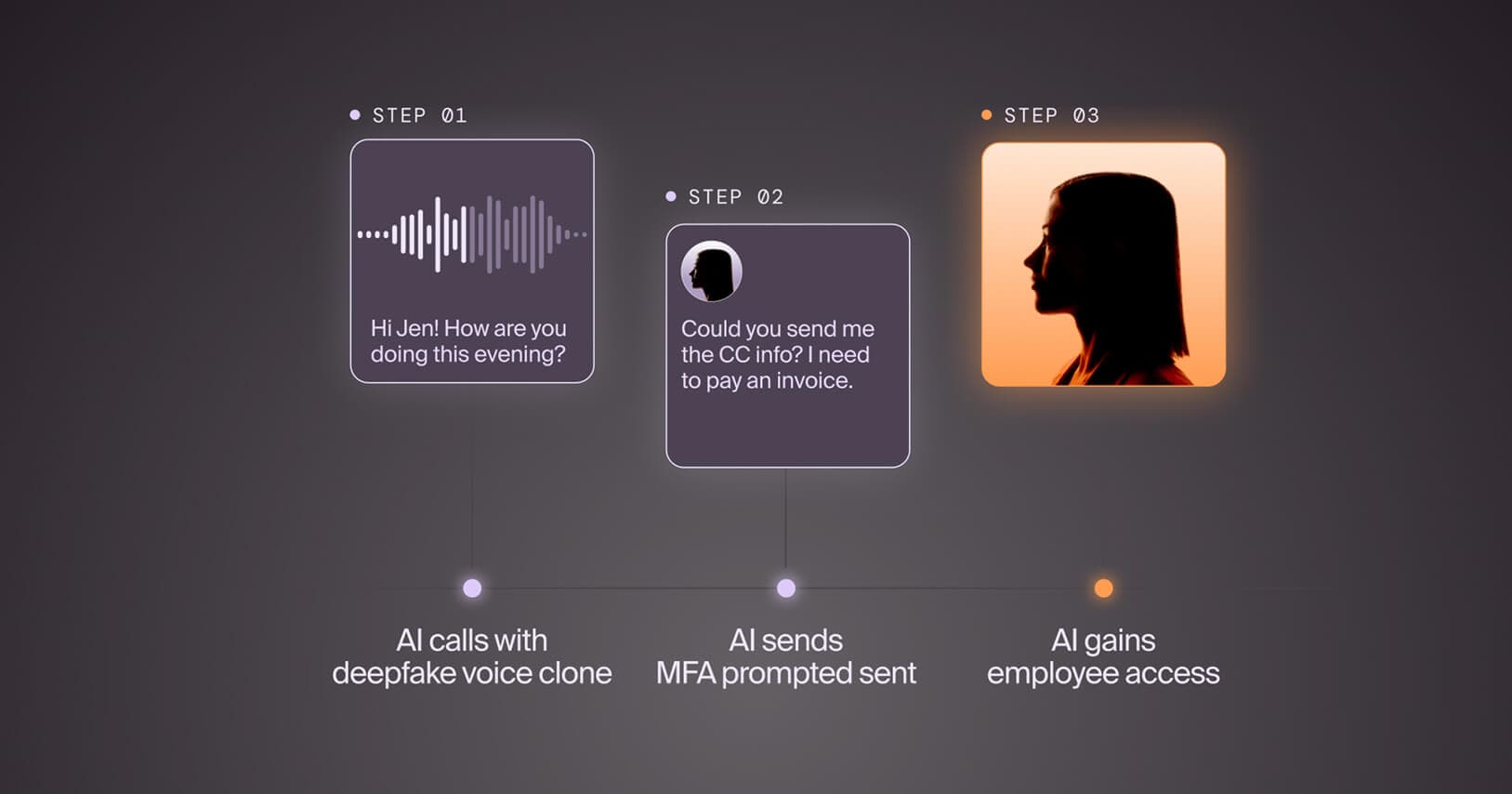
Attackers are leveraging large language models (LLMs) (opens in new tab) to perfectly mimic the tone, cadence, and vocabulary of your executive leadership. They’re deploying adversary-in-the-middle (AiTM) reverse proxies that perfectly clone your Microsoft 365 login page to capture live session tokens, and they’re utilizing deepfake audio to call your finance department and verbally authorize fraudulent transactions.
Expecting a tired marketing manager or a stressed junior accountant to flawlessly spot a mathematically perfect, AI-generated lookalike domain on a Friday afternoon is absurd.
When you punish an employee for falling for a world-class psychological trap, you are essentially blaming the bank teller for the bank robbery.
What is a just culture?
“Just culture” doesn't actually originate in cybersecurity. It comes from high-stakes industries like commercial aviation and healthcare, where concealing a mistake can literally cost lives.
In a just culture, the fundamental operating principle is that human error is inevitable. When a mistake occurs (whether a pilot misreads a gauge or a nurse administers the wrong dosage), the immediate reaction is not to fire the individual. The immediate reaction is to investigate the system.
- Did the system design encourage the error?
- Was the training adequate for the scenario?
- Were the warning signs clear enough?
A just culture doesn’t mean an absence of accountability. If an employee acts with gross negligence or malicious intent (like intentionally selling their credentials on the dark web), there are severe consequences. But if an employee makes an honest mistake while doing their job, the organization focuses on fixing the flawed process that allowed the mistake to occur in the first place.
Apply this to cybersecurity: When employees know they’ll be supported rather than punished for an honest mistake, reporting rates skyrocket, and high reporting rates are the lifeblood of a resilient network.
3 tips for a defensible (and just) security culture
Transitioning from a culture of blame to a culture of resilience requires more than just rewriting a mission statement. There needs to be a shift in how you measure success, deliver training, and deploy technology.
Here’s a practical blueprint for building a resilient, behavior-based security culture.
1. Shift to metrics that matter
Legacy security programs are obsessed with click rates. They run a simulation, find out that 4% of the company clicked the link, and present that number to the board as a failure.
Click rates are a vanity metric. If a phishing lure is good enough, someone will always click it.
A just culture focuses entirely on reporting rates and time to report.
- Out of the people who received the suspicious email, how many hit the "Report Phishing" button?
- How fast did they do it?
- If someone accidentally clicked a bad link, how quickly did they notify the security team?
When you reward high reporting rates, you actively incentivize the exact behavior you need to survive a real attack. You stop worrying about the one person who failed and start relying on the 99 people who correctly flagged the threat.
2. Implement contextual, in-the-moment coaching
The standard response to a failed phishing simulation is usually a delayed, generic compliance video. This is punitive (and ineffective).
To build resilience, the intervention must occur at the exact moment the mistake occurs and be contextually relevant to the error. If an employee scans a malicious QR code on their smartphone, they don’t need an hour-long lecture on password hygiene sent to their email three days later.
What they need is a 30-second micro-coaching module delivered immediately to their mobile screen that gently explains exactly how mobile browsers hide URLs and why scanning unfamiliar codes is dangerous.
This removes the shame and turns a potential catastrophe into an immediate, highly retained learning opportunity.
3. Making frictionless reporting the default
You can’t build a just culture if reporting a threat requires filling out a confusing IT ticket or navigating a labyrinthine intranet portal.
Employees are busy. If raising the alarm takes more than three seconds, they won't do it. Your organization should implement a frictionless, one-click reporting mechanism natively integrated into its existing workflows, whether that’s an add-in for Outlook, a dedicated Slack channel, or a prominent button in Google Workspace.
You have to close the feedback loop, too. When an employee reports a threat, your human risk management platform should acknowledge it immediately: "Thank you for reporting this. Our automated systems have confirmed this was a malicious domain, and your quick action just protected the entire company."
That simple validation builds immense psychological safety.
Realigning the incident response strategy
Look at the incident response lifecycle.
Here’s a breakdown of how different security environments handle the exact same human error, and the cascading business outcomes that follow.
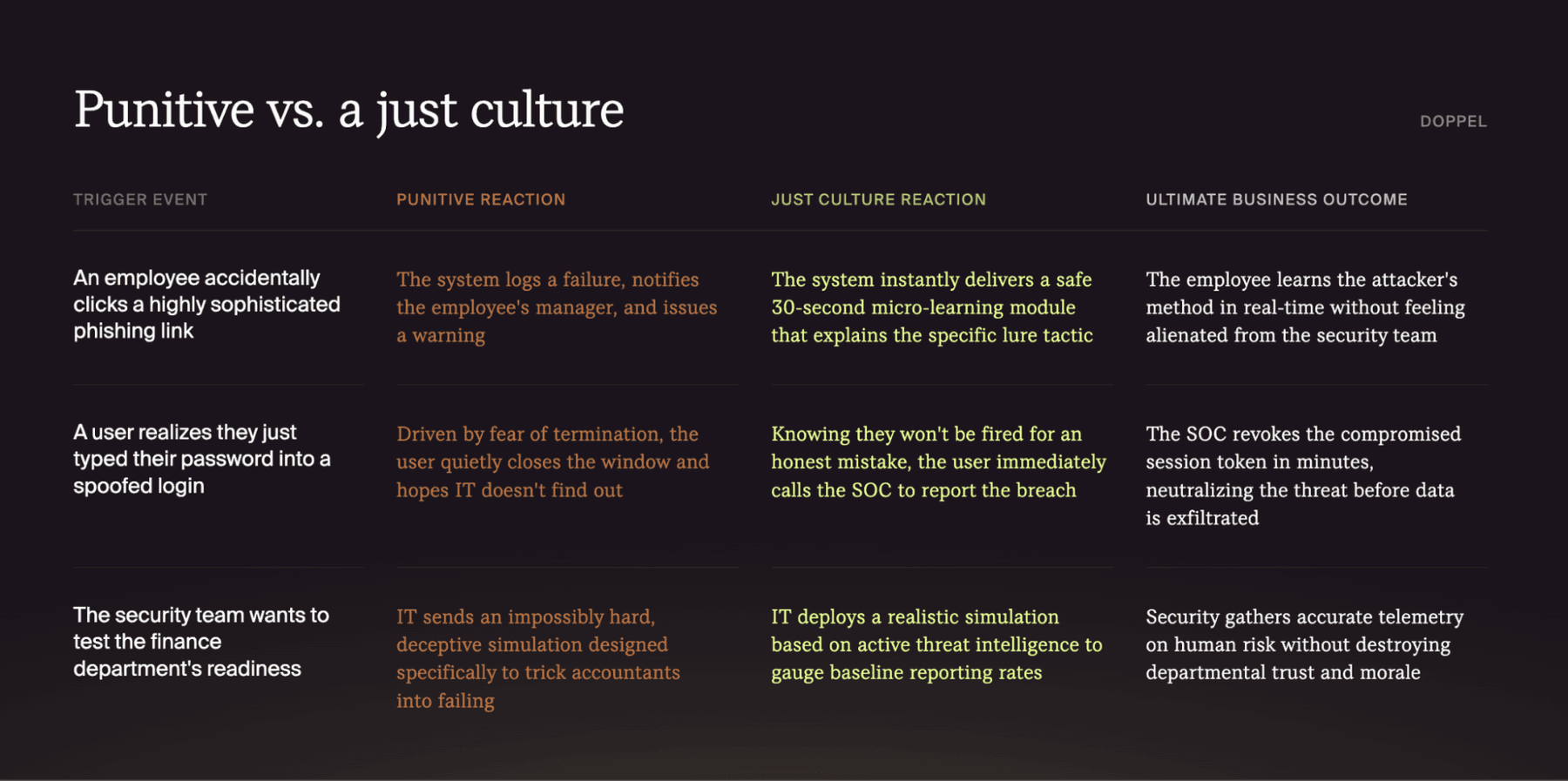
You can’t orchestrate this cultural shift using a spreadsheet and an outdated email filter. Managing human behavior at scale demands dedicated, intelligent infrastructure.
This is the exact purpose of a dedicated human risk management platform like Doppel.
Doppel's agentic AI-native platform actively manages the human perimeter. By converting live, real-world threat intelligence into safe internal simulations, the platform tests your workforce against the exact lures threat actors are currently using.
When mistakes happen (and they will), Doppel replaces the punitive HR death march with contextual, in-the-moment coaching. It seamlessly integrates one-click reporting tools, tracks the metrics that actually matter, and provides the CISO with real-time visibility into the organization's true behavioral resilience.
Empowering the active threat sensor
Cybersecurity is a behavioral science in 2026.
As long as threat actors continue to weaponize trust, urgency, and human psychology, your employees will remain the primary targets. Now, you have a choice in how you prepare them for that reality.
You can continue to treat your workforce as a liability, handing out digital demerits and wondering why your SOC is always the last to know about a breach. Or, you can embrace a just culture.
By removing the fear of punishment, rewarding proactive reporting, and deploying a modern human risk management strategy, you stop fighting your own employees.
Turn every single inbox, smartphone, and workstation into an active, highly trained threat sensor to build a defensible security perimeter with Doppel.