Effective Strategies for Human Risk Management
The biggest threat to your business isn’t a hacker in a dark room—it’s often a well-meaning employee trying to be helpful under pressure. But how can you protect against a problem that seems to come from everywhere? The key is realizing that human risk isn’t one big, unmanageable blob. In practice, the difference between an honest mistake and intentional sabotage is huge, and effective insider threat prevention strategies depend on telling them apart.
To move from confusion to clarity, most people-related risks can be sorted into three simple buckets. This framework is the first step in building a more resilient organization.
- The Accidental: Honest mistakes made with no bad intent.
- The Malicious: Someone intentionally trying to cause harm from the inside.
- The Coerced: A good person tricked into doing a bad thing, a core part of modern social engineering defense tactics.
Think of it in one company: an accountant accidentally deletes a folder of invoices. A month later, a disgruntled salesperson maliciously copies the customer list before quitting. Then, a manager is coerced by a fake ‘urgent’ email into approving a fraudulent payment. By separating risks this way, you can stop reacting and start building the right safety nets for each situation.
Stop Blaming People, Start Fixing the ‘Rug’: The Real Secret to Reducing Mistakes
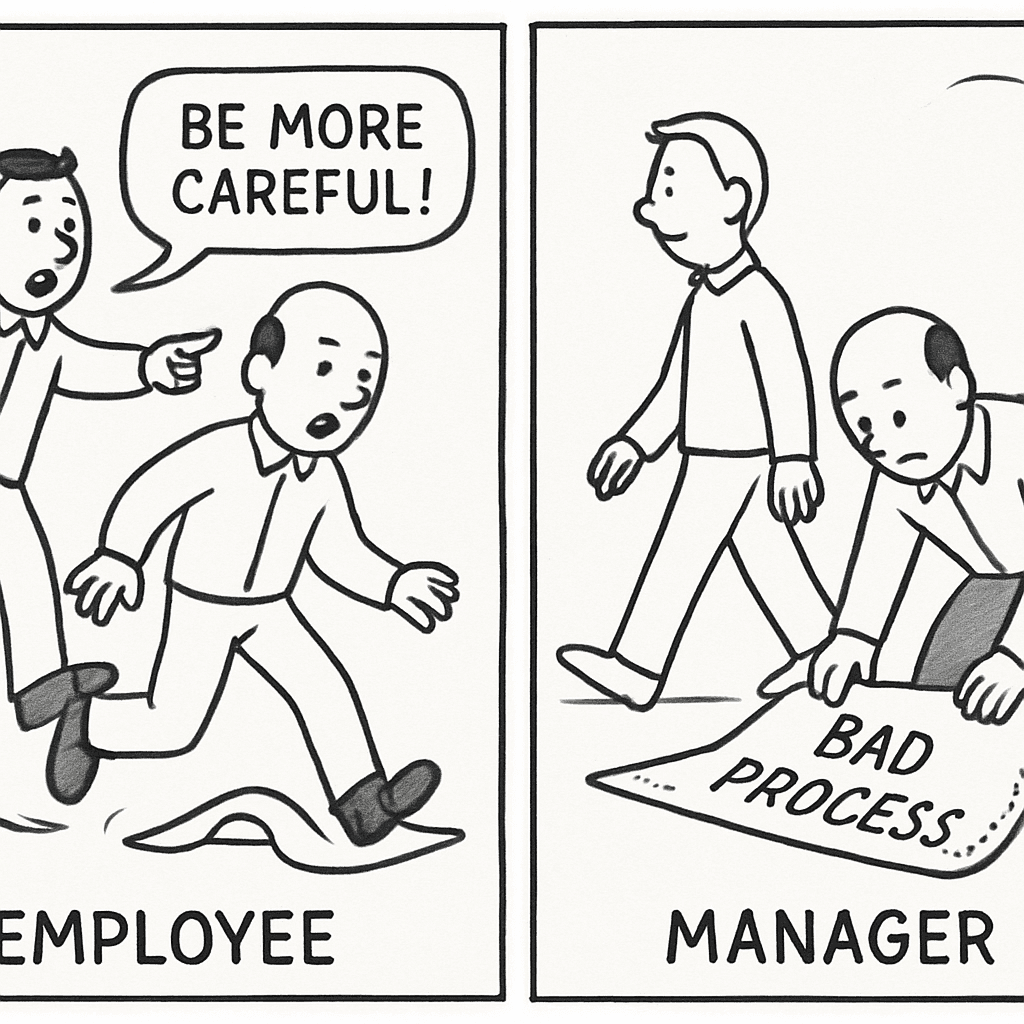
Imagine one person trips on a rug in your office hallway. Your first instinct might be to tell them to watch their step. But what happens if ten different people trip over that exact same spot throughout the week? The problem clearly isn’t a sudden outbreak of clumsiness—it’s the rug. This simple shift in perspective is the single most important secret to effectively managing human risk. Instead of focusing on who made a mistake, we need to start looking for the "rugs" that caused the trip.
In any business, these "rugs" are the confusing processes, outdated software, or high-pressure situations that set good people up to fail. Think of a spreadsheet template so complex that employees constantly enter data in the wrong place. Or consider a system that allows someone to accidentally delete a critical shared folder with a single click and no warning. These are design flaws in the work environment, not character flaws in your team. Focusing only on the person who erred is like repeatedly warning people about the bumpy rug instead of simply smoothing it out for everyone.
Adopting this mindset allows you to ask a far more powerful question. Instead of "Who messed up?" you begin to ask, "What part of our process made this mistake easy to make?" This changes your culture from one of blame to one of continuous improvement. Finding and fixing these underlying issues is a more permanent and respectful way to reduce errors. After all, the goal isn't just to catch mistakes after they happen, but to build guardrails that help prevent them in the first place.
How to Build 'Guardrails' That Prevent Honest Mistakes
Fixing those systemic 'rugs' means building thoughtful 'guardrails' into your daily work. Just like guardrails on a highway keep cars from veering off the road, these are simple checks and systems designed to guide people toward the correct action. They aren't about limiting freedom; they are safety nets that make it easy to do the right thing and hard to do the wrong thing, especially during a busy or stressful moment. This approach is one of the most effective employee error reduction strategies because it builds safety directly into the process.
One of the most powerful, low-tech guardrails is the humble checklist. Pilots and surgeons use them before every flight and operation for a reason: they prevent critical, yet simple, errors by offloading memory. For a team or small business, this could be a five-step checklist for closing out the day or a guide for onboarding a new client. This simple tool ensures that even on the most chaotic day, essential steps aren't forgotten, dramatically reducing risks from employee negligence on repetitive but important tasks.
Many of the best guardrails are digital. That “Are you sure you want to permanently delete this file?” pop-up is a perfect example—a simple pause before an irreversible action. Similarly, an email system that automatically flags when you're about to 'Reply All' to a large group can prevent massive embarrassment. Building a basic human risk assessment framework starts with this thinking: find where a simple slip-up causes a big problem, and add a small, helpful barrier. These guardrails are fantastic for preventing honest mistakes. But what about when the risk isn't an accident, but a deliberate trick?
The Scammer's #1 Weapon: How to Spot and Defeat Deception Tactics
While guardrails are great for stopping accidents, they can't block a deliberate trick. This is where scammers thrive, not by hacking computers, but by hacking our attention. They use powerful psychological triggers—most often urgency and authority—to bypass our common sense. An email that looks like it's from your boss, marked 'URGENT' and asking for a favor right now? That feeling of pressure is the weapon.
Your best defense is a simple, three-step habit: Stop, Look, Ask. This mental fire drill is one of the most effective social engineering defense tactics because it breaks the scammer's spell of urgency.
- STOP: The instant you feel rushed or emotional, just pause.
- LOOK: Scrutinize the message for red flags like a strange sender email, typos, or odd links.
- ASK: Verify the request through a different channel. Call the person on a number you already know.
It’s critical to remember that falling for these tricks has nothing to do with intelligence. Scammers are professionals at manipulation who succeed by catching good, helpful people when they're off guard. The real value in security awareness training isn't creating paranoia; its effectiveness comes from building the 'Stop, Look, Ask' reflex so it kicks in automatically, even on a stressful day.
Learning to spot these tricks turns your team into a human firewall. But even the most alert person can't leak information they don't have access to in the first place. This raises a crucial question in any insider threat prevention strategy: who really needs the keys to the kingdom to begin with?
Why 'Giving Everyone the Keys' Is a Disaster Waiting to Happen
In many workplaces, it’s tempting to give everyone access to everything for the sake of convenience. But just as you wouldn't hand every new hire a master key that unlocks every door in the building, the same logic should apply to your digital files. This leads to a powerful security rule known as the Principle of Least Privilege. The idea is simple: people should only have access to the specific information and tools they absolutely need to do their jobs, and nothing more. It’s like a hotel key card that only opens your room, not the entire floor.
The power of this approach is how it dramatically shrinks your vulnerability. If a scammer successfully tricks a marketing assistant into giving up their password, the damage is contained. The thief might see ad campaign drafts, but they can’t access your financial records or customer database because the assistant never had permission to. By limiting who can open which digital "doors," you automatically reduce the potential harm from both a disgruntled insider and a tricked, well-meaning employee who fell for a phishing email.
Beyond protecting against attackers, this principle is also your best defense against honest mistakes. An employee can't accidentally delete a critical folder if they never had permission to access it, turning a potential catastrophe into a non-event. This isn’t about a lack of trust; it’s one of the most effective insider threat prevention strategies because it creates a safer system where the fallout from one wrong click is small. Technical guardrails like this are only half the story, however. Their true power is unlocked when they are supported by a company’s culture.
Is Your Workplace Culture a Safety Net or a Tightrope?
Technical guardrails are essential, but a company’s culture determines whether people use them effectively or try to work around them. An environment filled with high pressure, long hours, and the fear of failure puts everyone on a tightrope. When people are exhausted or scared to ask questions, they are far more likely to make an honest mistake, like clicking a suspicious link in a rush or sending sensitive information to the wrong person. No amount of software can fully protect against burnout.
In this context, psychological safety becomes a powerful security tool. It’s not a complex theory; it’s simply the belief that you won’t be punished or humiliated for speaking up with ideas, questions, concerns, or mistakes. In a psychologically safe workplace, an employee feels comfortable saying, “I’m not sure about this email, can you look?” or “This process is confusing and seems risky.” This empowers your team to be your eyes and ears, helping you spot the "rugs" before anyone trips.
When you have psychological safety, you unlock a blame-free reporting culture. Think about it: would you rather an employee hide a mistake out of fear, letting the damage spiral, or tell you immediately so you can fix it? By treating honest errors as learning opportunities instead of grounds for punishment, you encourage people to raise their hands the moment something goes wrong. This transforms a potential disaster into valuable data that can help you strengthen your systems for everyone.
Ultimately, a supportive culture acts as the ultimate human-powered alarm system. It doesn’t just make for a nicer place to work; it builds a resilient organization where people look out for each other and the business. Shifting from a culture of blame to one of prevention is one of the most effective risk management strategies available.
Turning Human Risk Insight Into Action
Understanding human risk is only valuable if it leads to measurable behavior change. This is where a modern Human Risk Management approach comes in—one that focuses on identifying risky behaviors, reinforcing the right habits, and continuously improving how people respond under pressure.
Platforms like Doppel approach Human Risk Management by combining realistic Simulations with targeted Security Awareness Training (SAT). Simulations safely expose where “rugs” still exist—such as phishing emails that bypass urgency or authority defenses—while training reinforces practical habits like Stop, Look, Ask at exactly the right moments.
Instead of treating mistakes as failures, this approach turns them into signals. Over time, organizations can see which risks are decreasing, which behaviors are improving, and where new guardrails are needed—making human risk measurable, manageable, and continuously reducible.
Your 3-Step Plan to Start Managing Human Risk This Week
Workplace mistakes don't have to be seen as inevitable personal failings. Instead, this human risk assessment framework helps you view them as signals—clues that point to a "rug" that needs fixing. This shift from blame to prevention is the most powerful step toward reaping the benefits of managing people risk, creating a team that’s not just more careful, but fundamentally more supported.
Implementing a human risk program doesn't require a huge budget or a dedicated department. It begins with small, deliberate actions that build momentum. Here is your 3-point plan to start this week:
- Hold a "Fix the Rug" Meeting: Discuss a recent, minor 'oops' moment with your team. Together, brainstorm one small process change that could have prevented it.
- Create One Checklist: Identify a single recurring, important task and build a simple 5-10 point checklist for it.
- Practice 'Stop, Look, Ask': The next time you get an unexpected, urgent request via email, consciously pause to verify it before taking action.
These steps do more than just prevent errors; they build a culture where it’s safe to be human. You're showing your team that the goal isn't to find fault, but to create a system where everyone can succeed. Instead of just telling people to be more careful, you are building the safety nets that make your entire organization stronger and more resilient.