Attackers no longer need to breach the perimeter to damage a brand. They can register lookalike domains, set up spoofed social profiles, and run ads to drive your customers to that fake domain.
The infrastructure for doing all of that that sits outside the organization's control and outside the view of most security stacks. Digital risk monitoring closes that gap between where attackers operate and what your traditional security stack covers.
In this article, we cover what digital risk monitoring is, why it has become a baseline security requirement, and what to look for when building a program.
Key Takeaways
- Digital risk monitoring detects, correlates, and dismantles attacker infrastructure on channels the organization doesn't own, including domains, social profiles, ads, dark web, and messaging.
- Single-channel monitoring tools often miss multi-channel campaigns, and attackers can exploit those coverage gaps to reach your customers and employees.
- Effective digital risk monitoring programs run a continuous pipeline of multi-channel scanning, graph-driven correlation, and automated enforcement.
- Doppel powers digital risk monitoring with the Threat Graph and agentic AI that executes takedowns at attacker speed.
What Is Digital Risk Monitoring?
Digital risk monitoring is the continuous practice of detecting, correlating, and dismantling attacker infrastructure that targets a brand across channels the organization doesn't own or control. That includes domains the brand didn't register, social profiles the brand didn't create, ad placements the brand didn't purchase, and dark web activity referencing the brand or its people.
Traditional security tools focus on endpoints, cloud environments, email gateways, and internal networks. Digital risk monitoring extends detection to the external attack surface where attackers build and stage campaigns. That surface spans domains and URLs, social media platforms, paid advertising networks, app stores, messaging apps, telco infrastructure, dark web forums, and cryptocurrency exchanges.
Digital Risk Monitoring vs. Threat Detection vs. Infrastructure Takedown
Some security teams often use these three terms interchangeably, but they describe different stages of the same pipeline:
- Digital risk monitoring surfaces signals across external channels, including newly registered domains, suspicious social profiles, leaked credentials, and scam ads.
- Threat detection confirms which of those signals are actually malicious and worth acting on.
- Infrastructure takedown dismantles the confirmed threat by removing the domain, profile, ad, or listing from the channel where it lives.
Many legacy tools stop at monitoring or detection, leaving analysts to manually draft abuse reports for registrars, social platforms, and telcos. An effective digital risk monitoring program connects all three stages into a continuous pipeline so confirmed threats move directly to enforcement.
What a Complete Digital Risk Program Monitoring Covers
Attackers route campaigns across multiple channels at once, so a coverage gap on any one surface leaves the brand still vulnerable. A complete digital risk monitoring program covers the channels below.
Lookalike Domains
Phishing infrastructure is built for speed and disposability, with many domains active for only hours before going dark. Attackers can register hundreds of typosquatted variants and branded subdomains to host credential-harvesting pages. Detection must continuously track domain registrations, SSL certificates, DNS changes, and hosting patterns.
Fraudulent verified-style profiles, fake customer-support pages, and impostor executive accounts can appear across major platforms, including LinkedIn, Facebook, Instagram, TikTok, X, and Telegram. A spoofed executive profile carrying a wire-transfer request or a fake support handle responding to angry customer posts bypasses email security entirely, because the conversation never touches the inbox.
Detection has to scan for visual and textual brand matches across platforms where the organization has a legitimate presence and across adjacent platforms where impersonators can still gain traction.
Paid Ads
Scam ads that use a brand's name, logo, and visual identity push victims toward phishing pages or counterfeit storefronts. The ad networks themselves lend credibility to the lure, because a paid placement in Google, Meta, or TikTok results looks indistinguishable from a legitimate brand ad to the average user. Detection must continuously monitor ad placements across networks and correlate them with the lookalike domains and landing pages they point to, because the ad and its destination are two halves of the same campaign.
Dark Web Forums and Credential Markets
Stolen credentials, leaked executive PII, and data dumps circulating on dark web forums and credential markets feed the reconnaissance phase of impersonation campaigns. An attacker armed with an executive's email and reporting structure can craft a social engineering pretext that passes scrutiny. Monitoring these channels surfaces that exposure before attackers weaponize it.
Telco and Messaging Channels
SMS-based phishing (smishing), vishing calls using spoofed caller IDs, and impersonation through WhatsApp, Telegram, and RCS represent fast-moving delivery channels that sit outside legacy enforcement workflows. Leaving the WhatsApp and SMS legs of a campaign standing gives the attacker a live channel the security team hasn't touched.
Why Digital Risk Monitoring Has Become a Security Requirement
The volume, velocity, and multi-channel nature of brand impersonation campaigns have outpaced what manual review and single-surface tools can catch.
1. Impersonation Campaigns Scale Faster Than Analyst Teams Can Respond
Attackers register domains within days of a product launch, standing up impersonation infrastructure before the marketing team finishes its press cycle. Many of those domains disappear quickly after registration, having already served their purpose.
Security teams still take an average of 254 days (opens in new tab) to identify and contain phishing-initiated breaches. That gap between deployment and discovery is where impersonation converts, and manual analyst workflows run on a timescale that doesn't match the speed of attacker infrastructure.
2. Single-Channel Coverage Creates Blind Spots Attackers Exploit
A coordinated attack chain can combine email flooding, voice-based impersonation, messages on collaboration platforms, and credential-harvesting domains in a single operation. The dominance of phishing in incident reporting can create the illusion that email is where attacks happen, so SEO poisoning, malvertising, smishing, and help desk impersonation go undercounted when security teams don't detect across those surfaces.
3. Alerts Without Enforcement Leave Infrastructure Standing
Teams are shifting toward preemptive security capabilities as AI-driven attack speed compresses response windows, the direction Gartner forecasts (opens in new tab) for the next phase of cybersecurity. Alert-only monitoring that generates a queue of findings without enforcement can leave attacker infrastructure standing. At the same time, an analyst manually drafts an abuse report, submits it to a registrar, and waits for a response. By the time the response comes back, the campaign may already be complete.
How Digital Risk Monitoring Works
An effective program runs a continuous pipeline that converts raw signals into confirmed threats and then into dismantled infrastructure.
Continuous Multi-Channel Scanning
Scheduled scans miss infrastructure that goes live and comes down between review cycles. Continuous ingestion of signals across domains, social platforms, ad networks, app stores, messaging channels, telco networks, the dark web, and email helps teams keep pace with attackers' deployment speed.
Graph-Driven Correlation
A typosquatted domain, a spoofed social profile, and a scam ad campaign can look like unrelated alerts in a tool that evaluates each surface independently. Graph-driven correlation links those signals through shared registrars, hosting infrastructure, phone numbers, or visual assets to expose the full campaign. Campaign-level visibility gives the security team a connected view of attacker infrastructure and a clearer path to action.
Automated Enforcement
Enforcement has to match the attacker's speed. Automated takedown workflows push removals to registrars, social platforms, ad networks, and telcos through direct provider relationships and platform APIs. The operational measure of enforcement is the number of campaigns a program shuts down and how quickly it moves from detection to disruption.
What to Look for When Building a Digital Risk Monitoring Program
Building an effective program requires several capabilities working together across coverage, correlation, enforcement, and integration.
Coverage That Matches the Surfaces Attackers Actually Use
Evaluate coverage across primary surfaces such as domains, social media, paid ads, the dark web, and telco or messaging channels. Confirm whether detection runs in real time or on a schedule, and whether the platform explicitly includes executive protection, with PII removal across data broker sites and dark web credential monitoring for named individuals.
Correlation That Connects Signals Across Channels
Confirm that the platform maps isolated signals, such as a dark web credential leak, a newly registered lookalike domain, and a social impersonation account, into a single attacker-infrastructure view, rather than delivering them as unrelated alerts without operational context.
Enforcement Speed and Reach
Request takedown SLAs by surface type. Determine whether the platform maintains direct relationships with registrars, hosting providers, social platforms, ad networks, and telco carriers, or only submits abuse reports. Direct provider integrations materially change enforcement reach.
Integration With the Internal Security Stack
External threat detections should route into SIEM and SOAR workflows so the SOC can triage them alongside internal alerts. Bidirectional integration means the platform pushes campaign context into the security stack and receives enrichment or case status back. When external detection also feeds employee training, converting live phishing campaigns into simulations, the feedback loop between external defense and internal resilience closes.
How Doppel Powers Digital Risk Monitoring
Doppel is an AI-native Social Engineering Defense platform that unifies Digital Risk Protection (DRP) and Human Risk Management (HRM) into a single system built for digital risk monitoring. The platform monitors and enforces across domains, social media, paid ads, app stores, messaging apps, telco, dark web, crypto exchanges, and email, closing the channel gaps that legacy single-surface tools leave open.
Doppel's shared architecture combines a proprietary signal correlation engine, a multi-agent AI engine, and a bidirectional integration surface for SIEM and SOAR tools. The three capabilities below show how that works in practice.
The Doppel Threat Graph Turns Multi-Channel Signals Into Campaign-Level Intelligence
The Threat Graph continuously ingests signals across domains, social media, paid ads, messaging apps, telco, dark web, and email, then stitches them into a single interactive view of an attacker's full infrastructure. When a typosquatted domain surfaces, the Threat Graph maps the connected infrastructure, such as linked telco numbers, social profiles, and ad campaigns that share the same registrar. The result is campaign-level disruption that dismantles connected infrastructure and raises the cost of rebuilding.
Agentic AI Executes Takedowns at Attack Speed
Doppel's agentic AI handles autonomous detection, correlation, signal scoring, and takedown execution via platform APIs and direct provider relationships across registrars, social platforms, ad networks, and telcos, so analysts focus on the escalations that require human judgment. Coinbase's Trust & Safety team has used the platform to dismantle hundreds of social media accounts and fraudulent domains.
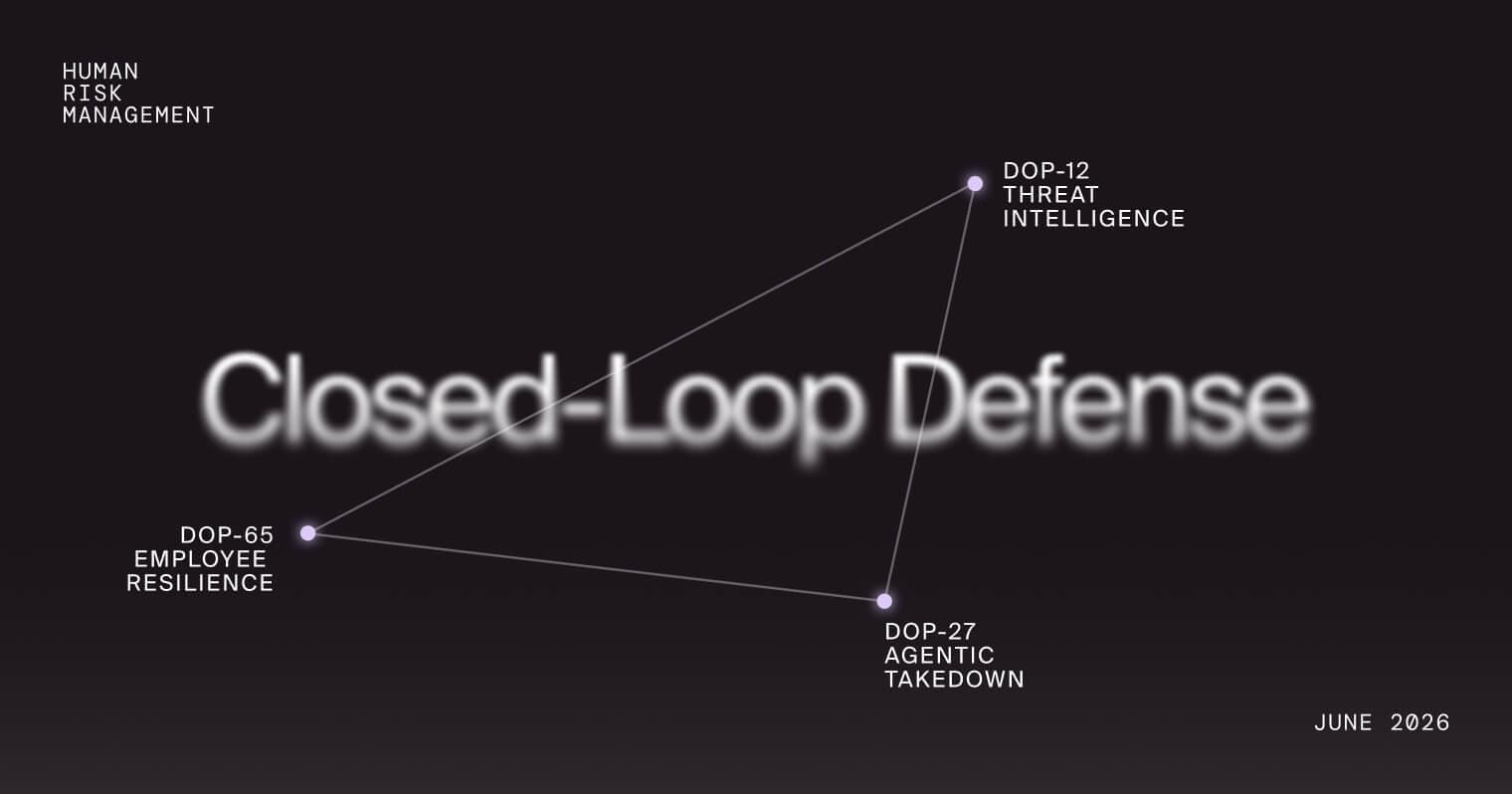
The Digital Risk Protection-Human Risk Management Closed Loop Trains Employees Against Live Threats
Security teams can convert every externally detected threat into an employee simulation with one click. If a phishing campaign is targeting a CFO today, that same campaign's lure copy, landing page, and infrastructure pattern can run as a defanged org-wide simulation tomorrow. Employees train against the actual tactics targeting their organization, and external detection and internal training reinforce each other.
Protect Your Brand with Digital Risk Monitoring Capabilities
Every domain registered, account opened, and ad served in a brand's name is an asset an attacker can clone. The time between when that cloned infrastructure goes live and when the security team sees it is where impersonation converts.
Indexed attacker activity targeting Financial Services and Fintech brands rose nearly fourfold from January to March 2026, with campaigns increasingly combining ads, messaging apps, phishing sites, and private channels in coordinated funnels.
Digital risk monitoring closes that gap. The organizations that operationalize this shift make their brand more costly to attack. The ones that wait keep learning about campaigns from customer complaints.
Request a demo to see how Doppel detects and dismantles brand impersonation across the channels attackers rely on most.
Frequently Asked Questions About Digital Risk Monitoring
What Is Digital Risk Monitoring?
Digital risk monitoring is the practice of detecting attacker infrastructure that targets your brand across external channels such as domains, social media, paid ads, messaging apps, telco networks, and dark web forums.
What Is DRP in Cybersecurity?
Digital Risk Protection (DRP) in cybersecurity is the discipline of detecting, analyzing, and dismantling external threats that target a brand, its executives, and its customers across channels the organization doesn't own.
What Are the Four Types of Digital Risk?
The four types of digital risk most analysts cite are:
- Cybersecurity risk: threats like phishing, credential theft, and attacker infrastructure built to impersonate the brand.
- Brand and reputation risk: lookalike domains, spoofed social profiles, scam ads, and counterfeit storefronts that erode trust with customers.
- Data leakage risk: exposure of credentials, executive PII, and sensitive documents on dark web forums and credential markets.
- Third-party and supply chain risk: exposure introduced through vendors, partners, and external services connected to the organization.
How Does Digital Risk Monitoring Protect Companies?
Digital risk monitoring protects companies by detecting attacker infrastructure before it reaches customers or employees, correlating isolated signals into full campaign views, and dismantling that infrastructure through automated takedowns across registrars, social platforms, ad networks, and telcos.