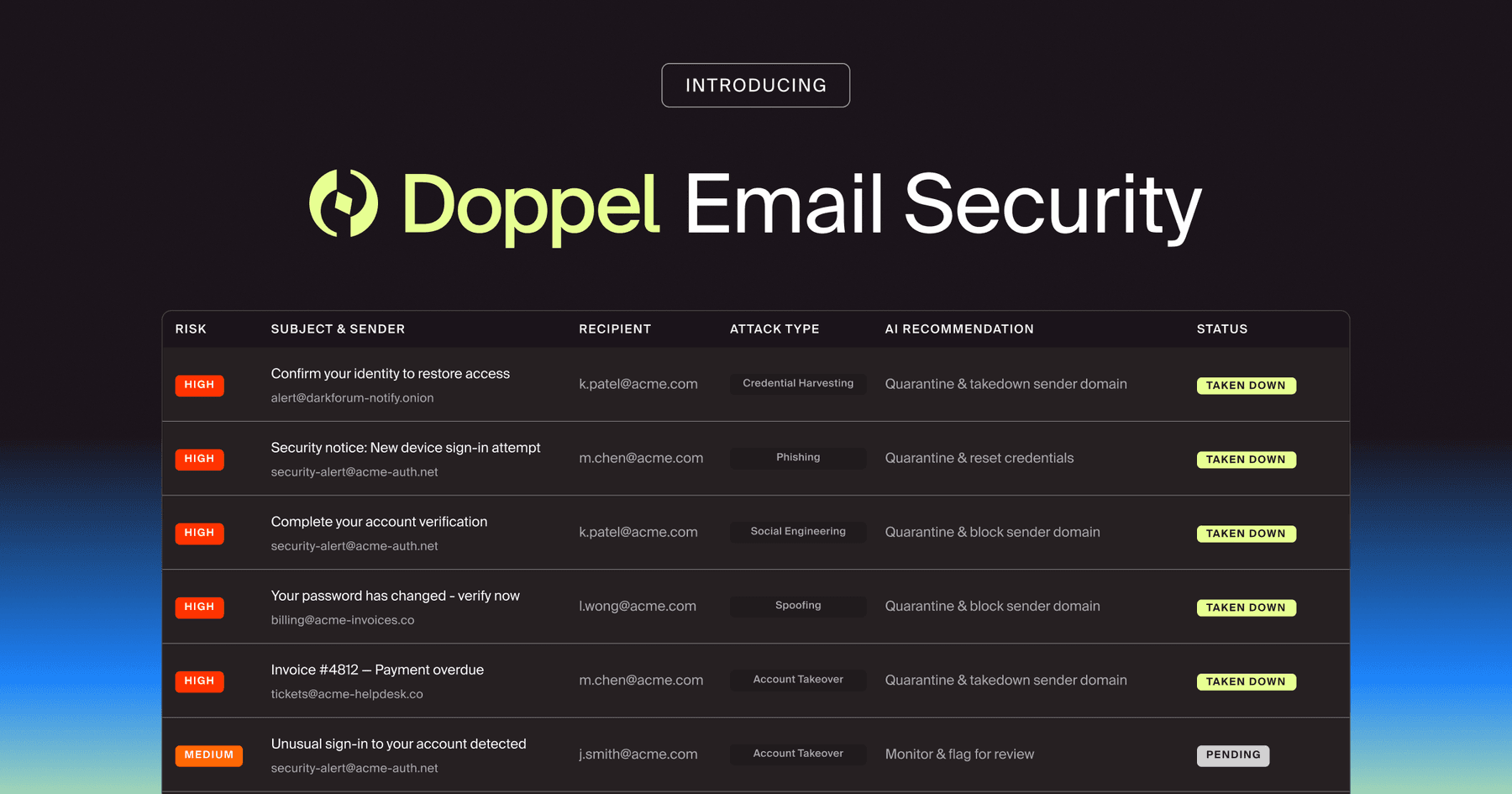
Doppel Email Security is now generally available
The agentic email security solution that empowers you to fight back against social engineering attacks. Detection isn't enough. Disruption is the difference.
Social engineering has entered a new era. With constant improvements in generative AI and incredibly believable deepfakes, attackers now run low-cost, hyper-personal campaigns at machine speed, across every channel.


by Kevin Tian and Rahul Madduluri
A note from Kevin and Rahul, co-founders of Doppel.
Social engineering has entered a new era. With constant improvements in generative AI and incredibly believable deepfakes, attackers now run low-cost, hyper-personal campaigns at machine speed, across every channel.
We’re seeing it hit customers in real time. Threat actor groups like Scattered Spider and Lapsus$, and techniques like BEC, SIM swaps, MFA fatigue, and deepfake-enabled vishing are no longer edge cases. They’ve made their way into our everyday conversations and it’s proof of the new model: social context and automation enable AI-powered deception at scale, turning the trust people place in ordinary interactions into the new attack surface.
The industry can’t defend against today’s threats with yesterday’s tools. That gap is why Doppel exists.
We built the leading AI-native, intelligence-driven platform to correlate signals automatically, move faster on takedowns, and unify digital and human risk so teams can cut noise and close the gaps attackers live in.
This is our candid take on what we’re seeing, what’s changing, and what we think it takes to keep up.
Every decision we make at Doppel starts with one question: how do we help our customers outpace modern social engineering attacks?
Attackers are increasingly using AI to move faster, personalize attacks, and scale across employees, executives and customers. Defending against this reality requires more than incremental improvements — it requires using AI to fight AI.
That is the mission behind Doppel. We exist to protect the world against social engineering attacks every day. That includes helping our customers protect what matters most: their people, their brands, and the trust they’ve built with their customers.
A number of companies helped define early approaches to digital risk protection, brand monitoring, and security awareness training. That work paved the way and brought awareness to the importance of protecting against these attacks. But the threat landscape has evolved faster than the tools originally designed to defend against it.
The question today is no longer about who has been around the longest.
The real question is: which platform is architected for how AI-powered social engineering attacks actually happen now — and how they will evolve next?
Most legacy security platforms were designed for a different era.
They rely on static rules and manual workflows and the result is disconnected point solutions. Security teams spend too much time tuning systems, chasing alerts and false positives, and reacting to threats that have already adapted.
Doppel was built as an AI-native, agentic threat intelligence platform from day one.
Our architecture continuously learns from real-world attack patterns using advanced machine learning and reinforcement fine-tuning. Instead of brittle rules, the platform adapts as attacker behavior changes, without requiring constant manual intervention from security teams. This means faster takedowns and faster protection for our customers.
Doppel has worked with OpenAI to apply machine learning and reinforcement fine-tuning techniques to improve modern threat detection for Doppel customers.
Read how Doppel and OpenAI applied machine learning and RFT to modern threat detection.
Security teams evaluating Doppel alternatives are rarely looking for “another tool.”
They are looking for a more effective way to defend against social engineering attacks that move faster than traditional platforms can adapt.
In these evaluations, conversations consistently shift away from feature checklists and toward fundamentals:
Rule-based systems assume threats behave predictably. They don’t.
Manual workflows assume teams have time to investigate every signal. They don’t.
Doppel is designed to reduce noise, surface real risk, and continuously improve detection quality as new attack patterns emerge. The goal is not more alerts — it’s better outcomes.
Threat actors do not separate brand abuse, executive impersonation, and employee targeting. Neither should security platforms.
Doppel unifies Digital Risk Protection and Human Risk Management in a single, intelligence-driven social engineering defense platform. This unified approach allows organizations to understand how threats evolve across surfaces, identify vulnerabilities earlier, and respond more effectively.
We believe modern social engineering defense must do more than detect threats. Platforms should:
This comprehensive approach enables organizations to strengthen their defenses over time — not just react to the latest attack.
Today, Doppel works with dozens of the Fortune 500 and hundreds of total customers to protect their brands, executives, and employees from modern social engineering threats.
When teams compare social engineering defense tools or evaluate a Doppel alternative, we believe a few questions matter more than any individual feature:
These are the areas where architectural decisions matter most.
Legacy defenses, often point solutions that protect a single channel and rely on static blocklists or templates, aren’t equipped to protect businesses, employees, or consumers from today’s modern threats. They can’t stop an attack that begins on LinkedIn, pivots to a deepfake video call, and ends with compromised credentials on a mirrored domain. They don’t train employees to be vigilant against tactics like smishing and vishing, or offer training personalized to a company’s unique environment.
Modern attacks require modern defense. The future of defense is multi-channel, multi-layered, and AI-native. It’s about fighting the new AI threat with new AI defenses.
Welcome to the age of AI-native deception.
— Kevin and Rahul, co-founders of Doppel
Doppel is built as an AI-native, multi-channel agentic threat intelligence platform. It spans multiple channels including domains, social channels, messaging apps, paid ads, and even the dark web, to protect customers against impersonations and threats across every vector, eliminating the need for point solutions for each channel. Unlike rule-based or manual systems, it continuously learns from real-world attack patterns and adapts as threats evolve — reducing noise and improving outcomes over time.
Traditional DRP tools focus on monitoring and alerts, and require manual steps from humans. Doppel is an AI-native platform that goes further by correlating threats across digital and human surfaces, automating faster takedowns, and integrating human risk management to provide a unified defense against social engineering.
Traditional Human Risk Management tools typically focus on check-the-box security awareness training (SAT) and email simulations, often delivered on a fixed schedule and disconnected from real attacker behavior. Doppel is SCORM-compatible and approaches Human Risk Management differently, embedding AI-native threat intelligence directly into training and simulation workflows.
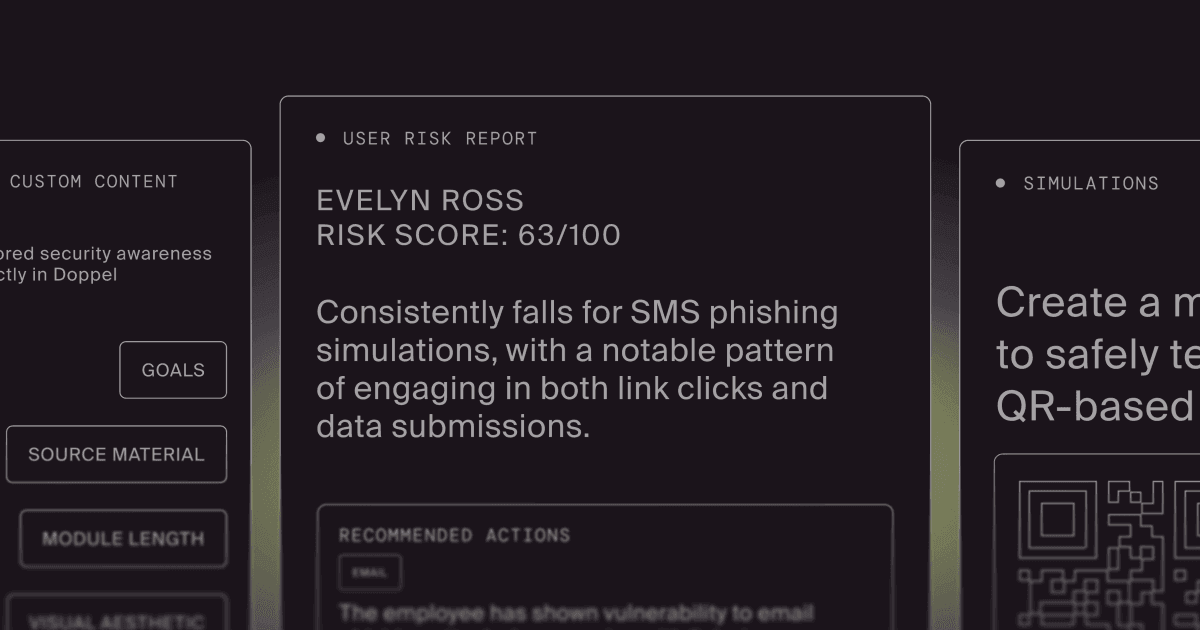
Doppel’s Human Risk Management solution helps teams build resilience against actual attacker tactics, by exposing and eliminating risk within an organization. Doppel replaces generic training videos and email-only phishing simulations with threat-informed, tailored training content and multi-channel, hyper-realistic phishing simulations. Doppel also proactively recommends training content and simulation campaigns based on user behavior, company demographics, and even new attack campaigns that we detect. This gives security leaders clear visibility into the risk that exists within their organization, and equips them to strengthen defenses in the areas that need it most.
Yes. Doppel upgrades training by grounding it in real-world context. Doppel offers threat-informed training content that is built for the modern era: covering the latest attacker campaigns and tactics, tailored to every role and organization, and personalized based on user behavior and company policies. Security leaders can even create custom, deepfake-enabled training content featuring their executives or employees, and purpose-built for every industry, milestone, or compliance requirement.
Training content is then supplemented with phishing attack simulations that offer unparalleled attacker realism, to validate readiness across channels. Doppel ultimately helps organizations prepare employees and executives for how attacks actually unfold, rather than relying solely on static training content.
Yes. Doppel is trusted by hundreds of companies and dozens of Fortune 500 organizations and is designed to operate across complex, global environments with high signal volume and evolving threat landscapes.
Teams should assess adaptability, takedown effectiveness, analyst efficiency, and whether the platform can unify digital and human risk into a single operational view.
BLOG
Attackers don’t need days anymore — they need minutes. Our latest customer story with OpenAI shows how Doppel rebuilt social engineering defense for that reality, cutting analyst workloads by 80% and compressing response times from hours to minutes.


by Rahul Madduluri, Vinci Chen, and Kiran Arimilli