
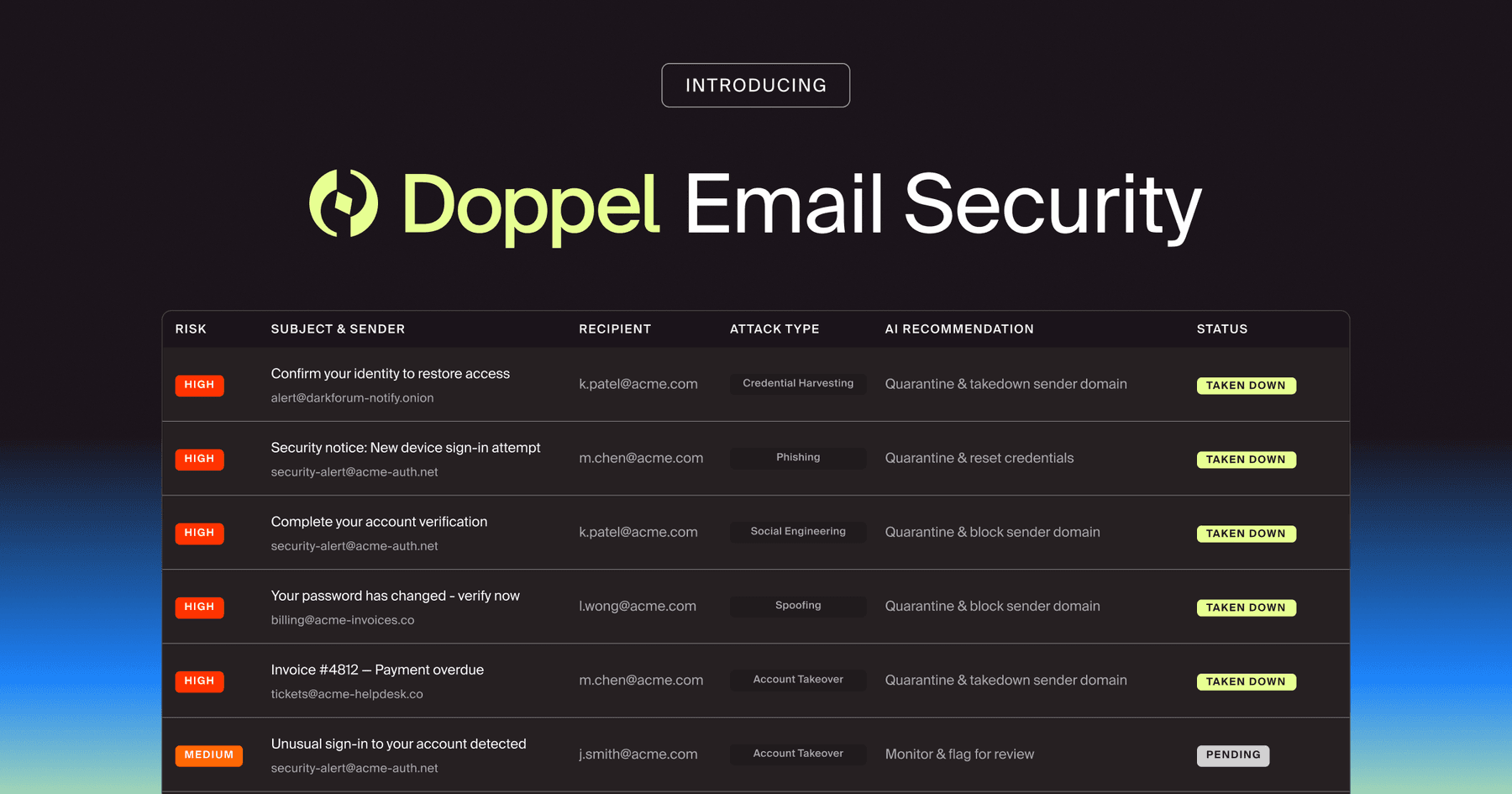
Doppel Email Security is now generally available
The agentic email security solution that empowers you to fight back against social engineering attacks. Detection isn't enough. Disruption is the difference.
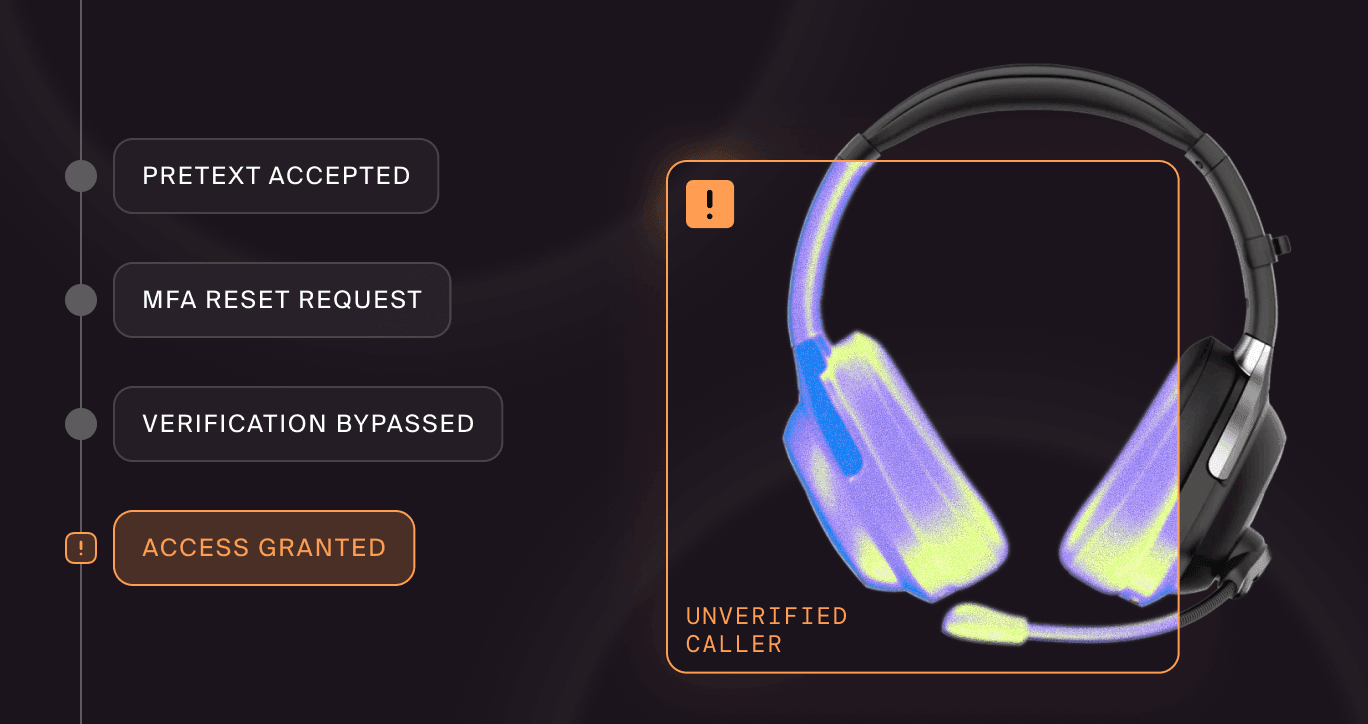
Account takeover prevention often begins long before a suspicious login is detected. It begins when someone asks for a password reset, claims they lost a device, requests MFA recovery, or pressures an employee to make an exception. These moments sit inside ordinary support and identity workflows, which is why they are so attractive to attackers.
That’s why account takeover prevention has become a human risk problem as much as an identity problem. Attackers do not always need to steal credentials or defeat controls directly if they can persuade an employee to reset a password, re-register a device, bypass a verification step, or approve an exception. Helpdesk teams are a prime target because they sit close to high-impact access decisions and are measured on speed, resolution, and user experience. Threat actors know that. They build pretexts around locked accounts, lost devices, travel issues, payroll access, executive urgency, and MFA failures, then pressure the employee on the other side of the ticket to treat the interaction as routine support rather than a potential compromise.
With AI-assisted scripting, more scalable impersonation, and increasingly convincing multi-channel fraud, that pressure is getting harder to spot and easier to operationalize. In some cases, attackers may also use cloned or synthetic voice techniques to make a pretext sound more credible. A single password reset or factor reset can open the door to internal systems, lateral movement, fraud, and brand damage. Effective account takeover prevention starts earlier than most programs think. It starts when a human is asked to verify, approve, or override access. For organizations building a broader social engineering defense, account takeover prevention starts at the moment a human is asked to verify, approve, or override access.
Account takeover prevention works best when organizations treat verification as a security control, not a courtesy. The highest-risk moments often happen during helpdesk interactions, password resets, MFA recovery, device enrollment changes, and exception handling. If employees can be manipulated into bypassing policy, technical controls alone will not hold. The strongest programs combine independent verification, tighter recovery controls, and realistic workflow testing through Doppel Simulation so teams can identify where unsafe approvals happen before attackers do.
Account takeover becomes a human risk problem when access depends on judgment calls under pressure.
Most teams still frame ATO as a login security issue. That misses how many takeovers occur before the login even happens. A threat actor doesn't always need a stolen password if they can convince a support agent to reset one. They don't always need to defeat MFA if they can socially engineer a factor reset, device re-registration, or identity exception. They don't need sophisticated malware if a believable pretext gets them approved through a routine workflow.
That’s the blind spot. Organizations invest in identity stacks, detection, and authentication hardening, yet operational moments around identity remain vulnerable to manipulation. Helpdesks, service desks, IT support, HR support, payroll support, and customer service teams all sit in the path of high-consequence access decisions.
When those teams are measured on speed, resolution, and customer satisfaction, but not on verification discipline, attackers see an opening.
This is also where Security Awareness Training and simulation should work together. Training helps employees recognize suspicious behavior, but realistic testing shows whether the workflow actually holds when the request feels urgent, plausible, and familiar.
Helpdesks are targeted because they can convert social engineering into legitimate access.
Threat actors understand how support environments work. They know agents are expected to unblock users, reduce downtime, and keep tickets moving. They know queues are crowded, escalations are stressful, and frustrated callers can sound legitimate. They also know that password resets, MFA recovery, and device re-registration are some of the fastest ways to turn a convincing pretext into authenticated access.
This is especially dangerous when verification is inconsistent. One agent follows policy. Another improvises. A third makes an exception because the caller knows internal names, project details, or travel context. That variation is where social engineering succeeds.
Attackers also exploit channel fragmentation. An email starts the story. A phone call adds urgency. A text or collaboration message confirms the pretext. By the time the helpdesk interaction happens, the victim employee may already sound familiar. The fraud feels operational, not malicious.
They win by making the unsafe action feel reasonable.
A strong pretext does three things at once. It establishes legitimacy, creates urgency, and narrows the support agent's choices. The attacker wants the agent to focus on service recovery rather than on adversary tradecraft.
Exception paths are where many programs break down. Standard verification may be documented, but edge cases often aren't. Lost phone. New device. Travel issue. Locked authenticator. Executive access problem before a board call. Payroll issue before a cutoff. Attackers don't need to beat the normal process if they can trigger the backup process.
Modern pretexts aren't random. They're tailored. Attackers gather org charts, executive names, vendor details, job titles, office locations, and public social signals. In many cases, they know enough to sound like they belong. That makes the conversation feel routine rather than risky.
AI doesn’t create the problem, but it makes it easier to scale. It can help attackers produce more convincing scripts, messages, and role-based pretexts faster, and run coordinated lures across email, SMS, chat, and voice. Recent threat reporting points to continued helpdesk social engineering, identity workflow abuse, and broader use of AI to accelerate deception and operator efficiency.
Strong controls reduce discretion where attackers expect to find it.
Human verification controls are not generic awareness reminders. They're operational safeguards that define what an employee must verify, what evidence counts, what exceptions require escalation, and what actions are never allowed based on a single interaction.
The best verification does not rely on the same channel through which the request came. If someone calls asking for a password reset, the proof should not be whatever they can say on that call. Independent verification means checking trusted records, using known callbacks, requiring approved identity signals, or moving the user through a controlled workflow that the attacker cannot easily hijack.
That principle also matters for high-risk approvals. A claimed executive emergency should trigger a stronger process, not a looser one.
If password resets, MFA resets, and device enrollment changes are treated as routine service actions, attackers will keep targeting them. These are privileged events. They should carry stronger verification requirements, tighter logging, and review paths that reflect their impact.
Teams building better social engineering defense programs often start here because this is where human judgment directly changes access outcomes.
Organizations should also reduce reliance on weak factors wherever possible, because phishing-resistant authentication and tighter recovery controls make helpdesk social engineering materially harder to turn into account access.
Helpdesk agents need language that makes secure verification feel natural and non-negotiable. Without that, they’re forced to improvise under pressure. Good scripts do more than tell agents what to ask. They explain when to stop, when to escalate, and how to respond to pressure tactics without being drawn into the attacker's frame.
Because awareness without control still leaves the decision exposed.
Traditional training has value, but it often stops at recognition. It tells employees what suspicious behavior looks like. It doesn’t always redesign the workflow to prevent suspicious behavior from succeeding. An agent may know a caller sounds off and still complete the reset because the process is vague, the queue is overloaded, or the escalation path is unclear.
That’s why organizations are shifting toward human risk management. The goal is not just to teach better instincts. It is to identify where people sit in attacker workflows, measure how they respond under realistic pressure, and reduce the conditions that make unsafe approvals more likely.
For account takeover prevention, that means testing the actual moments where access can be granted, not just sending generic phishing emails and calling it coverage.
They should test the workflow, the person, and the channel together.
If a program only measures whether employees click simulated phishing links, it will miss some of the most consequential ATO paths. Threat actors are not limited to email, and neither should defenders be.
Teams need scenarios based on the requests attackers actually use. Locked account. MFA reset. New phone enrollment. Travel issue. Payroll access problem. VIP urgency. The point is not to embarrass employees. It is to see whether the verification process holds when the request feels plausible.
This is where attack simulation testing becomes valuable. It lets organizations pressure-test real workflows and employee decisions against modern social engineering tactics, rather than relying on static awareness content.
Completion rates and training scores do not tell the full story. Security leaders need to know which teams are approving risks, which exception paths are weakest, which scripts are failing, and which channels pose the highest risk of bypass. That data is what turns account takeover prevention into an operational program. That is also why Doppel has emphasized moving beyond simple click-rate metrics in its recent guidance on phishing simulation metrics beyond click rate
Real attacks do not stay in one lane. A campaign may begin in inboxes, move to messaging apps, and end in a phone conversation with support. Testing should reflect that. Multi-channel scenarios reveal where context stitching helps attackers look credible and where teams are least prepared to challenge the story. Doppel Simulation is positioned specifically around multi-channel, threat-informed testing rather than generic phishing tests, which is a closer fit for this account takeover use case.
Recent threat reporting also shows that social engineering is expanding across messaging platforms and voice-based tactics, not just email.
They should start with the highest-impact access decisions and the employees closest to them.
A mature program does not try to rewrite every workflow at once. It focuses on the moments where human verification failure creates outsized risk.
Password resets, MFA recovery, device registration changes, and high-risk account unlocks should be reviewed first. These are common pressure points because they sit at the intersection of identity, service operations, and human trust.
If teams are rewarded only for speed and closure, risky approvals become predictable. Metrics should reinforce secure verification, escalation discipline, and adherence to process during high-pressure interactions.
Many employees know when something feels wrong. What they often lack is organizational backing to pause, escalate, and insist on stronger proof. Clear leadership support changes that. It tells frontline teams that protecting access matters more than resolving a ticket in record time.
The same attacker behaviors that target employees often target customers, partners, and your brand.
Account takeover does not exist in isolation. The same social engineering patterns used against internal helpdesks also appear in brand impersonation campaigns aimed at customers and third parties. Attackers leverage the brand's trust, create urgency, and manipulate people into surrendering access, credentials, or completing verification steps.
That’s why brand impersonation protection and internal human risk efforts belong in the same conversation. The threat is not just credential theft. It is an abuse of trust at scale across external channels and internal workflows. When the same deception patterns show up in fake domains, spoofed messages, voice scams, and helpdesk pretexts, security teams need connected visibility rather than separate tools and separate narratives.
Organizations that treat external impersonation, internal social engineering, and identity workflow abuse as separate issues usually end up with fragmented visibility. Organizations that connect those signals are better positioned to spot recurring tactics, harden exposed teams, and reduce the pathways that lead to takeover.
It looks like fewer judgment calls, better verification, and continuous testing against real attacker behavior.
The organizations making progress are not just adding more warnings to login screens. They’re redesigning the human decisions around access. They’re tightening recovery workflows. They’re standardizing what counts as proof. They’re testing the helpdesk and support teams with realistic scenarios. They’re using outcomes to improve scripts, escalation paths, and policy.
That’s the shift. Account takeover prevention is no longer just an authentication problem. It is a human verification problem.
Doppel helps organizations test these risks the way attackers exploit them. By simulating believable, multi-channel social engineering against real verification and support workflows, teams can identify where employees, scripts, and escalation paths break down before those gaps become account takeover paths.
Account takeover prevention gets stronger when organizations stop treating verification as a soft skill and start treating it as a frontline control. The fastest way to reduce risk is to find where employees can be pressured into granting access, then close those gaps before attackers exploit them.
See how Doppel Simulation helps security teams test helpdesk verification, reset workflows, and multi-channel social engineering before those weaknesses turn into account takeover paths. You can also explore Doppel’s broader approach to social engineering defense and brand protection to connect internal workflow risk with the external impersonation campaigns that often feed it.