

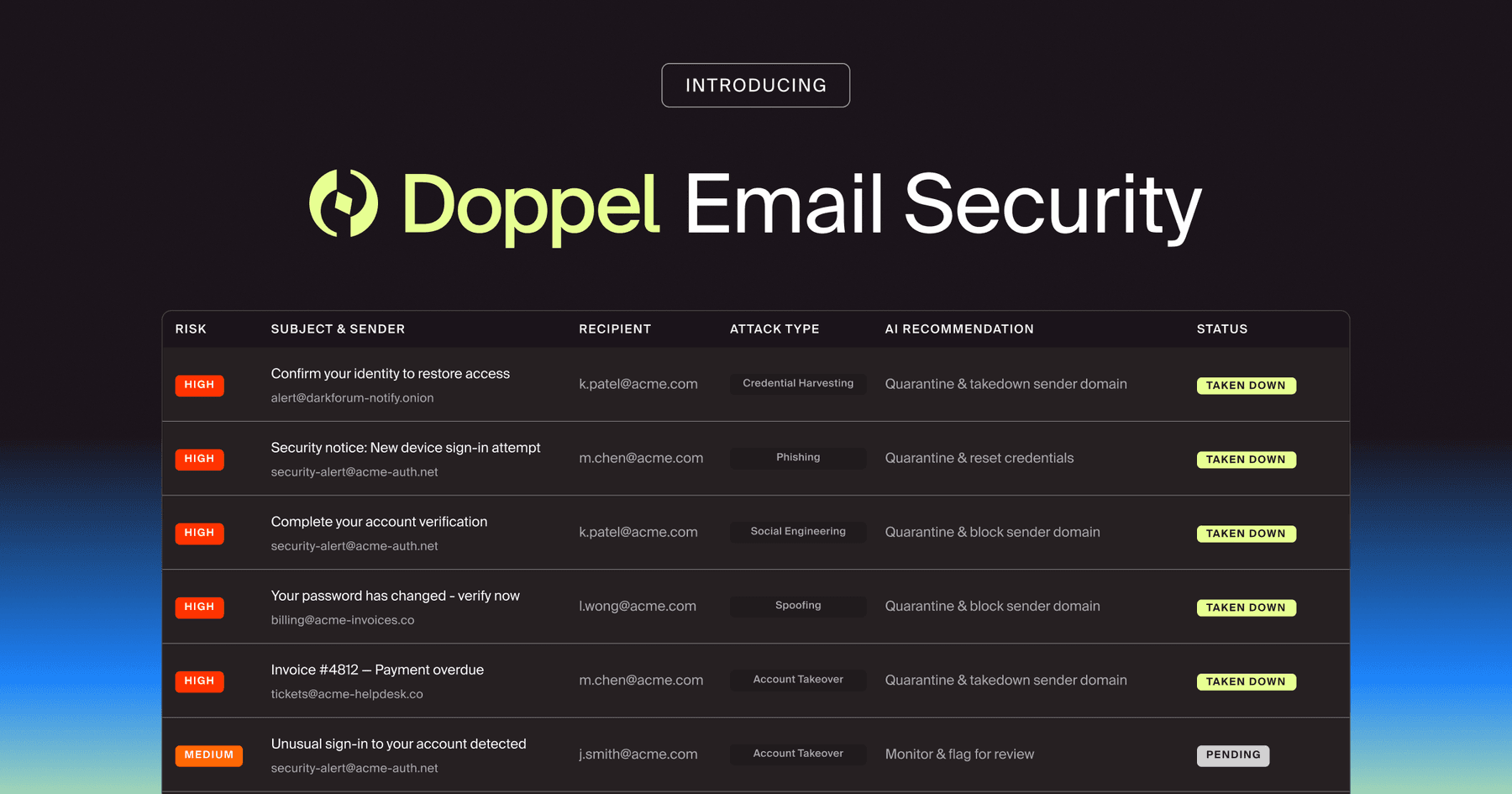
Doppel Email Security is now generally available
The agentic email security solution that empowers you to fight back against social engineering attacks. Detection isn't enough. Disruption is the difference.
Security teams are being asked to stop multi-channel deception campaigns: impersonation, scams, phishing, voice fraud, and helpdesk manipulation using tools built for a simpler era.
Use these comparisons to understand what changes when you shift from legacy approaches to an AI-native, closed-loop defense model: detect → disrupt → simulate → strengthen.
Threat indicators analyzed daily
Median Resolution Time for Domain, Social Media & Paid Ads
Median Response Time
Threat indicators analyzed daily
Median Resolution Time for Domain, Social Media & Paid Ads
Median Response Time
Legacy digital risk protection programs often excel at monitoring, but struggle to keep pace with modern, multi-channel deception—where threats evolve quickly, spread across platforms, and require rapid disruption.
Legacy digital risk protection programs often excel at monitoring, but struggle to keep pace with modern, multi-channel deception—where threats evolve quickly, spread across platforms, and require rapid disruption.
Legacy security awareness training (SAT) programs are often optimized for compliance and completion—not for how attackers actually operate today. Multi-channel scams, operational social engineering, and AI-enabled deception require more realistic simulation and behavior-based measurement.
Legacy security awareness training (SAT) programs are often optimized for compliance and completion—not for how attackers actually operate today. Multi-channel scams, operational social engineering, and AI-enabled deception require more realistic simulation and behavior-based measurement.
Digital Risk Protection (DRP) is the practice of identifying and mitigating external threats that exploit your brand, executives, and customers—such as impersonation domains, scam sites, fraudulent social accounts, and malicious or misleading content. DRP works best when detection is paired with prioritization, workflows, and rapid disruption.
Security Awareness Training (SAT) is a program that educates employees on security risks and best practices—often through courses and periodic tests. Traditional SAT is frequently compliance-driven; more effective programs focus on measurable behavior change like faster reporting and better escalation.
If your biggest pain is customer-facing impersonation/scams and takedowns, start with legacy DRP. If your biggest pain is employee susceptibility and incident reporting behavior, start with legacy SAT. If both are true, read DRP first, then SAT.
Look for outcomes like reduced exposure (assets removed/suppressed), faster time-to-disruption, reduced operational load, improved time-to-report and escalation quality, less false positives and alerts, and reduced repeat susceptibility in high-risk cohorts.
Social Engineering Defense (SED) is a modern approach to stopping deception campaigns across channels (email, SMS, voice, social, messaging apps, ads). It unifies detection and threat intelligence with disruption/takedowns, realistic simulation, and reinforcement—so organizations reduce exposure, reduce attack success, and reduce repeat risk over time.