
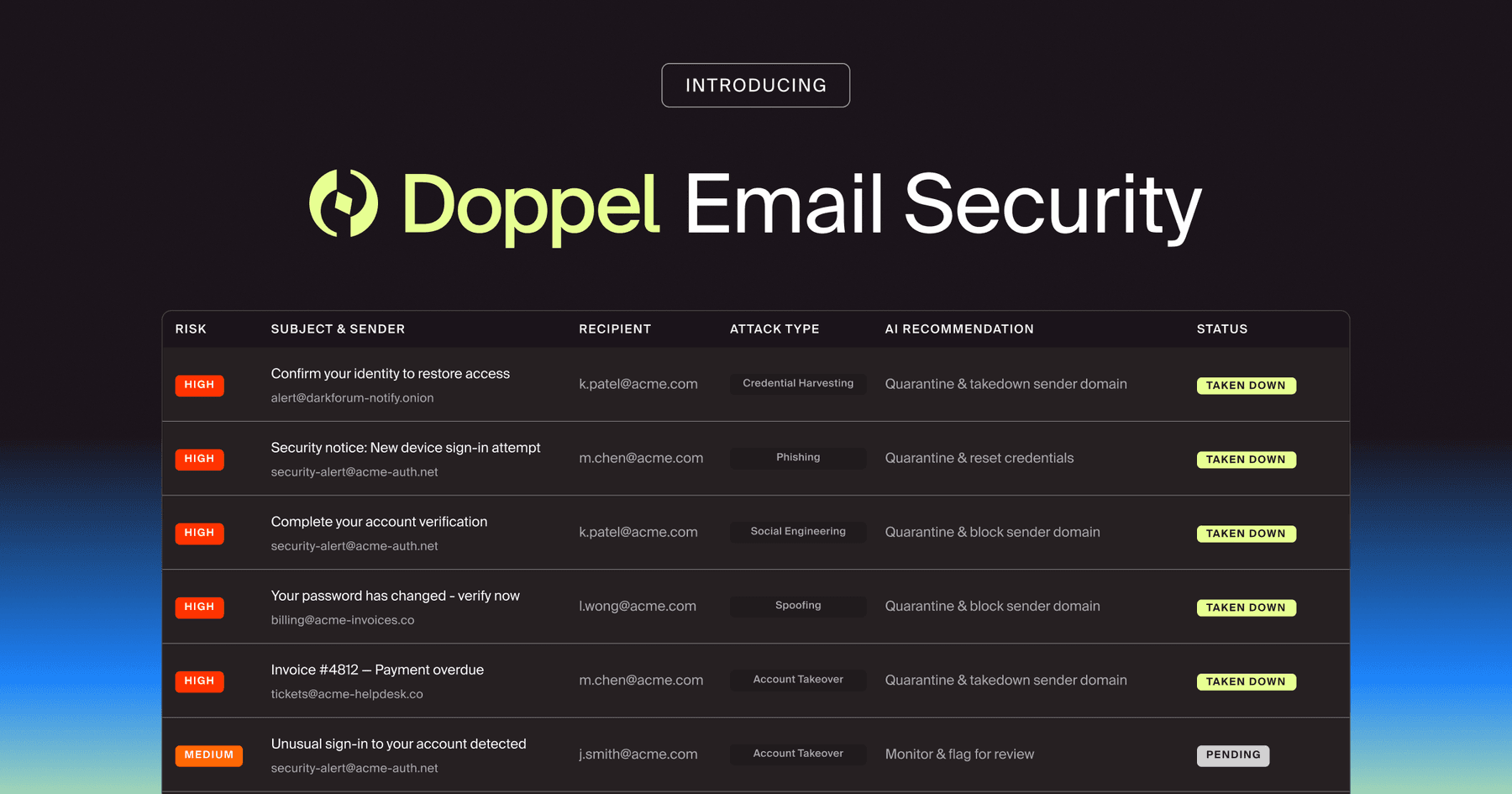
Doppel Email Security is now generally available
The agentic email security solution that empowers you to fight back against social engineering attacks. Detection isn't enough. Disruption is the difference.
Strong passwords won’t stop social engineering. See why phishing is up 1,000% and how unified SED uses agentic AI to dismantle attacker infrastructure.
Every May 7th, the cybersecurity industry pauses for World Password Day. Originally championed by Intel in 2013, the goal was simple: encourage better password hygiene.
You’re familiar with password-creating best practices: longer strings, special characters, and the then-novel concept of multi-factor authentication (MFA).
But in 2026, the strong password is a relic of a bygone era of static defense. While World Password Day remains a necessary reminder for baseline security, it also highlights an uncomfortable truth: 98% (opens in new tab) of cyberattacks now involve social engineering. Attackers aren't hacking passwords anymore. Now, they’re socially engineering the humans who hold them.
As AI lowers the barrier to entry, the cost for attackers to launch these campaigns has dropped by 95% (opens in new tab). In this blog, we’ll cover how modern defense means being prepared for agentic AI that reasons, pivots, and adapts in real-time to steal credentials.
The traditional threat model for World Password Day focused on brute-force attacks and credential stuffing. Today, the threat has shifted to AI-native deception.
GenAI has fundamentally changed the economics of identity theft by allowing hackers to combine high-quality, personalized content with massive scale.
As a result, phishing volume has increased by over 1,000% (opens in new tab).
Modern credential harvesting follows a sophisticated social engineering attack chain:
The rise of deepfakes has made visual and auditory information unreliable.
62% (opens in new tab) of organizations have already been targeted by deepfake attacks, and 99.9% (opens in new tab) of people can’t distinguish an AI clone from a real person.
When an "executive" calls the IT help desk using a cloned voice to request an MFA reset, a million-dollar technical perimeter can be bypassed for the price of a $5 subscription to a voice-cloning tool.
MFA and SSO auditing don’t defend against modern, adaptive attacks that operate at infinite scale. The primary failure of legacy systems is velocity. AI agents exploit exposures in minutes, but it takes an average of 260 days (opens in new tab) to identify and contain a social engineering attack because different security tools do not communicate effectively.
Defending what's real requires more than just better passwords. It requires a Unified Social Engineering Defense (SED) that targets the operational core of the attacker.
Here’s the approach:
1. Networked Intelligence via the Threat Graph
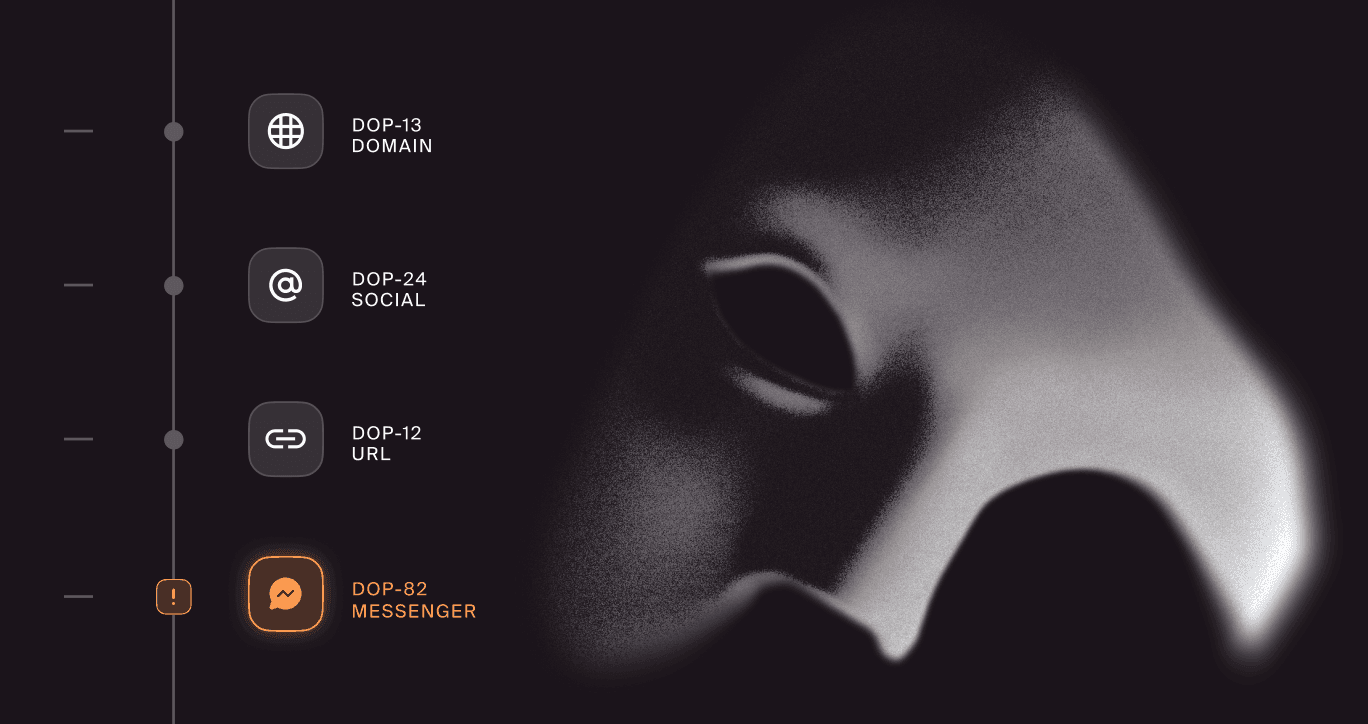
Identity theft is rarely an isolated event. It’s part of a broader campaign. Doppel’s Real-Time Threat Graph links domains, social handles, phone numbers, and paid ads. By connecting these noisy signals, security teams gain the context to see the full campaign rather than just one-off alerts.
2. Machine-Speed Infrastructure Disruption
Traditional tools play "whack-a-mole" with malicious artifacts. Doppel's Agentic AI executes autonomous, cross-vector takedowns across registrars, hosts, and ad networks. Instead of just defending against the click, we dismantle the threat before the link is even created.
3. Closing the Loop with Human Risk Management (HRM)
Since over 60% (opens in new tab) of breaches involve the human element, training must be as dynamic as the threats. Doppel feeds live intelligence from our Digital Risk Protection (DRP) takedowns directly into HRM.
This World Password Day, don't just ask your employees to change their passwords.
Ask your security team if they can disrupt the infrastructure that makes passwords irrelevant.
Identity is a target-rich surface that requires a unified, automated, and proactive defense. Doppel can outpace the economics of the attacker, transforming your workforce from a liability into a distributed sensor network.
Schedule a demo to see how our AI-native SED platform can harden your perimeter and disrupt the social engineering kill chain at machine speed.