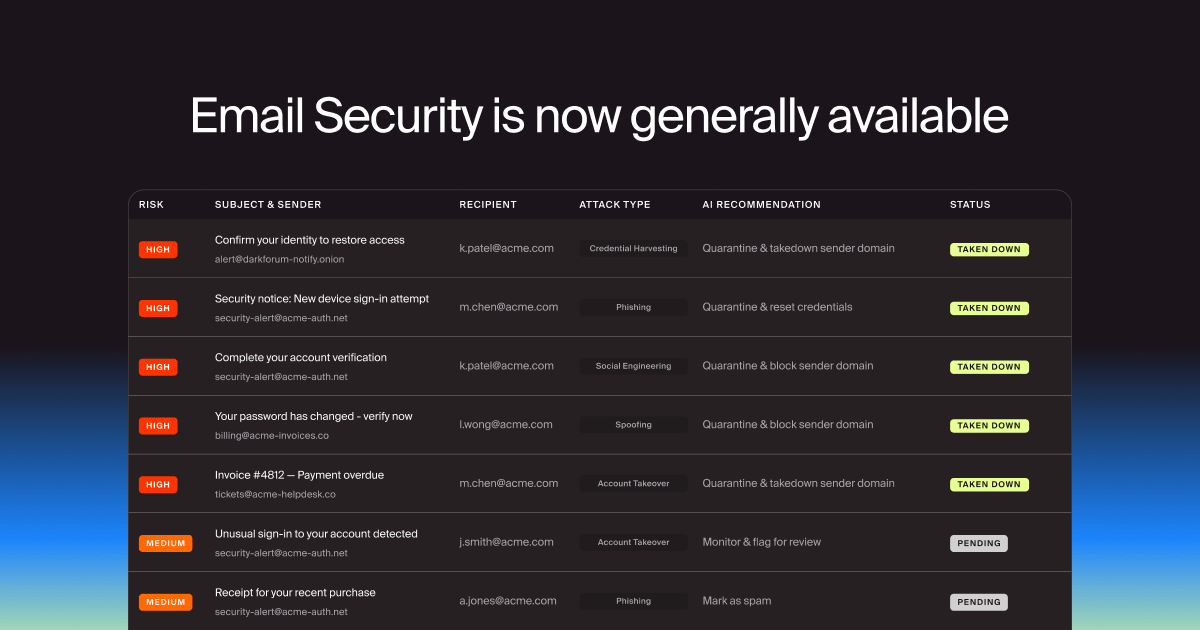

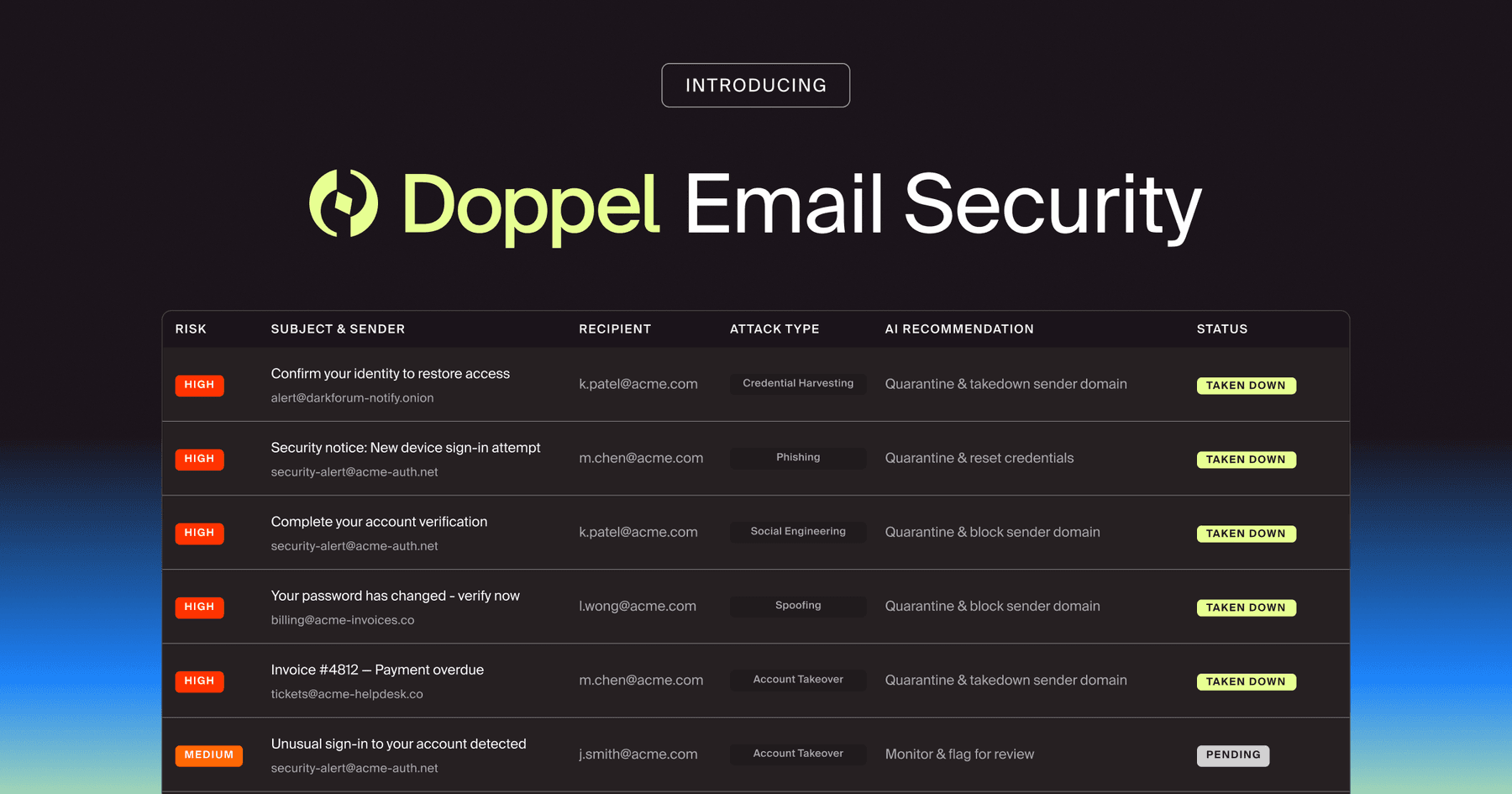
Doppel Email Security is now generally available
The agentic email security solution that empowers you to fight back against social engineering attacks. Detection isn't enough. Disruption is the difference.
Learn how punitive phishing programs suppress reporting — and how positive feedback, better metrics, and automated triage build resilience.
Imagine an employee spots a document-share email that feels slightly off. The sender address is unfamiliar, the message is unusually urgent, and the employee does exactly what the security team asked: They report it.
The message turns out to be legitimate. A few hours later, the employee receives a blunt automated response saying the ticket is closed. Their manager is copied. What began as a cautious decision now feels like a public mistake.
Nothing dramatic happened, but the employee learned something important: Reporting carries social risk. The next suspicious message may be deleted quietly instead of escalated. If it's part of a real campaign, the security team loses one of its earliest and most valuable signals.
Human risk management (HRM) depends on more than teaching people how to spot phishing. It also depends on whether employees trust the reporting process enough to raise their hand when they're uncertain.
Security teams and employees often see the same message through different lenses. To an analyst, a report is another data point to investigate. To an employee, it can feel like a judgment of their competence, especially when the message appears to come from a leader, customer, or colleague.
That creates a lopsided decision. Reporting a real attack may help the company, but the benefit can feel distant and invisible to the person clicking the button. Reporting a legitimate message can produce an immediate personal cost: embarrassment, a delayed workflow, or an awkward conversation with a manager.
People naturally avoid actions that expose them to a visible loss. In this case, the perceived loss is social. The employee isn't only asking, "Is this malicious?" They're also asking, "What happens to me if I'm wrong?"
If the answer is ridicule, correction, or extra work, silence starts to feel safer.
Attackers understand that hesitation isn't evenly distributed across an organization. An unusual request from an unknown sender is easy to question. An unusual request from the CEO, a major customer, or a senior partner is much harder.
Authority creates friction. A junior employee may worry that reporting an executive's message looks insubordinate. A salesperson may hesitate to flag a customer's link because they don't want security to interrupt a deal. A finance employee may comply with a confidential request because asking for another approval feels like slowing the business down.
But these aren't failures of intelligence. They're predictable responses to workplace incentives. A resilient reporting program has to make the secure action feel professionally safe, even when the employee's concern turns out to be a false positive.
Many legacy security awareness programs were designed around failure. Security teams sent a deceptive test, waited for someone to click, and responded with a warning, remedial training, or a score to share with management.
That model may produce a clean click-rate chart, but it can also teach employees that the security team is trying to catch them. Training becomes something to survive. Reporting becomes another opportunity to be evaluated.
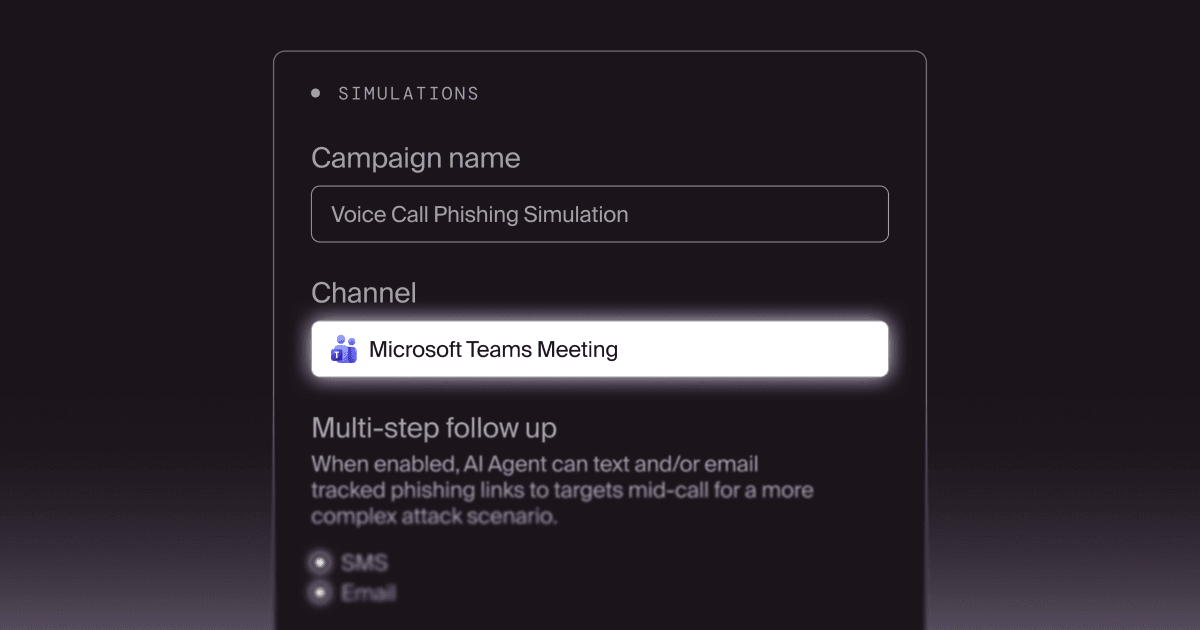
The better alternative is realistic simulation without humiliation. Doppel’s simulations test how people respond to the channels and tactics attackers actually use, while giving security teams evidence about where behavior and process break down. The purpose is to improve readiness, not manufacture a list of employees who failed a trick question.
When people believe the program is designed to help them succeed, they're more willing to report uncertainty. That willingness is part of the control.
Click rate measures one behavior during one test. It doesn't tell you whether employees report a suspicious message, how quickly the first report arrives, or whether the security team can act on that signal before the campaign spreads.
Consider two organizations. The first has a very low simulation click rate, but employees rarely report anything because they fear being wrong. The second has a slightly higher click rate, but employees report suspicious messages quickly and in volume. The second organization may have better visibility into a real attack and more time to contain it.
That's why resilience can't be reduced to "who clicked?" A stronger measurement set includes:
These measures connect employee behavior to breach prevention and resilience. They show whether the organization can turn human judgment into timely defensive action.
Employees report more consistently when the process removes social friction and closes the loop. That requires a few deliberate choices:
False positives aren't the enemy of a healthy reporting culture. They show employees are paying attention. The operational challenge is handling that volume without moving the burden onto analysts.
Doppel approaches reporting as part of a connected human-risk program, not a standalone inbox button. Training and simulation build the behavior. Reporting captures the signal. Phishing triage helps security teams classify employee-submitted messages and remediate threats at scale.
That closed loop matters for both sides. Employees receive timely feedback instead of sending a report into a black box. Security teams gain another source of intelligence without requiring analysts to manually investigate every newsletter, file share, and internal message.
The same intelligence can improve what happens next. Live threats found through Digital risk protection can become relevant simulation material. Employee reports can add context to email security and the Doppel Threat Graph. Training can focus on the behaviors and attack patterns that are creating real exposure, rather than repeating generic annual content.
The goal isn't to drive reporting volume for its own sake. It's to create a workforce that acts early, a feedback loop that strengthens good judgment, and a security operation that can separate signal from noise quickly.
An employee's first wrong guess should teach them that speaking up was useful. If the experience instead teaches them to stay quiet, the next message may be the one the security team needed to see.
Schedule a demo to see how Doppel can turn employee reporting into faster, connected defense without burying your analysts in noise.