
Doppel Email Security is now generally available
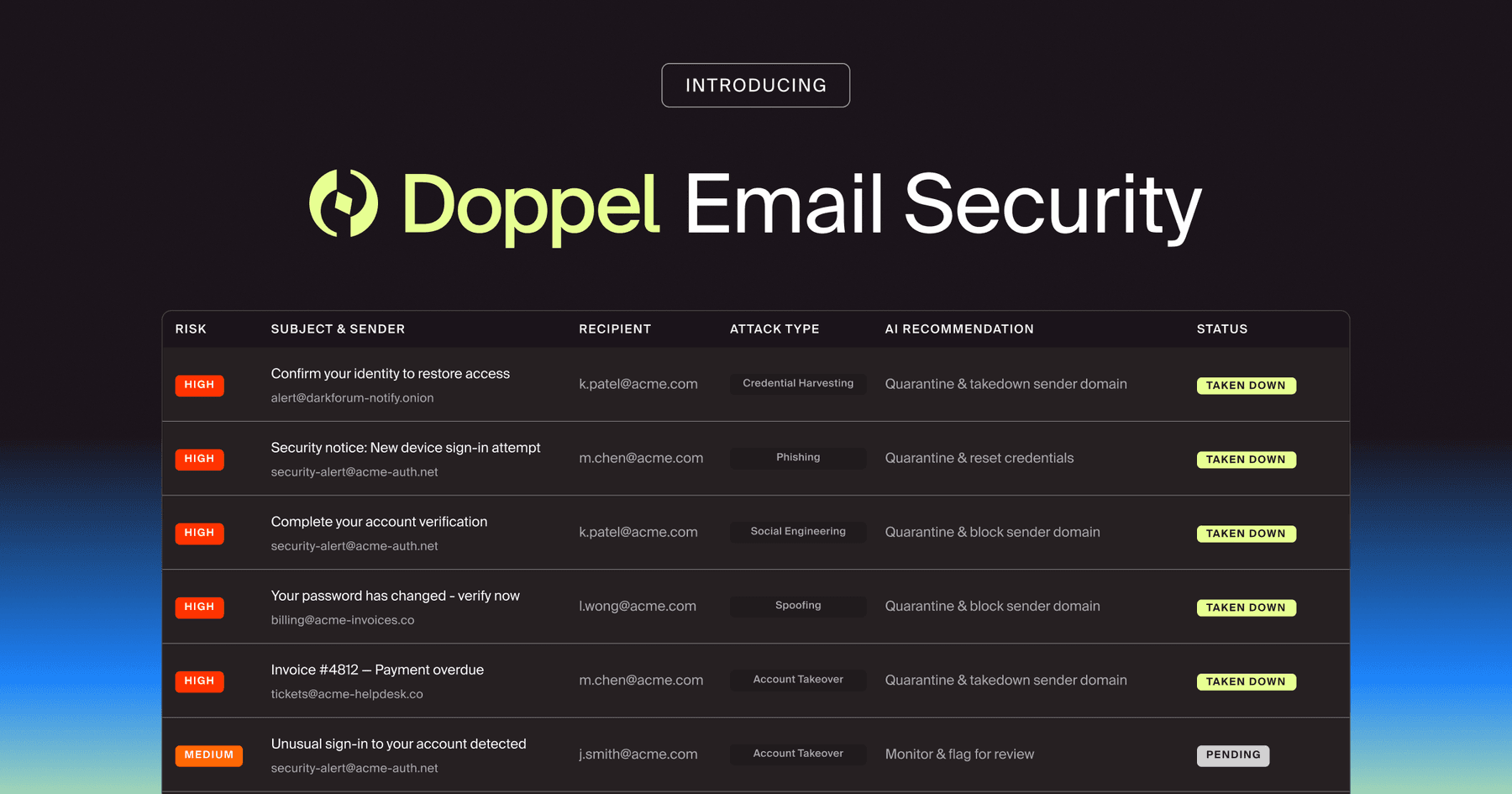
The agentic email security solution that empowers you to fight back against social engineering attacks. Detection isn't enough. Disruption is the difference.
When a critical executive email is quarantined, black box AI isn’t an acceptable explanation. Learn why modern SOCs demand human-readable AI logic.

As the quarter comes to a close, your VP of Sales is pacing a hole. A multi-million-dollar enterprise contract has suddenly stalled.
The vendor promised to send the final, signed agreement an hour ago. But the executive is frantically refreshing their inbox. Nothing. Just total silence.
Now, the VP of Sales demands to know whether the corporate email filter has swallowed the contract. The lead security analyst nervously taps their keyboard, pulls up the email security dashboard, and finds the missing message sitting in quarantine.
The executive demands to know exactly why a legitimate, business-critical email was blocked.
The analyst looks at the dashboard. They look at the proprietary risk score. And then, they realize they have no idea.
"Well," the analyst stammers, "the system gave the sender's behavior a risk score of 89. So, it blocked it."
In 2026, "Because AI said so" isn’t a defensible security policy.
As threat detection increasingly leans on AI to combat automated attacks, security leaders are drawing a hard line. They’re aggressively rejecting opaque, black box machine learning models (opens in new tab). Instead, they’re demanding human-readable, natural-language logic.
If you can’t confidently explain why a security tool took a specific action, you don’t actually control your defense. You’re just a passenger.
Here’s why the black box is broken, and why the future of the SOC belongs to explainable AI.
Look at how email defense has evolved over the last decade.
We moved away from basic block lists and rigid signature-based rules because attackers figured out how to easily bypass them. The industry’s solution was to embrace behavioral machine learning (ML).
Native cloud security tools and modern integrated cloud email security (ICES) platforms heavily rely on these proprietary, black box ML models to score inboxes.
On paper, this sounds fantastic. The ML model ingests millions of data points, analyzes sender behavior, and spots subtle anomalies that a human would miss.
But in practice, it creates a massive operational nightmare.
While black box ML is highly efficient at spotting anomalies, it is inherently terrible at explaining its own math. It operates behind a closed curtain. It issues a verdict, usually a vague numerical risk score, without showing any of its work.
This creates a catastrophic bottleneck when things go wrong.
What happens when the SOC needs to fix a false positive? If a new marketing SaaS tool is repeatedly getting blocked because the ML model doesn't recognize the domain's sending behavior, the analyst cannot simply open up the engine and edit the logic.
They can’t see the logic.
Instead, the analyst is forced to submit a support ticket to the security vendor. They have to complain to a customer success manager, wait for the vendor's data science team to review the case, and pray that the engineers tweak the global algorithm in the next software update.
Meanwhile, the marketing team cannot do their jobs, the business grinds to a halt, and the security team looks incompetent.
Security analysts are burning out because they spend half their day trying to reverse-engineer how their own tools make decisions, rather than actually hunting threats.
Era | Methodology | Explainability | Tuning Process | Analyst Empowerment |
Legacy | Static YARA rules and rigid regex strings | Highly technical, requiring advanced syntax knowledge to decipher | Extremely manual, requiring rewriting and testing complex, fragile code | Bottlenecked; only senior engineers can safely write or modify the rules |
Black Box ML | Proprietary behavioral machine learning | Completely opaque, outputting a vague numerical risk score with zero context | Friction-heavy, requiring submitting support tickets and waiting for global vendor updates | Frustrating; analysts have no control over the underlying logic |
Agentic AI | Reasoning-based AI agents driven by natural language policies | Total transparency, with every verdict auditable back to a plain-English sentence | Instantaneous, with analysts editing the policy in plain text like they’re talking to a colleague | Scalable; junior analysts feel empowered to manage complex detection engineering |
The shift away from black box ML isn’t just a technical preference; it’s a business imperative.
Security leaders need agility. They need transparency and the ability to defend their operations in a boardroom.
Here are the reasons why Chief Information Security Officers (CISOs) and SOC managers are demanding human-readable detection logic.
In cybersecurity, you’re always one incident away from an audit.
Whether it’s an internal compliance officer, external legal counsel, or an angry executive demanding to know why a vendor invoice was quarantined, you have to provide evidence. You can’t hand an auditor a spreadsheet full of proprietary "Risk Score: 89" data points and expect them to be satisfied.
Human-readable logic solves this instantly.
Every verdict is explicitly tied back to a plain-language policy. When asked why an email was blocked, the analyst can point to a clear sentence: "This email was quarantined because the sender domain was registered less than 48 hours ago, the text contains high-urgency financial keywords, and the routing header spoofed an internal executive."
It’s clear, defensible, and instantly understandable by non-technical stakeholders.
Threat actors don’t wait for your vendor's bi-weekly patch cycle. Your defense shouldn't either.
When your detection logic is written in plain English, you remove the friction of tuning the system. If a legitimate internal HR newsletter is suddenly getting flagged as spam, an analyst doesn't need to write a complex YARA rule or beg a vendor for help.
They open the policy and type a conversational adjustment: "Ignore links to our internal benefits portal when the sender is our verified HR communications domain."
The system instantly updates. The false positive is resolved in seconds, without dragging legitimate business mail into quarantine.
The threat landscape evolves daily. The tactics attackers use on Monday might be completely obsolete by Friday.
With legacy tools, organizations suffer from detection drift. Their static rules slowly lose efficacy as attackers pivot, requiring massive, manual rewrite cycles.
Agentic, human-readable logic allows security teams to keep pace with attackers effortlessly. If an analyst reads about a novel zero-day phishing tactic over their morning coffee, they can instantly add a natural language parameter to their defense policy.
The AI agents will continuously investigate and enforce that new logic immediately, ensuring the defense never drifts out of alignment with the current threat environment.
Hiring a brilliant, highly experienced detection engineer who can write flawless, complex YARA rules in their sleep is incredibly expensive and difficult.
Most SOCs are staffed by Tier 1 analysts who are brilliant investigators but may not be elite coders.
Natural language policies completely democratize detection engineering. You no longer need a regex wizard to maintain a strong email security posture. If an analyst can investigate a threat and articulate what went wrong in plain English, they can tune the defense.
This empowers junior analysts to operate at a significantly higher level. They spend their time making strategic decisions and asking critical questions, rather than grinding through endless alerts or parsing obscure machine learning outputs.
For too long, the cybersecurity industry has operated on a dynamic of blind trust. Vendors built incredibly complex, opaque systems and told their customers, "Don't worry about how it works. Just trust the algorithm."
But when the algorithm hallucinates or blocks the VP of Sales from closing a massive deal, that blind trust evaporates instantly.
Security teams are tired of handing the keys over to a black box and hoping for the best. They demand absolute transparency. They need investigations that explain themselves.
This operational reality is exactly why Doppel built a different kind of defense.
Where other vendors built email security around rigid blackbox ML or complex whitebox YARA rules, Doppel’s detection stack is entirely agentic. Our platform is driven by natural language policies.
Doppel believes that your team should interface with your security system the exact same way our AI agents do: in plain, understandable language.
When a message hits the inbox, Doppel’s AI agents continuously investigate, explain, and allow your team to patch detection logic in plain English. Every single verdict is fully auditable back to a policy that your team can actually read and defend in a board review or a compliance audit.
You get the unmatched speed and pattern-recognition capabilities of artificial intelligence, without sacrificing an ounce of control or visibility.
It’s time to stop reverse-engineering your own security tools, and it’s time to stop guessing at ML scores. Demand human-readable logic, take control of your defense, and fight back.
Ready to abandon the black box? See how Doppel’s natural language policies and agentic SOC bring absolute transparency and power back to your security team.
BLOG
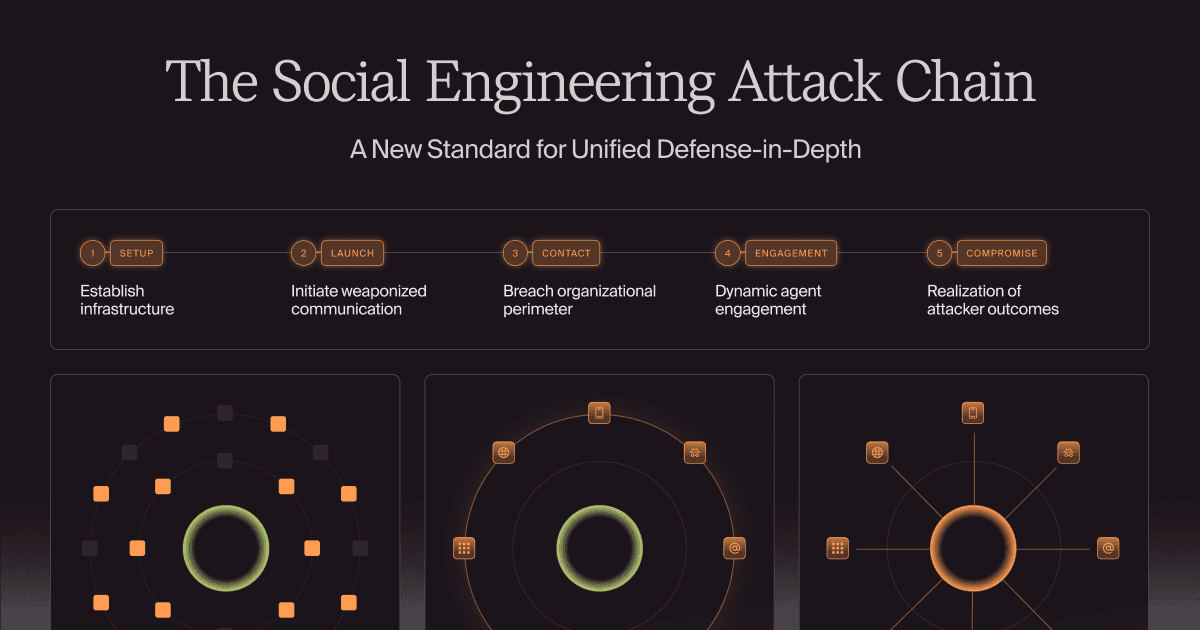
Modern social engineering is a relentless, AI-orchestrated lifecycle. Learn how to map the five-stage attack chain—from setup to contact—and why a unified defense platform is the only way to outpace AI-driven social engineering attacks.



by Bobby Ford, Rahul Madduluri, and Alvin Lin