In private equity and venture capital, trust is the asset that actually moves money. A single transaction can represent hundreds of millions of dollars, riding on relationships with limited partners and reputations that took decades to build. So it's no surprise that attackers have figured out the easiest way to get at that capital isn't breaking encryption. It's pretending to be the people who control it.
Generative AI has made that kind of deception cheaper and more convincing than ever, and private market firms are especially exposed. Scammers register domains that look almost identical to real capital-call portals, clone managing partners' profiles on Telegram and WhatsApp, and use cloned voices to talk their way past a helpdesk. Most security teams at these firms are lean (a handful of people covering billions in AUM and a growing list of portfolio companies), and the tools they're using weren't built for this.
This article looks at why PE and VC firms are such an attractive target, why the usual digital risk tools can't keep up, and what an AI-native approach to social engineering defense actually looks like in practice.
Why private markets are such an easy target
Compared to a typical large enterprise, VC and PE firms tend to run with small internal teams, move fast on transactions, and have partners whose names carry real weight publicly. That combination is exactly what attackers look for.
Executives and LPs get impersonated everywhere
Partners and managing directors are constant targets for credential leaks and identity cloning, and attackers don't stop at spoofed email addresses. They'll build a fake LinkedIn profile, start a Telegram group, or run a WhatsApp channel to pitch LPs on a fake co-investment or collect "management fees" that go nowhere. None of this shows up if your defenses only watch the inbox.
Big moments create big openings
Fund closes, acquisitions, board announcements, and IPO filings are the moments attackers wait for. In the weeks before a major announcement, they'll quietly register lookalike domains and stand up fake landing pages, then activate everything right when public attention peaks and a rushed employee is most likely to click.
Most of it comes down to money
The endgame is usually wire fraud or an LP fee scam. A domain that swaps one letter in a fund's actual URL is enough to intercept a capital call or trick a finance team into wiring funds to the wrong account. One compromised channel, and you're looking at a multi-million-dollar loss and LPs who no longer trust you with their money.
Why legacy protection models fall short in private capital
Most security stacks in this space were built piecemeal over the years: an email filter here, an annual training video there, a digital risk monitoring contract somewhere else. That patchwork leaves real gaps.
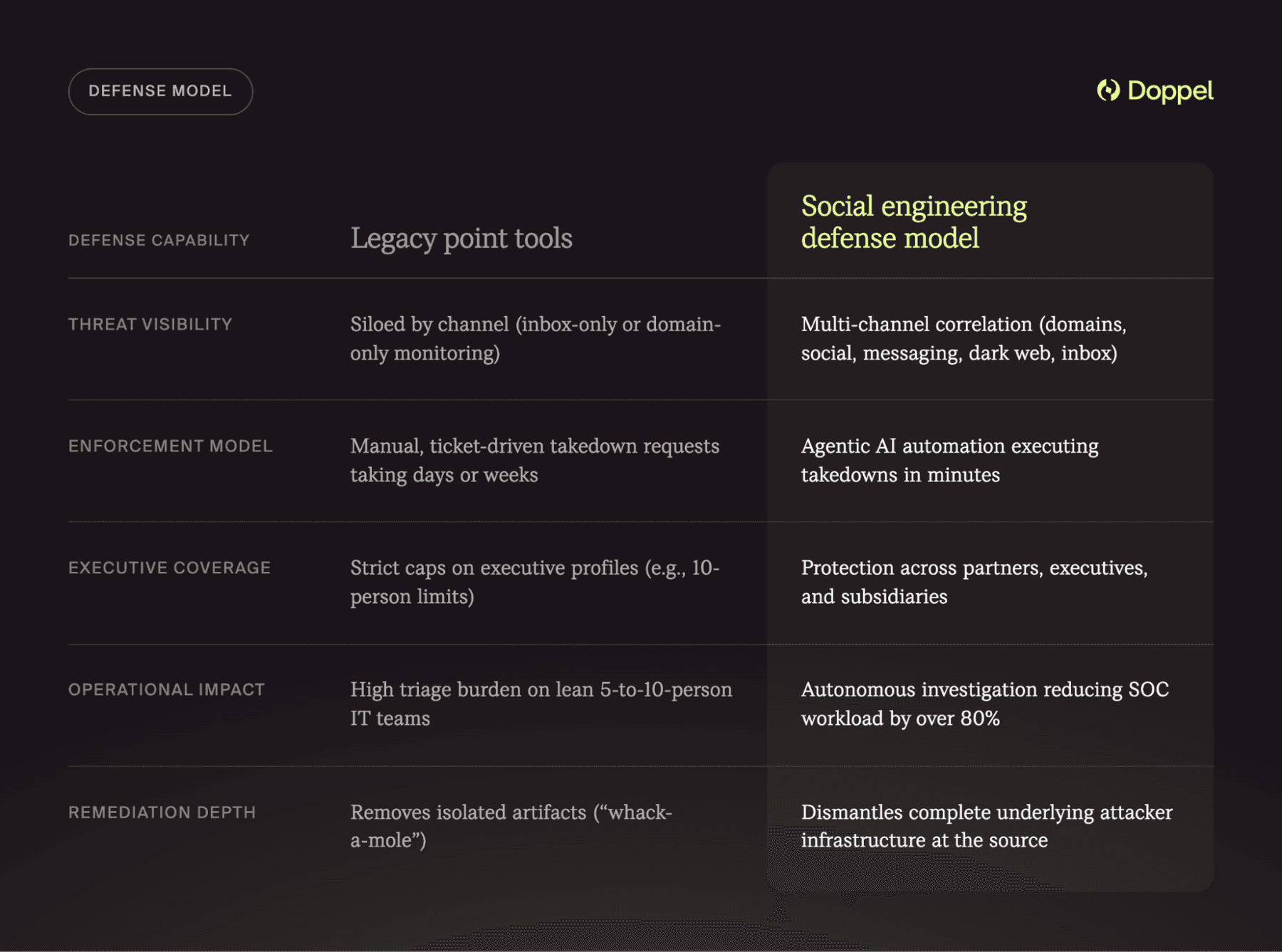
Legacy digital risk protection (DRP) tools mostly just tell you something's wrong. They'll flag a lookalike domain, but getting it taken down usually means a manual request and a multi-week wait, assuming you haven’t burned through your takedown quota for the year.
Meanwhile, email security tools look at each message on its own, with no way to notice that today's phishing email is coming from the same infrastructure that was set up two weeks ago for a fake executive persona.
What a modern defense actually looks like
Beating this kind of attack means shifting from reacting to alerts toward actually taking down the infrastructure behind them before it's used. Here's what that involves in practice.
Connecting the dots across channels
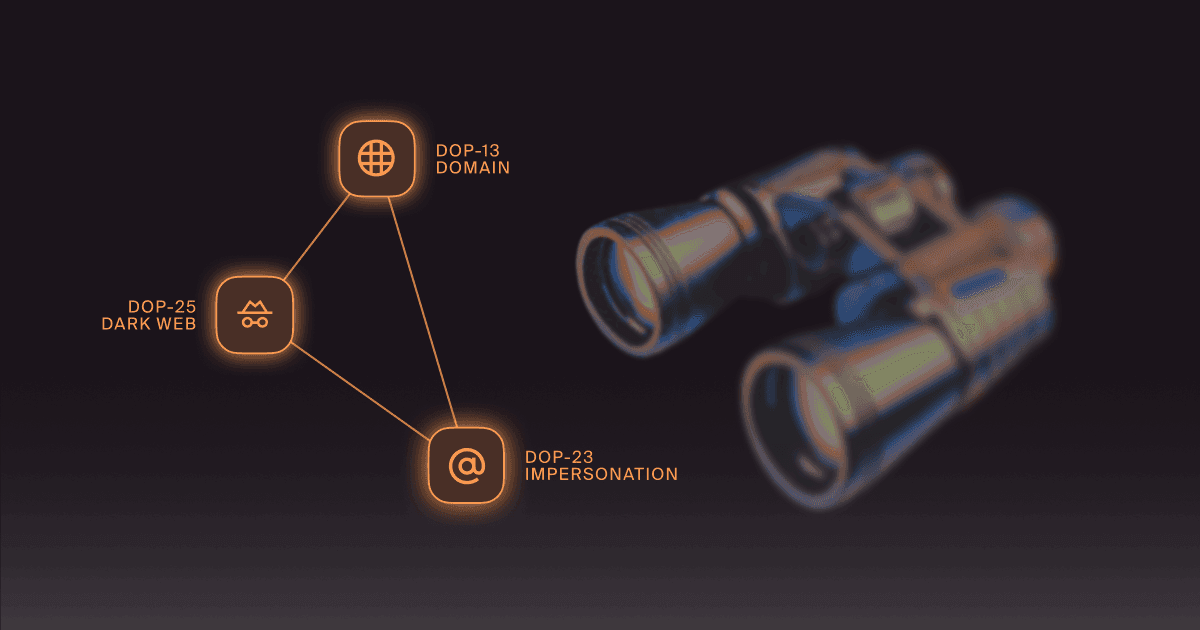
Attackers rarely stay in one place. They hop between email, messaging apps, and fake domains to stay ahead of detection. A defense system needs to link those signals together: when a new lookalike domain shows up, it should automatically connect to related IPs, SSL certs, phone numbers, dark web listings, and any messaging accounts tied to the same campaign. That turns fifty scattered alerts into one clear picture of what's actually happening.
Taking down infrastructure fast
Spotting a threat is the easy part. What’s difficult is dismantling it before it's used. Automated enforcement across domain registrars, hosting providers, ad networks, and telecom carriers can shrink takedown times from days to hours or even minutes. That speed matters: the faster attackers lose their setup, the less profitable it is to keep targeting you.
Turning real attacks into real training
Generic annual security training doesn't prepare anyone for a voice-cloned phone call or a near-perfect lookalike domain. A better approach takes the actual threats hitting your organization and turns them into training within a day or two, so your team is practicing against what's genuinely out there, not a hypothetical.
What this looks like for security leaders and boards
For CISOs and risk committees at PE and VC firms, the metrics that matter aren't how many emails got blocked or how a phishing test scored.
What actually matters:
- How fast malicious domains and phishing infrastructure get taken down, ideally under an hour, especially around sensitive transactions
- Whether a small team can maintain 24/7 coverage across hundreds or thousands of users without adding headcount
- Whether protection extends to everyone who matters, not just the top few executives, but portfolio leaders and administrative staff, too
- Whether you can show LPs and board members clear, time-stamped evidence that threats are actually being caught and shut down
Protecting private capital with Doppel
Private equity and venture capital firms cannot afford to treat social engineering as an inevitable tax on doing business. Dismantling multi-channel campaigns requires a unified defense system built to outpace AI-native deception.
To break the social engineering attack chain across every digital surface, leading financial institutions turn to Doppel. As a Frontier AI Social Engineering Defense platform, Doppel unifies Digital Risk Protection, Human Risk Management, and Email Security onto a single intelligence layer powered by the Doppel Threat Graph. Doppel automatically detects cross-channel threats, dismantles attacker infrastructure at the source, and transforms live campaign data into adaptive training that hardens your workforce.
Ready to eliminate blind spots and protect your firm's brand, executives, and LPs? Request a demo with Doppel today.