Deepfakes have moved from a theoretical concern to a working enterprise attack vector with measurable consequences. Losses from fraud powered by generative AI in the U.S. alone are on track to hit $40 billion by 2027 (opens in new tab), up from $12.3 billion in 2023.
Finance employees are wiring tens of millions based on synthetic video calls, attackers are being hired into engineering roles using AI-generated identities, and consumer-facing scams are running on the cloned faces and voices of named executives.
The deepfake examples in this article come from documented incidents at real companies and show how the attack has matured across executive authorization, hiring and onboarding, identity verification, and public-figure impersonation in social engineering attacks.
Key Takeaways
- Deepfakes are a working enterprise attack vector. Documented incidents span executive fraud, hiring, identity verification, and public-figure impersonation.
- You can't blindly trust what you see or hear on a call, in a voicemail, or on a video conference simply because it looks and sounds like a person you know.
- Technical controls don’t prevent deepfake attacks because SOC, SIEM, EDR, and MFA defend technical access, while deepfake attacks target humans.
- The workforce is the last line of defense against deepfake attacks. Role-targeted simulations, out-of-band verification, and live threat-to-training feedback help them recognize, question, and stop convincing fakes.
Why Deepfake Attacks Now Succeed Against Enterprises
Deepfake attacks now succeed against enterprises because generative models have outpaced the verification habits that most people learned. Four shifts in the underlying technology explain why employees can no longer spot a fake the way they used to.
- Synthetic video looks like the real person. Modern diffusion-based generators (opens in new tab) produce video without the visual giveaways that earlier deepfakes carried, such as warped ears, extra fingers, or unnatural blinking. Diffusion models don't leave detectable artifacts that frame-by-frame detection tools and trained employees could sometimes catch.
- Synthetic voice sounds like the real person. Voice cloning now needs only 20 to 30 seconds (opens in new tab) of source audio to produce a convincing replica, including accent, cadence, and tone. Executives publish far more than that voluntarily through earnings calls, podcast appearances, and media interviews, and that material is often more than enough for attackers to create voice clones.
- Real-time synthesis enables dynamic, two-way conversations. A deepfake on a call isn't reading a script. Agentic AI layered on top of voice and video clones can hold an unscripted conversation, respond to objections, apply or release pressure, change topics, and recover from interruptions, all in real time.
- Live face-swapping extends the same trick to video meetings. Attackers can also swap faces live (opens in new tab) during a Zoom or Teams call, mapping a target executive's face onto the attacker's own video feed in real time. Combined with a cloned voice and an agentic conversation layer, this enables the multi-participant video calls described in the Arup and WPP examples.
Attackers no longer need a sophisticated operation to mount a convincing impersonation; they need a few minutes of public audio, an off-the-shelf avatar tool, and a target whose verification habits trace back to an earlier era.
Examples of Deepfake Attacks Targeting Executive Authorization
The highest-loss incidents on record involve attackers impersonating executives to authorize wire transfers or extract sensitive information. In each of the deepfake examples below, the attackers exploited the trust employees place in a senior leader's voice or face.
1. Arup
A finance employee at Arup's Hong Kong office received a phishing email purportedly from the UK-based CFO. Initially skeptical, the employee joined a video call (opens in new tab) and encountered what appeared to be the CFO and several familiar colleagues, all of whom were AI-generated deepfakes. The employee executed a series of wire transfers across multiple bank accounts before exposing the fraud to Arup headquarters through a separate channel.
The incident shows how a multi-participant deepfake call can override the instinct to double-check, particularly when several "colleagues" appear to corroborate the request in real time.
2. WPP
Fraudsters created a fake WhatsApp account using a publicly available image of WPP CEO Mark Read, then set up a Microsoft Teams meeting (opens in new tab) that appeared to include Read and a senior executive. During the meeting, they ran a voice clone built from public interviews, impersonated Read, asked the target to set up a new business, and solicited money.
In this attack, WhatsApp carried the identity setup, Teams video carried the audio and visual impersonation, and meeting chat carried the written impersonation, all at once. The target recognized the deception before any funds moved, a reminder that the same attack against a less skeptical target could easily have succeeded.
3. Ferrari
A Ferrari executive received WhatsApp messages, followed by a phone call purporting to be from CEO Benedetto Vigna, citing a confidential acquisition that required immediate assistance with a currency-hedge transaction. The scammer used AI deepfake technology to mimic Vigna's voice (opens in new tab) and even his southern Italian accent, which the executive described as nearly perfect.
The scam failed when the executive tested the caller by asking the title of a book Vigna had recently recommended, a shared-knowledge question, the kind of verification primitive attackers can't scrape from public audio.
Examples of Deepfake Attacks Targeting The Hiring Process
Deepfake attacks can also target the hiring pipeline, where deepfaked candidates pass interviews, accept offers, and gain insider access from day one.
4. North Korean IT Workers
State-sponsored IT workers from North Korea have used stolen identities, fake websites, and residential "laptop farm" addresses to fraudulently obtain remote IT employment (opens in new tab) at U.S. companies. Because most operators don't physically reside in the U.S., small networks at drop locations turn on company-issued computers and configure them for remote access. The worker then connects via VPN so that access logs appear to be U.S.-based.
The DOJ has charged individuals tied to schemes infiltrating hundreds of companies and channeling proceeds back to the regime.
5. KnowBe4
In one of the most cleanly documented variants of the scheme, KnowBe4 hired a North Korean threat actor (opens in new tab) as a principal software engineer on its AI team, but caught the actor before they gained access to the corporate network. The investigation showed that the threat actor used deepfake technology to obtain the job and a VPN to manipulate their location, after HR conducted four video-conference interviews confirming the individual matched the photo on the application.
The incident shows how a deepfaked candidate can survive a thorough hiring process and that strong post-hire monitoring is what closes the gap.
Examples of Deepfake Attacks Targeting Identity Verification
Deepfakes can also pass liveness checks and document verification at the identity-proofing stage. Attackers now bypass many of these controls by feeding synthetic media directly into the video data stream at the software layer.
6. ABN AMRO
A fraudster merged their own face onto photos of stolen identity documents and submitted manipulated selfies (opens in new tab) via ABN AMRO's standard onboarding flow. The bank's verification compared the submitted selfie against the ID document photo, and because both showed the same synthetic face, the match succeeded.
The fraudster opened 46 bank accounts before the bank detected the scheme. The exposed gap is structural: a selfie-to-document match assumes neither side is synthetic, and that assumption no longer holds.
7. Indonesian Financial Institution
Attackers injected AI-generated deepfake photos (opens in new tab) into the digital KYC process of a major Indonesian financial institution's mobile app to obtain fraudulent loans. Face-swapping technology replaced the applicant's face with another person's in real time, creating synthetic faces that mimic expressions well enough to deceive facial recognition.
The attack flow is a virtual camera driver sitting between the operating system and the KYC app, which means that blink- and motion-based liveness checks are no longer reliable because the controls could be watching a video stream controlled by an attacker.
Deepfakes can also impersonate executives and other recognizable individuals in consumer-facing scam campaigns. The precise target matters here: deepfakes impersonate people, and the downstream damage lands on the company those people work for.
8. Patrick Hillmann
Scammers constructed a deepfake (opens in new tab) of Binance Chief Communications Officer Patrick Hillmann, drawing on previous news interviews and television appearances, and used it to impersonate him on calls with Binance customers and business contacts.
The impersonation weaponized executive trust to drive fraud at the customer level, the kind of campaign that erodes confidence in legitimate communications even when no individual victim's loss traces to a control failure inside the firm.
9. Martin Lewis
Scammers impersonated UK consumer-finance personality Martin Lewis in a deepfake video advertisement (opens in new tab) that ran on Facebook and Instagram. The ad used his face and voice to promote an investment app called Quantum.AI, supposedly backed by a $3 billion investment from Elon Musk, and was presented as a clip from a This Morning segment where Lewis often provides advice.
The example shows that public-figure deepfakes don't need to reach a single corporate workflow to cause damage; they reach the public directly through ad platforms, with reputational fallout for the named individual and any associated brand.
How to Prepare Your Workforce for Deepfake Attacks
Preparing for deepfake impersonation requires two things to work together. First, employees need rehearsed exposure to realistic synthetic-voice and video lures within their actual workflows. Second, they need verification procedures that don't depend on the senses attackers can now spoof.
- Run realistic, role-targeted simulations. Successful enterprise deepfake attacks cluster around three role groups: finance employees, HR teams, and senior leaders. Drills targeting those roles, including live voice and video scenarios, build the muscle memory that detection tools can't provide.
- Build out-of-band verification into money and access workflows. Teams handling sensitive communications should verify them through a separate, pre-established channel, such as a known-good number, an internal directory entry, or an agreed-upon challenge question.
- Feed live threat intelligence back into training. When external detection surfaces a deepfake campaign using the company's executives, the same tactics, scripts, and lures should become the next internal drill.
These three practices work as a system rather than in isolation: simulations build the reflex to pause, out-of-band verification gives that pause somewhere productive to go, and a live feedback loop keeps both calibrated against what attackers are running this quarter.
How Doppel Prepares Workforces for Deepfake Attacks
Doppel is the AI-native social engineering defense platform that combines Digital Risk Protection (DRP) and Human Risk Management (HRM) to prepare employees to spot and stop deepfake attacks.
DRP gives the external view, tracking impersonation campaigns targeting the company's executives and brand across the surfaces attackers use. HRM runs the internal program that turns those signals into training and verification practice for the people most likely to be targeted. Wiring the two together means the deepfake lure used against the company today becomes the drill employees see tomorrow, rather than waiting for a quarterly content refresh. Three capabilities matter most for the deepfake threat specifically.
Realistic, multi-channel deepfake simulations
Security teams can run deepfake drills that mirror how real attackers operate, rather than relying on static phishing templates.
- Dynamic, unscripted conversations. Agentic AI holds two-way calls with stock or custom voice clones, adapting in real time to whatever the target says.
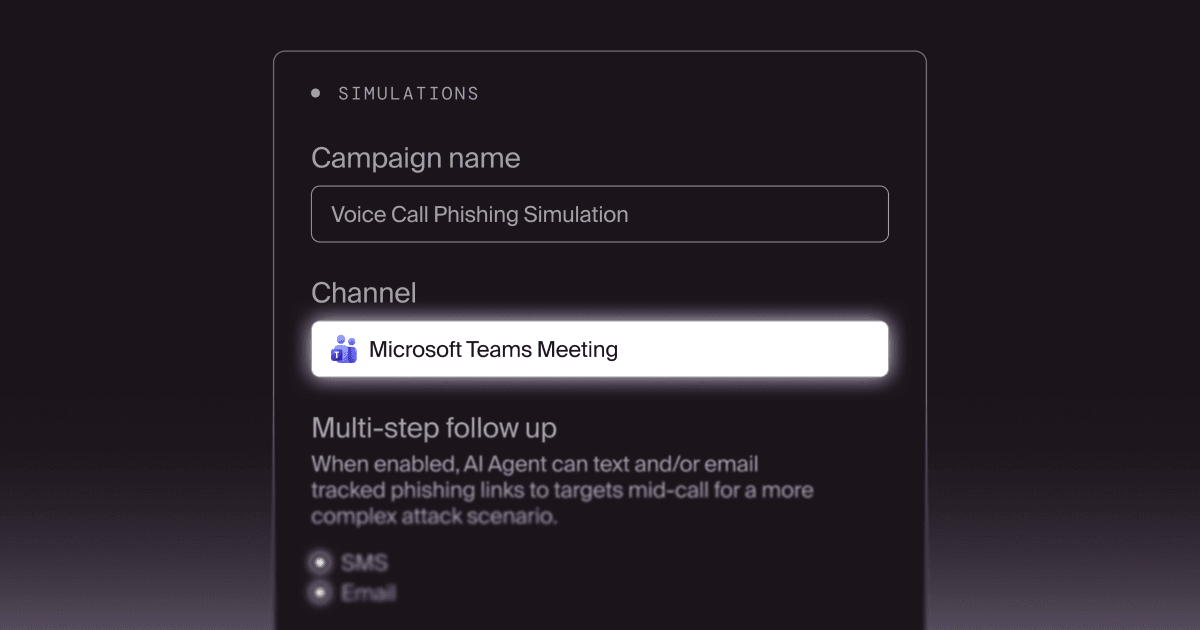
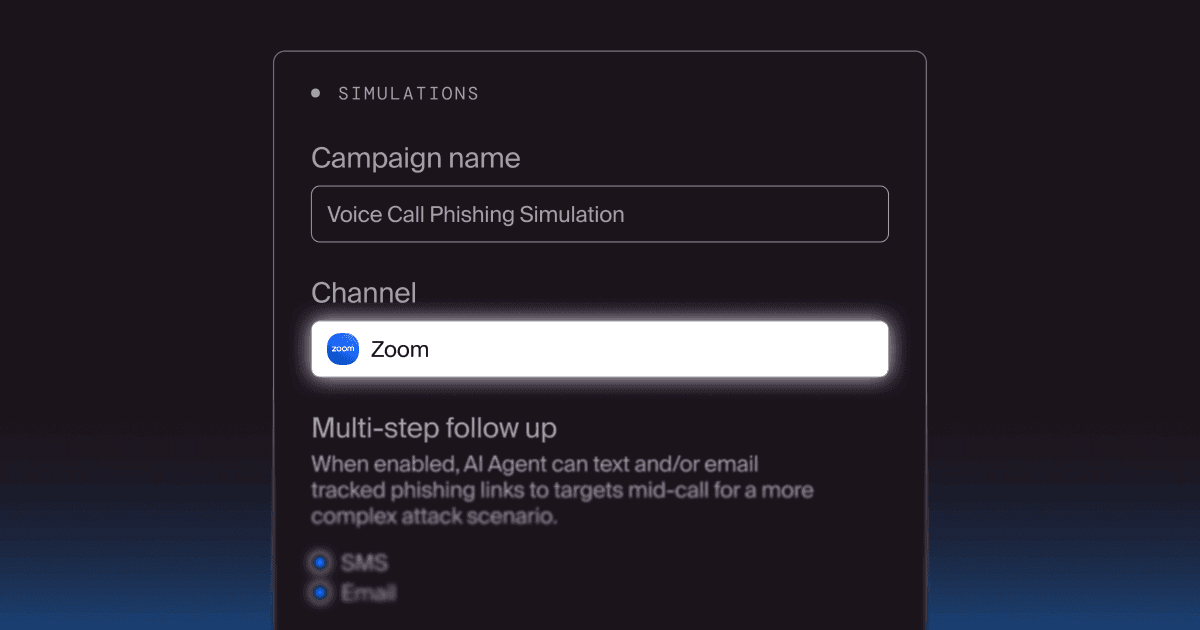
- Channel coverage. Simulations span voice, SMS, email, Microsoft Teams, Zoom, Telegram, and WhatsApp.
- Global by default. One campaign runs across more than 70 voice languages and more than 100 text languages, with per-employee localization configured automatically from the customer's IDP.
The result is a drill that resembles the actual attack employees are likely to see, rather than a generic phishing test that bears no relation to it.
Per-employee risk profiles tied to real behavior
Every simulation generates a profile showing what each employee actually did, not just whether they passed or failed.
- Behavioral signals. Click rate, data submission, response speed, consecutive fail streaks, and per-channel behavior.
- Voice-call analytics. A full transcript, line-by-line sentiment analysis ("Refused → Deflected → Deflected → Submitted"), and policy-by-policy benchmarking against the company's own protocols.
- Adaptive training intensity. Fast-clickers get progressive content, frequent failers get reinforcement, no analyst intervention required.
This turns helpdesk verification gaps and individual habits into concrete training targets, rather than a single org-wide compliance number.
A live feedback loop from external threats to internal drills
External detection and internal training run as one loop, so the lure attackers are using this week becomes the drill employees see next.
- Threat-to-simulation conversion. When DRP surfaces a live impersonation campaign against the company's executives, the lure copy and landing page can be cloned, defanged, and pushed into an org-wide simulation with a single click.
- Just-in-time training. SIEM and IDP integration fires a brief lesson at the moment of a risky action, such as a click on a flagged URL or a sign-in attempt from a personal device, rather than waiting for the next quarterly cycle.
Together, these capabilities turn the workforce into a functioning control layer for the part of the attack surface that technical tooling alone can't reach, and keep that layer calibrated against live external threat signals so the drills evolve as fast as the attacks do.
Make Your Workforce Harder to Fool
The sophistication of deepfake attacks will continue to improve, and technical controls won’t always prevent attacks that target trust rather than access. The best defense against deepfake attacks is a workforce that has already practiced against such attacks and operates verification procedures that withstand convincing fakes.
When a workforce is trained to recognize and challenge deepfakes, every attempt the attacker mounts is a sunk cost. The cloned voice doesn't get the wire, the staged Teams call doesn't get the credential, the deepfaked candidate doesn't get the offer. After enough failed runs, the economics no longer work, and the attacker moves on to a softer target.
Request a demo to see how Doppel's deepfake simulations and threat-to-training feedback loop prepare your workforce for the deepfake threats.