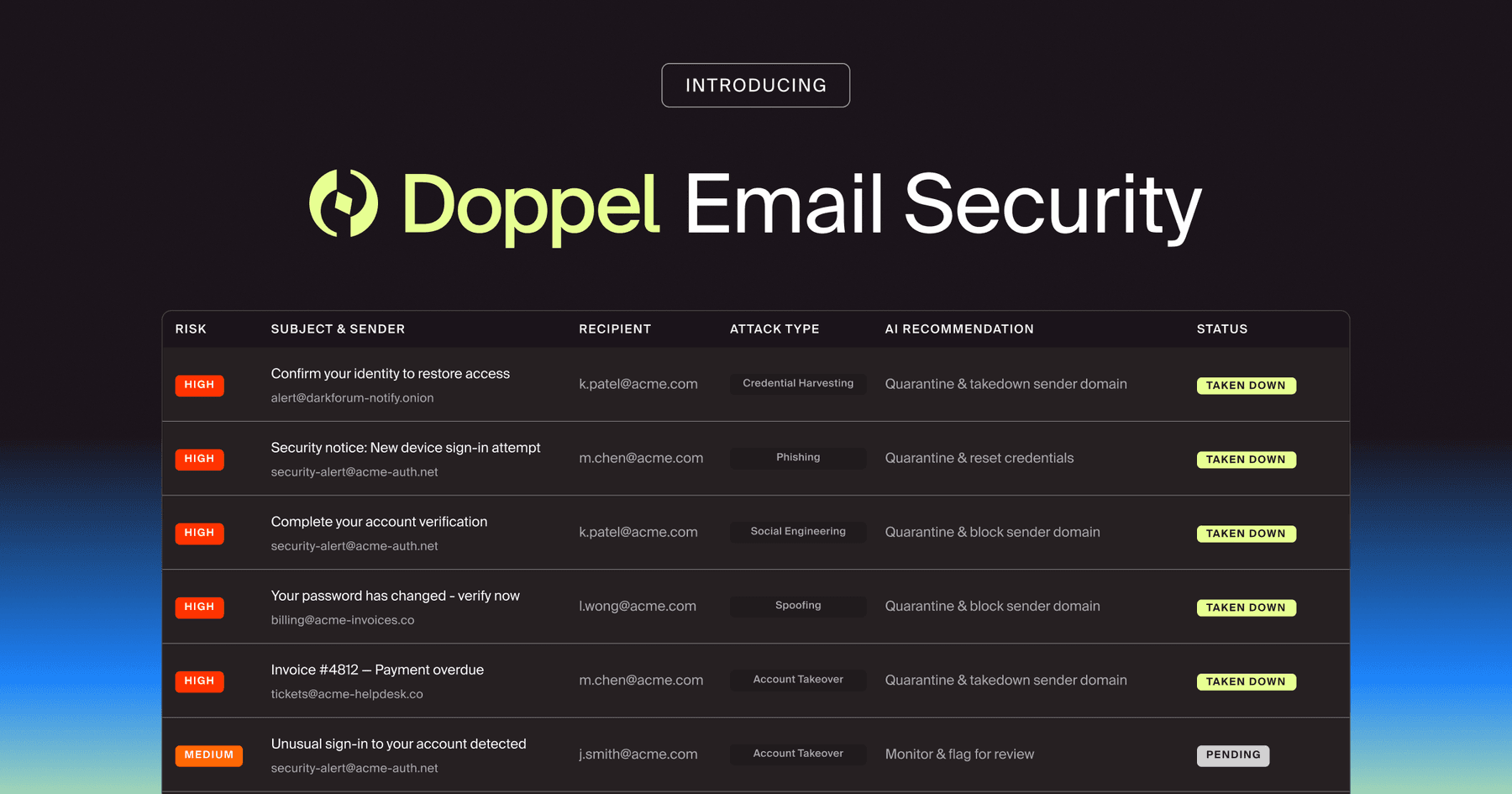
Doppel Email Security is now generally available
The agentic email security solution that empowers you to fight back against social engineering attacks. Detection isn't enough. Disruption is the difference.
AI-powered conversational vishing uses voice clones to pull off social engineering. Learn how to train your workforce against real-time psychological attacks.
Legacy security awareness training and phishing simulations ask employees to play a simple game of spot-the-typo.
In these programs, employees are taught that hackers are terrible at spelling. The entire workforce is trained to hover their mouse over a suspicious link and scrutinize visual elements that look weirdly formatted.
The entire strategy is built on the assumption that social engineering is a static, text-based puzzle. If you just pay a little bit of attention to your inbox, you could outsmart the adversary.
But generative AI is here, and it didn’t just fix the grammar in those phishing emails. It took attacks outside the inbox with hyper-realistic sophistication. Now, threat actors want to get you on the phone.
This is an era of AI-powered, conversational social engineering. Generative AI has transformed voice phishing, or vishing, into a dynamic, real-time psychological attack.
Cybercriminals aren’t relying on bad links. They’re using low-latency AI voice clones to bypass help desks, manipulate finance teams, and walk through the digital front door of your corporate network.
If your training consists of a walkthrough video and a quiz on identifying a bad URL, your employees are far from prepared.
Here’s a deep dive on how threat actors in 2026 orchestrate AI vishing campaigns, why your help desk is their favorite target, and how to actually train your workforce to survive these attacks.
This isn’t a lone teenager using a cheap, robotic voice changer to prank call a receptionist. Vishing is a highly orchestrated, heavily automated operation.
Adversaries are chaining together generative AI tools to create flawless, interactive deception.
Here’s how an attacker builds and executes a live, AI-driven phone call in 2026:
If you want to know exactly where an AI vishing campaign is going to strike first, look directly at your IT help desk.
In cybersecurity, we spend millions of dollars on locking down firewalls, deploying endpoint detection and response, and securing email gateways. But we often ignore the glaring human vulnerability sitting right in the middle of the organization: the IT support team.
The help desk is the perfect target for conversational social engineering.
Help desk agents are evaluated, compensated, and promoted based on their speed, their time-to-resolution, and their overall customer service scores. Their entire professional existence is culturally conditioned around being as helpful and accommodating as possible.
Attackers aggressively weaponize this empathy.
They don’t call the help desk pretending to be a peer. They call pretending to be the Chief Financial Officer, a Senior Vice President, or a board member.
The scenario usually plays out exactly like this: The AI voice clone of the CFO calls the Tier 1 support agent, and the fake CFO sounds incredibly stressed, angry, and rushed.
They claim they're at an airport gate, about to board an international flight in five minutes, and they’re completely locked out of their corporate account. They absolutely must have access to a specific financial presentation before the plane takes off, or the upcoming merger will fail.
The attacker applies massive psychological pressure. They use artificial urgency. They might even throw in some synthetic background noise of an airport terminal to sell the illusion.
Faced with a frustrated, high-ranking executive demanding immediate access, the help desk agent panics. The agent's fight-or-flight response kicks in.
Instead of forcing the "CFO" to go through the standard, time-consuming identity verification protocols, the agent makes a "VIP Exception."
They bypass the MFA prompt. They issue a temporary password. They hand the keys to the kingdom directly to the attacker.
The threat actor didn't write a single line of malicious code. They just used conversational pressure to convince the person who holds the master keys to open the door for them.
In 2026, you can’t fight a real-time voice attack with the same tools you use to fight a classic phishing email.
Here’s why traditional defenses fall apart when the phone rings:
Defensive Metric | Legacy Phishing | Conversational AI Vishing |
Attack Medium | Asynchronous; the user has time to stop, read, and analyze text | Synchronous; real-time interaction demands an immediate verbal response |
Indicators of Compromise | Bad grammar, unusual sender domains, and suspicious URLs | Psychological pressure, extreme urgency, and appeals to authority |
Technical Defense | Secure email gateways (SEGs) and URL scanners | Strict out-of-band human verification protocols |
Psychological State | Low pressure; the user is casually scrolling through their inbox | High pressure; the user’s fight-or-flight response is triggered by a demanding ‘executive’ |
Attacker’s Goal | Trick the user into clicking a link or downloading a file | Trick the user into executing an administrative action or bypassing MFA |
If your employees can’t rely on bad grammar or spam filters to save them, how do you actually defend the human perimeter against AI vishing?
You have to change your organization's culture. More importantly, you have to upgrade how you train your people.
Security leaders need to implement these three non-negotiable strategies immediately:
The transition from text-based phishing to AI-powered vishing is the most significant leap in social engineering seen in a decade.
When a synthetic voice that sounds exactly like your boss is yelling at you to bypass a security protocol, all of that passive video training goes right out the window.
The only thing that saves an employee in that exact moment is behavioral muscle memory. They need the ingrained, practiced reflex to pause, breathe, and verify.
This is why the legacy security awareness model is broken. It’s also why Doppel built an agentic AI-native social engineering defense platform.
We know that checking a compliance box does not stop a breached network.
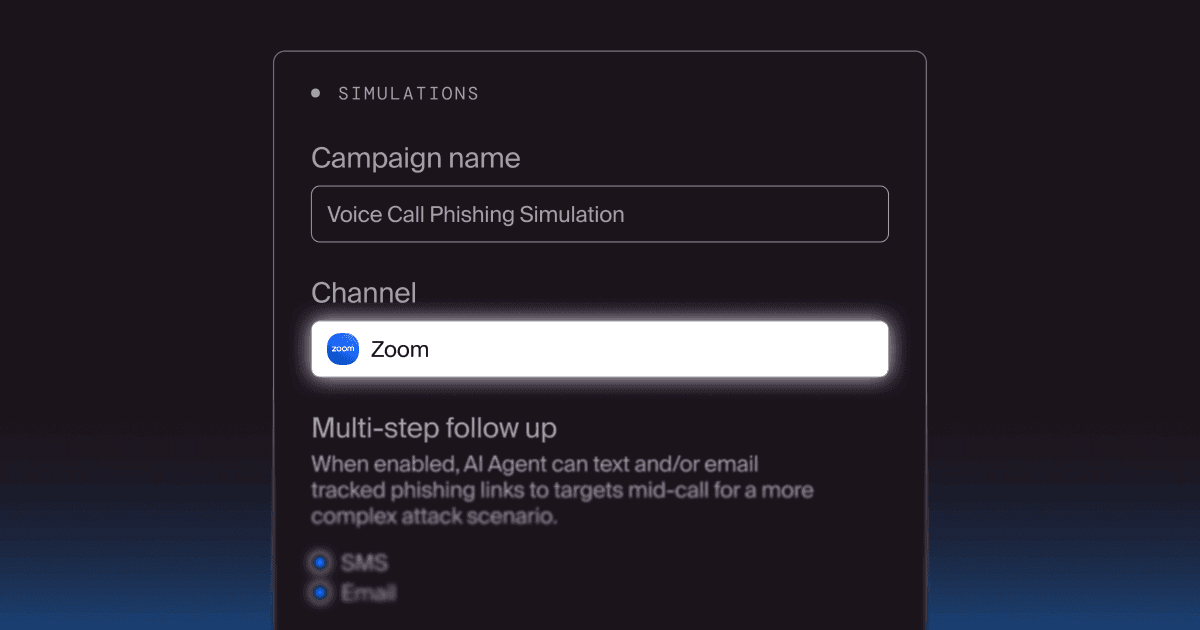
Doppel allows security teams to move entirely beyond the inbox. The platform enables organizations to deploy safe, highly realistic, multi-channel simulations that actually test the human perimeter.
This isn’t just sending fake emails. This simulates the exact conversational pressure, voice tactics, and SMS lures that modern attackers use today.
Continuously testing your IT help desk and your finance teams with realistic conversational simulations removes the shock value of a real attack. You train your workforce to recognize psychological manipulation rather than just look for a typo.
The attackers have upgraded their toolkits, and they’ve automated their social engineering.
Are you ready to build true behavioral muscle memory against AI voice cloning? Get a demo of Doppel to see how our social engineering defense platform prepares your workforce for the reality of conversational vishing.