
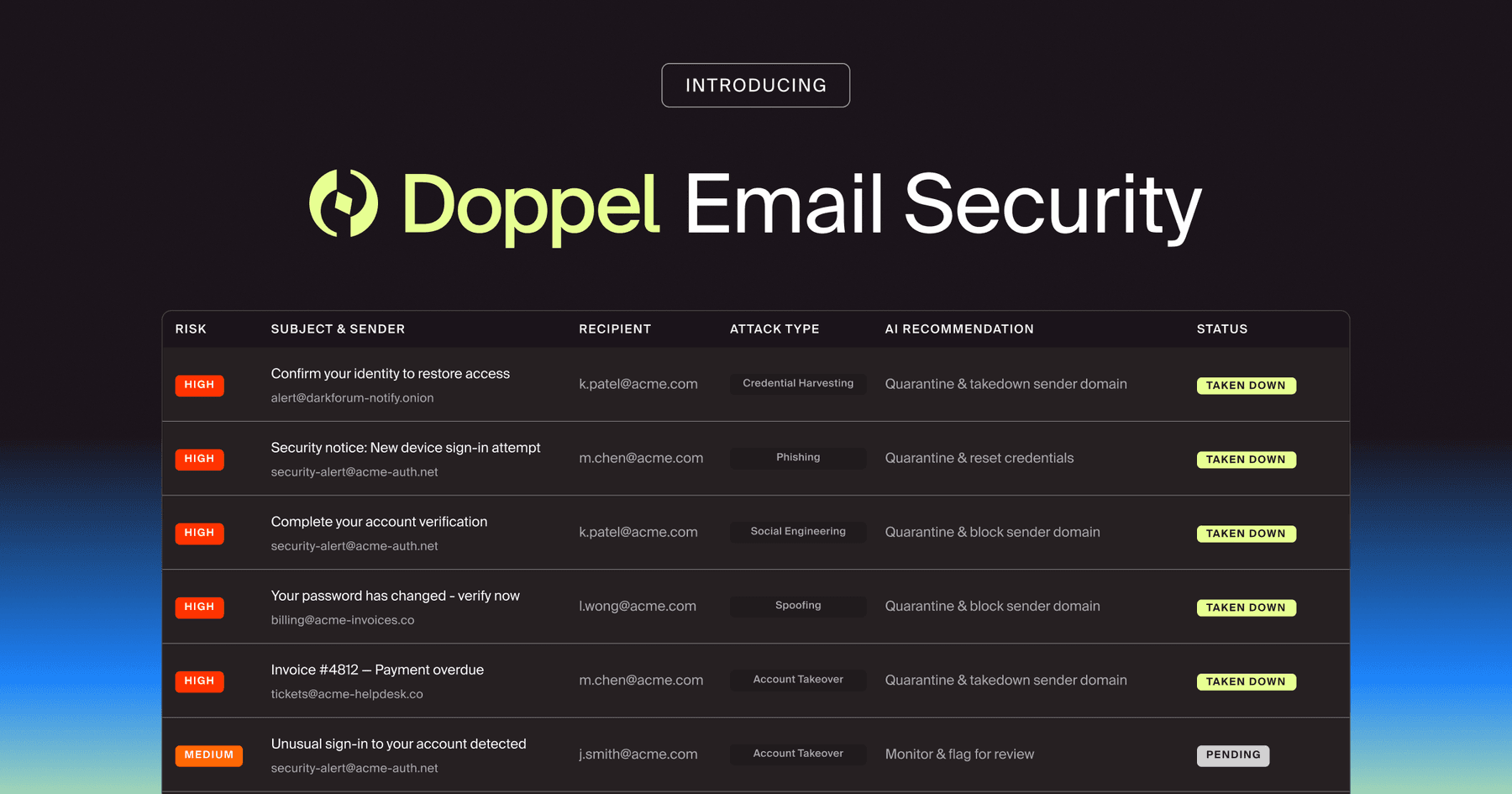
Doppel Email Security is now generally available
The agentic email security solution that empowers you to fight back against social engineering attacks. Detection isn't enough. Disruption is the difference.
Learn how to prevent social engineering attacks like phishing, vishing, BEC, and deepfakes with the human, technical, and external controls that actually work.

by Doppel Team
A help desk analyst picks up the phone. The caller knows the employee's name and department, and says they are locked out of their account and need an urgent password reset. The request sounds legitimate, so the analyst grants the request, and the attacker is in without having to bypass a single technical control.
That phone call is part of a social engineering attack: the manipulation of human trust to extract credentials, access, or money. It is also the most reported category of cybercrime (opens in new tab) in the United States, with nearly 200,000 phishing and spoofing complaints filed in 2024 alone.
This guide walks through what social engineering attacks are, the forms they take across channels today, and the practical steps your organization can take to prevent them.
A social engineering attack is an exploit that manipulates a person into giving up credentials, access, money, or sensitive information. Instead of exploiting a software vulnerability, the attacker exploits trust, urgency, fear, deference to authority, or the simple instinct to be helpful. A convincing pretext on a phone call, a well-timed email that looks like it came from a CEO, or a fake IT support message in a Teams chat can each do what a zero-day exploit would otherwise be needed to accomplish.
Social engineering attacks succeed because attackers take advantage of workplace complacency. By using urgency, authority, etc., to trick people into doing what they want or giving them access that they need to extract value from the organization. Employees are trained to respond quickly, defer to leadership, and help colleagues. Attackers engineer scenarios that turn those instincts against the organization.
Common psychological triggers include:
Because the lever is human judgment, an effective defense has to start with people and processes, then layer technical controls on top.
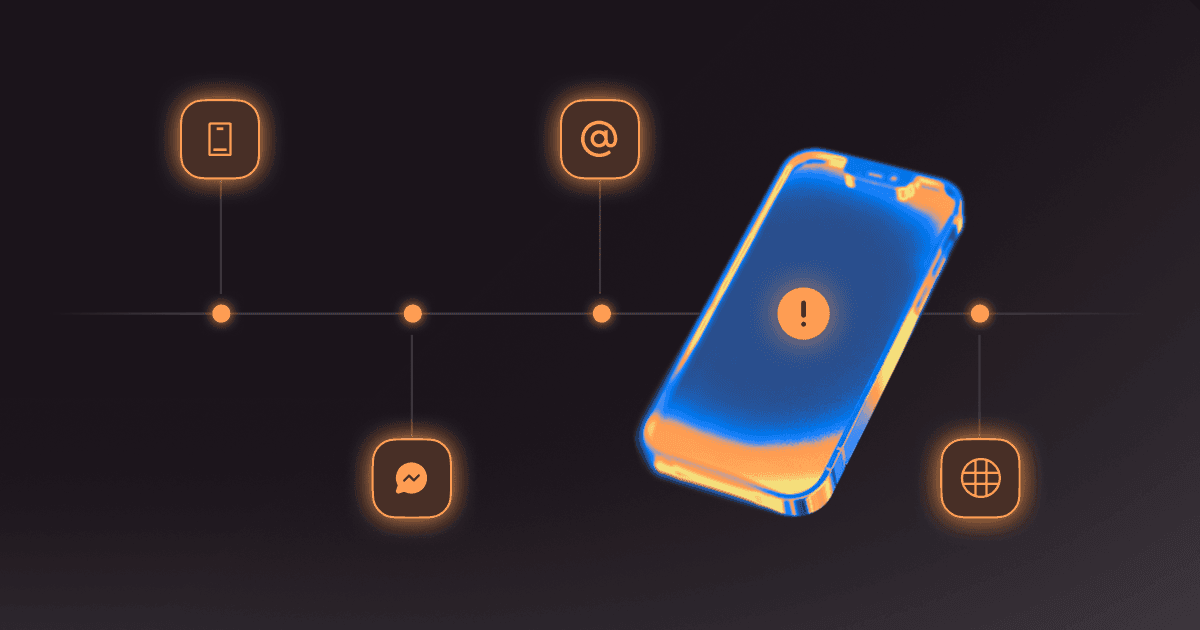
Social engineering attacks are multi-channel by default: A single campaign might begin with a spoofed email, escalate to a vishing call using an AI-cloned voice, and finish in a Slack or Teams chat impersonating IT. The six most common types of social engineering attacks to plan against are:
Other forms worth tracking include deepfake-enabled impersonation in video and voice calls, collaboration platform attacks that abuse Microsoft Teams and Slack to impersonate IT staff, and physical tactics such as tailgating into secured facilities.
Stopping social engineering requires a layered program that combines human judgment, process discipline, and external visibility.
People are the first line of defense against social engineering, so the highest-leverage move a security team can make is to reduce the success rate of the human decisions that attackers exploit. Every campaign is designed to trick someone into clicking a link, approving an MFA prompt, or resetting a password, which means measurable progress starts with the workforce, not the firewall.
The fastest path to reducing the success rate of attacks is HRM: the discipline of measuring, training, and shaping employees' responses to manipulation. Technical controls matter, but they are the second line. The first line is the person on the phone, in the inbox, or in the Microsoft Teams DM.
Employees do not change behavior because they watched a 20-minute video once a year. They change behavior when training reflects the threats actually targeting them and recurs often enough to build pattern recognition. Replace static annual modules with short, frequent sessions tied to current attacker tactics: AI voice clones, ClickFix lures, Teams impersonation, MFA fatigue. The goal is to make recognition automatic, so that a suspicious request triggers a pause rather than a click.
Email-only phishing tests no longer reflect how attackers operate. Simulate across the same channels they use: email, voice, SMS, and collaboration platforms. The strongest simulations are tied to real-world campaigns currently in flight against your brand or industry, so the scenarios employees encounter in training mirror the ones they will see in production. Track click rates, report rates, and time-to-report as leading indicators of human risk.
When someone requests credentials, money, or access, verification must occur through a separate, pre-established channel. The protocol should be the same whether the request comes from an executive, a vendor, or an IT colleague: pause, hang up, and confirm using a known good number, address, or directory entry. Bake this into written policy so employees do not have to make the judgment call alone in the moment.
Help desks sit at the chokepoint of account recovery, which is exactly why threat actors target them. Two protocols meaningfully reduce risk:
Deepfake detection at this checkpoint should move from being optional to standard, with adoption expanding across help desks, HR interviews, and financial services.
If an employee fears punishment for clicking a malicious link, they stay silent, and a containable incident becomes a breach. Designate a single, easy-to-remember reporting alias. Make the reporting workflow one-click in email and chat clients. Treat every report, even false positives, as a contribution to defense. The metric to optimize is time from exposure to report, not click rate alone.
HRM addresses the inside of the threat perimeter. Digital Risk Protection (DRP) addresses the outside: the spoofed domains, impersonation profiles, fake ads, and dark web infrastructure that attackers stage before they ever reach an employee. Pairing the two lets you take down a lookalike domain before the phishing email lands, and feed live attacker tradecraft directly into the next training cycle.
Human and external defenses work best on top of a baseline of technical controls that shrink the attack surface and limit the blast radius of any single mistake. Five controls do most of the heavy lifting.
Configure your email authentication protocols to stop attackers from spoofing your domain in outbound mail. Without enforcement, an attacker can send a convincing "CEO" email to your entire workforce, and recipients will have no technical signal that it is fraudulent. Even with enforcement in place, only a small fraction of domains (opens in new tab) operate at the highest level of DMARC enforcement, and AI-generated phishing can still pass authentication checks on look-alike domains the attacker owns outright.
Retire SMS and push-based MFA for anyone with elevated access. Push bombing, SIM swapping, and SS7 exploitation are all part of the attacker toolkit, and threat groups like Scattered Spider have built playbooks to defeat standard MFA at the help desk. Move privileged users and high-risk roles to phishing-resistant MFA built on FIDO2/WebAuthn and hardware security keys.
Replace signature-based filters with detection that works the way attackers do. Static rules miss polymorphic phishing that mutates with every send, and they cannot see across channels at all. Multimodal AI detection (opens in new tab) analyzes content across email, messaging, voice, and collaboration platforms in correlation, catching campaigns that any single-channel filter would miss. The detection layer should also map external infrastructure, such as lookalike domains, impersonation profiles, and paid scam ads, so that takedowns occur before employees are ever exposed.
Keep anti-malware, firewalls, and email filters up to date, and apply software and firmware patches on a predictable schedule. These are the unglamorous controls, but they are what contain the damage when, not if, an employee is fooled into clicking a link or running a ClickFix script. A patched, well-configured endpoint turns a successful social engineering attempt into a contained incident instead of a breach.
Harden the physical perimeter, because digital controls do not help if an attacker walks through the door. Require badge access at all entry points, enforce challenges on tailgating, log visitors, keep CCTV operational, run physical pen tests alongside digital ones, and shred sensitive documents before disposal. Social engineering campaigns increasingly pair digital pretexts with physical entry attempts, and a defense that ignores the lobby leaves a door wide open behind every other control.
The framework above works best when HRM and DRP run as a single, connected program rather than two parallel ones. External signals should shape internal training in real time, and internal reports should trigger external takedowns. Most security stacks split these into two siloed dashboards, and the advantage goes to teams that close the loop.
Doppel is an AI-native social engineering defense platform that unifies HRM and DRP, enabling security teams to run them as a single program. Three capabilities make that unified model work in practice:
External threats inform internal training, and internal reports feed external takedowns. The result is a single continuous defense surface rather than two disconnected programs.
Attackers run coordinated campaigns across email, voice, SMS, social media, and collaboration platforms in the same week. Defenses built around a single channel or a single control will keep losing ground.
The teams that close the gap will be the ones that treat social engineering as a human-and-infrastructure problem, running HRM and DRP as one connected program with technical controls underneath.
Request a demo to see how Doppel detects, simulates, and dismantles social engineering campaigns across every channel attackers use.