Most security awareness programs prepare employees for a threat landscape that no longer exists. They train employees to spot bad grammar, mismatched URLs, and generic greetings in suspicious emails. Attackers have moved on. They can now clone executives' voices from public audio, generate real-time video of colleagues, and run multi-step campaigns that switch between email, voice, SMS, and collaboration platforms.
This article covers what a deepfake simulation for security awareness is, where legacy training falls short against AI-enabled social engineering attacks, how a deepfake simulation program defends against those attacks, and what it takes to build an effective program.
Key Takeaways
- Deepfake simulations expose employees to AI-generated voice, video, and synthetic personas across every channel attackers use.
- Legacy awareness training falls short against deepfakes because it anchors to the inbox, runs on annual cycles, and relies on outdated artifacts.
- Effective deepfake programs rehearse verification behavior, deliver pre-exposure, and span every attacker channel.
- Doppel operationalizes deepfake simulations with multi-channel lures, live attacks converted into training scenarios, and per-employee risk profiling with automated remediation at the moment of failure.
What Is Deepfake Simulation for Security Awareness?
A deepfake simulation is a controlled, safe-to-fail exercise that exposes employees to AI-generated synthetic media in scenarios designed to mimic real attacks.
In a security awareness context, the goal is specific: give employees realistic, repeatable exposure to cloned voices, fabricated video, and AI-generated personas so they build the verification reflexes needed to detect deception in the moment.
The simulation also lets the organization measure detection capability, identify who failed and why, and remediate the specific behavioral lapse before a live attack finds it first.
How Deepfake Simulations Differ from Standard Phishing Tests
Deepfake simulations differ from standard phishing tests in what they measure, the channels they run on, and the behaviors they test.
Standard phishing tests send a suspicious email and measure who clicks the link. Deepfake simulations test whether an employee maintains verification discipline when the person on the other end of a call sounds exactly like their CTO, when the face on a video conference belongs to a known colleague, or when a multi-step campaign builds trust across channels.
That difference shows up in three concrete ways:
- Cognitive load: A phishing email is asynchronous and inspectable. A cloned voice on a live call demands an immediate response under social pressure, without the option to re-read or hover over a link.
- Channel coverage: Deepfake simulations span phone, video conferencing, SMS, and collaboration platforms because that's where synthetic media attacks actually land.
- Behavior measured: Deepfake simulations measure whether employees follow verification protocols, such as callbacks to known numbers, out-of-band confirmation, and escalation, when the social cues say everything is fine.
An organization that runs only email-based simulations has no read on how its workforce performs against the attacks most likely to cause material loss.
How a Deepfake Social Engineering Attack Unfolds
A deepfake attack wears down a target's cognitive defenses through reconnaissance and pretext before the synthetic media ever shows up. The full chain typically runs through three stages:
- Reconnaissance builds the pretext. Attackers harvest voice and video samples from earnings calls, podcasts, and LinkedIn videos, and pull organizational intelligence (opens in new tab) from job postings, 10-K filings, and press releases.
- Synthetic media delivers authority under pressure. A spear-phishing email from the "CEO" references an urgent confidential acquisition and warns that a call will follow. When the call comes, the pretext has already primed the target to comply.
- Urgency and channel-switching close the loop. Attackers demand confidentiality to block verification, then switch channels mid-interaction. For example, a voice call pivots to an SMS with a "secure link."
Clear channel policies can turn channel-switching into a detection signal, but only if employees have learned to recognize it as suspicious.
Why Legacy Security Awareness Training Falls Short Against Deepfakes
Legacy security awareness training teaches employees to spot artifacts that AI has already stripped away. It also trains employees on a single channel that attackers no longer rely on, at a cadence the technology has long since outpaced.
- Deepfakes weaponize the signals employees learned to trust. Legacy awareness training teaches employees to read familiar voices, known faces, and recognized phone numbers as cues of authenticity.
- The curriculum anchors to the inbox. Training modules cover suspicious links, attachments, and sender domains. None of that translates to a WhatsApp message or a phone call with a familiar voice.
- Annual cycles can't keep pace with AI-generated attack capability. If the training happens annually, it would be generations behind the sophisticated attacks employees actually face.
- Static content can't rehearse live verification behavior. Watching a module about social engineering is one experience. Holding the line on a live call with a cloned executive voice demanding an urgent wire is another.
Basic OpSec hygiene from security awareness training still matters, but on its own, it no longer prepares employees for the attacks they're most likely to face. The shortcomings are concrete:
How a Deepfake Simulation Program Defends Against Social Engineering Attacks
A deepfake simulation program defends against social engineering attacks by taking employees through hyperrealistic attack scenarios, so that detection becomes a procedural reflex rather than an individual judgment call.
1. Rehearsal of Verification Behavior
Rehearsing the verification response in a simulation is what turns a written protocol into an automatic behavior under pressure.
Employees who have answered a simulated cloned-voice call from their "CFO" and received coaching on the correct response (pause, end the call, dial back on a known number, escalate to a second approver) have a script to run when the real call arrives.
Without that rehearsal, the verification protocol exists only on paper, and paper protocols lose to urgency every time.
Pre-exposure recalibrates an employee's assumption that familiarity proves identity before an attacker gets to exploit it.
The first time an employee hears a convincing AI replica of someone they know can't be the real attack. Once an employee has experienced how good the synthesis actually is, and how unsettling it feels to hear their own colleague say something the colleague would never say, they stop treating familiar voices and faces as proof.
That recalibration only happens when a simulation delivers the synthetic media into the same channels and contexts attackers use.
3. Multi-Channel Coverage That Mirrors the Attack Chain
Running scenarios across every channel attackers use trains employees to recognize the shape of an attack across its full chain, not just the synthetic moment at the end.
Real campaigns start with reconnaissance, move through email, switch to voice, pivot to SMS or Teams, and demand confidentiality to suppress verification. A simulation program that runs scenarios across phone, video conferencing, SMS, Telegram, WhatsApp, and collaboration platforms, including multi-step campaigns that chain those channels together, trains employees to recognize the pattern of an attack across every stage.
What You Need to Build an Effective Deepfake Simulation Program
Building an effective deepfake simulation program comes down to five structural requirements, each one closing a shortcoming that email-only programs leave open:
- Realism that matches the attacker's capability. Low-quality synthetic audio or low-fidelity video creates false confidence in employees who would fail under real conditions. The simulation must track the curve of accessible attacker tooling.
- Coverage across voice, video, and collaboration channels. Attackers run campaigns across phone, video conferencing, SMS, and collaboration platforms.
- Per-employee risk data over organizational averages. Measurement must be segmented by role, department, and channel surfaces to prepare high-risk individuals, such as executive assistants or finance teams.
- Immediate remediation tied to the specific failure mode. Generic post-simulation training doesn't change behavior. Remediation must be within hours and directly tied to the exact channel, technique, and cognitive failure mechanism.
- Pre-exposure before the live attack arrives. Effective programs put employees through repeated, escalating scenarios so they aren’t locked to just one variant of the deepfake attack.
Setting up a high-performing deepfake simulation program in-house is operationally demanding. It requires synthetic media tooling that keeps pace with attacker capability, scenario authoring across half a dozen channels, per-employee tracking infrastructure, and a remediation engine ready to fire at the moment of failure.
How Doppel Powers Deepfake Simulations for Security Awareness
Doppel is an AI-native Social Engineering Defense (SED) platform that unifies Digital Risk Protection and Human Risk Management in a single system. It powers deepfake simulations for security awareness by feeding the synthetic media attacks targeting an organization externally into the realistic, multi-channel simulations that train employees internally
Doppel closes the loop between the threats an organization sees in the wild and the simulations that prepare employees for those threats across three broad functions.
1. Multi-Channel Simulations with Real Voice and Video Deepfakes
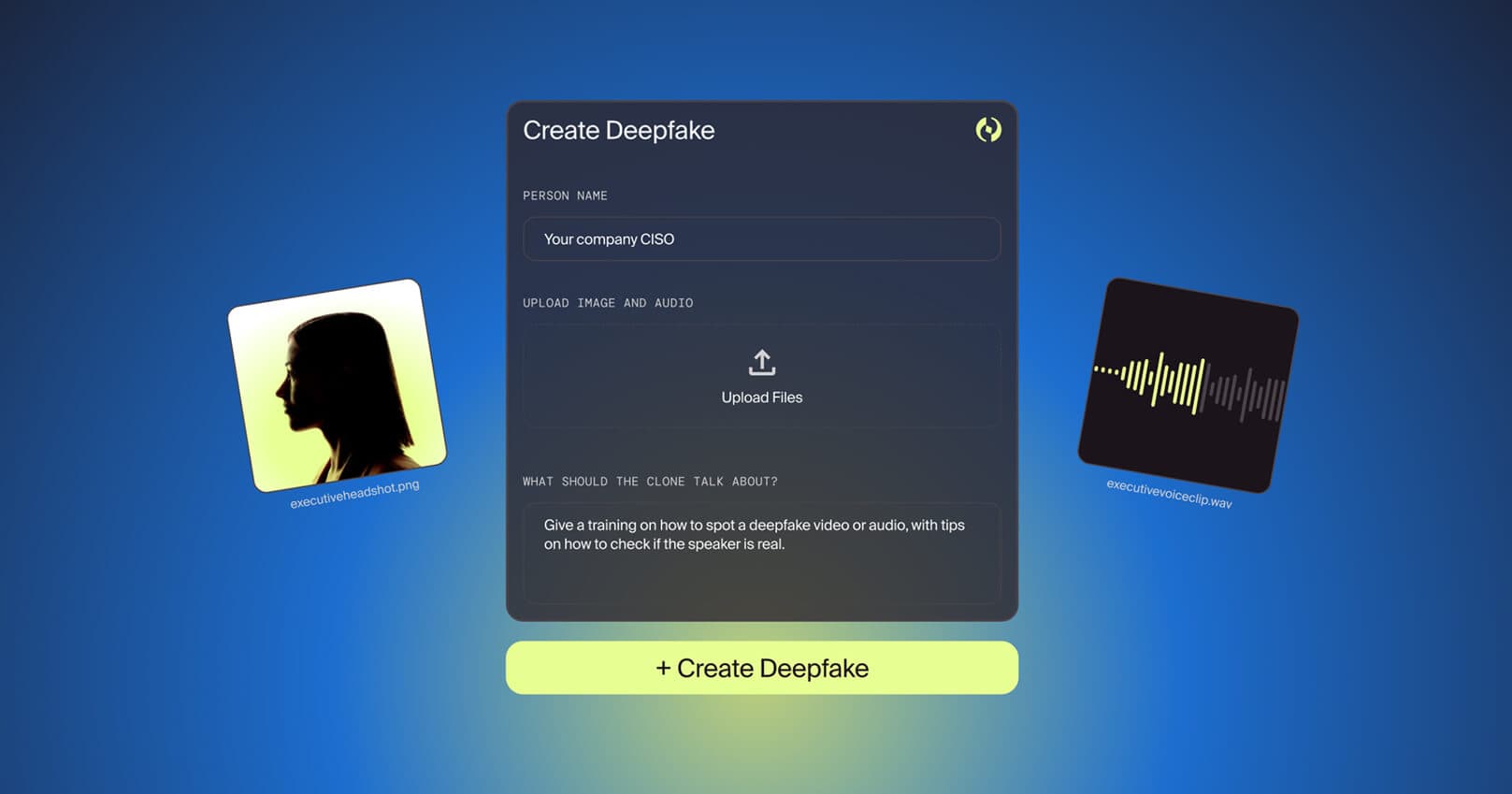
Doppel runs deepfake simulations across every channel attackers actually use, not just email. Doppel Simulation delivers AI-powered simulations across phone calls, Microsoft Teams, Zoom, SMS, Telegram, and email, including deepfake-enabled voice cloning and dynamic conversation flows.
Doppel's agentic system orchestrates real-time, channel-spanning conversations that mirror how real attackers behave when a target hesitates or asks a question. Helpdesk Mode extends the same capability to external contact centers and business process outsourcing (BPOs), so Doppel tests the channels attackers most commonly use to reset credentials at scale.
2. Converting Live Attacks Into Training Scenarios
Doppel turns the attacks targeting an organization right now into the training scenarios its employees run, so practice mirrors what's actually in the wild.
When the Doppel Threat Graph detects a live threat, Doppel dismantles the attacker infrastructure externally while the security team converts the attack pattern into a defanged employee simulation with one click. The lure copy, landing page, and infrastructure pattern from an active campaign become the training scenario.
Doppel measures risk at the individual level, segmented by role, channel, and attack technique, then pushes remediation to each employee at the moment they fail.
Every employee carries a dynamic risk profile that tracks personal risk score, click rate, consecutive fail streak, response speed, data submission rate, per-channel behavioral breakdown, and an LLM-generated behavioral summary with recommendations for the next simulation.
That data drives targeted remediation tied to the specific failure mode: Doppel personalizes training based on actual user behavior and delivers automated micro-coaching at the moment of failure, tying remediation to the channel and technique that led to the lapse.
Each subsequent cycle calibrates the difficulty upward to test whether the lesson held, so detection rates climb, time-to-report shortens, and the verification reflex becomes durable enough to withstand a live attack.
Equip Your Employees to Recognize Deepfake Attacks
Deepfake simulations for security awareness won’t stop a synthetic voice from reaching an employee. The call still comes through, the video still renders, and the WhatsApp message still arrives.
What changes is what happens in the seconds after the employee picks up. By rehearsing that moment under realistic conditions, repeatedly and at increasing difficulty, the program builds a verification reflex that holds up under social pressure.
Doppel runs deepfake simulations across the channels attackers actually use and turns live threats into employee training in a single step, so an organization can measure and improve detection capability rather than assume it. Every quarter that passes without realistic exposure leaves employees rehearsing the wrong reflexes against the wrong attacks, while the synthesis technology attackers rely on keeps getting cheaper and more convincing.
Preview Doppel Simulation to see how deepfake threats really work ot request a demo to see how Doppel prepares your employees to be vigilant when the voice, face, or message on the other end mimics someone they trust exactly.