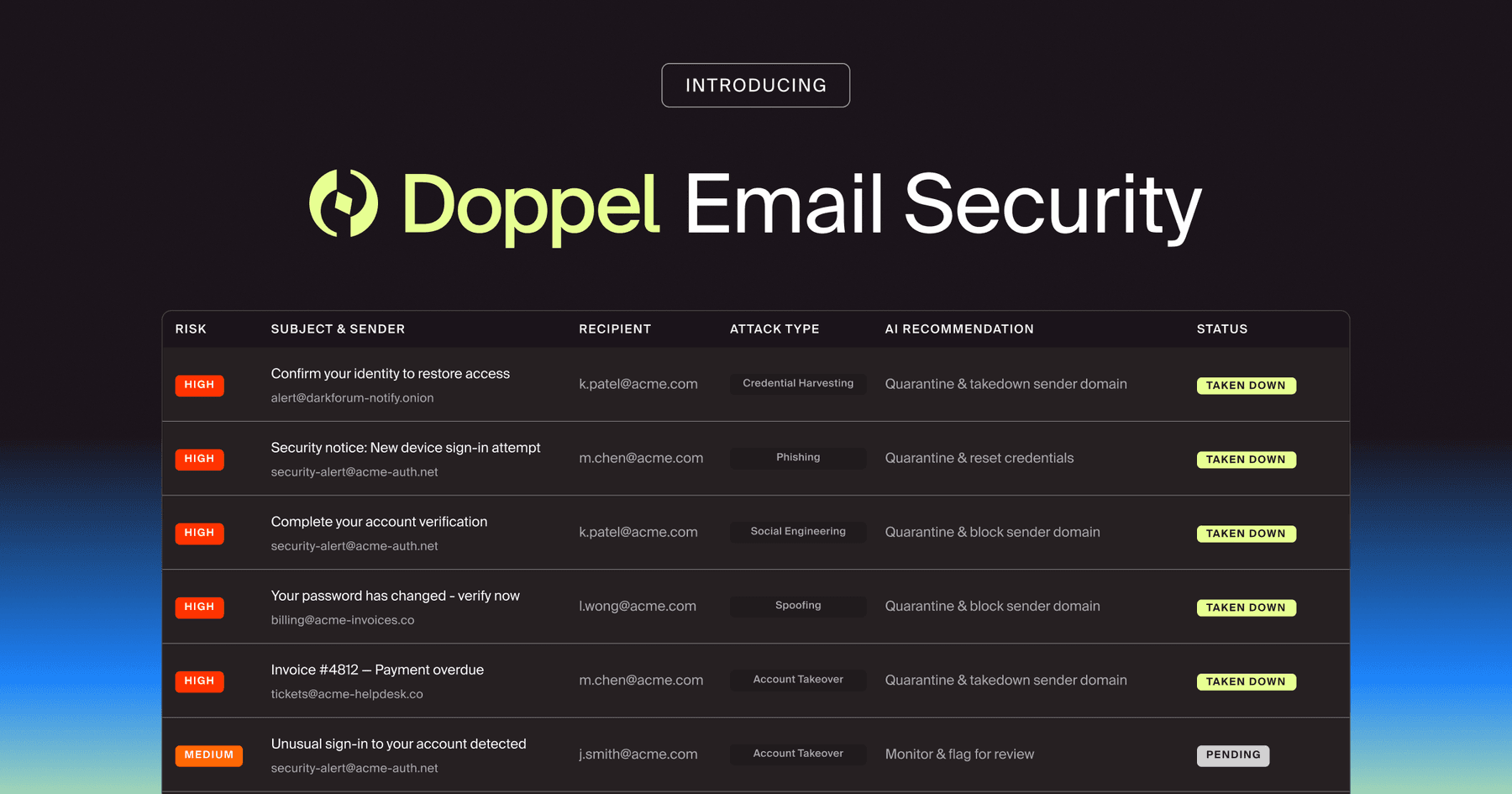
Doppel Email Security is now generally available
The agentic email security solution that empowers you to fight back against social engineering attacks. Detection isn't enough. Disruption is the difference.
Manufacturing brands remain a high-priority target for cybercriminals due to their reliance on interconnected suppliers, distributed operations, and business-critical systems, but Doppel telemetry from early 2026 highlights a meaningful shift—not just in threat volume, but in how attackers establish access and scale risk.
Industrial & Manufacturing
Report Date: 06/15/2026
Manufacturing organizations remain a high-priority target because attackers can create business impact without immediately touching production systems. Credential exposure, spoofed infrastructure, social impersonation, and third-party abuse can all support fraud, access brokering, vendor compromise, or disruption that eventually affects plant operations, logistics, customer trust, or supplier continuity.
Doppel telemetry from January through May 2026 shows that industrial and manufacturing threat activity is heavily shaped by credential exposure and external infrastructure abuse. After reaching its lowest point in March, threat activity surged sharply in April and remains elevated in May.
The broader manufacturing threat landscape supports this pattern. IBM X-Force reported that manufacturing remained the most targeted sector for the fifth consecutive year in its 2026 Threat Intelligence Index, reinforcing that attackers continue to view manufacturers as high-leverage targets because of operational downtime sensitivity, supply chain dependency, and complex hybrid IT/OT environments.
Across Doppel telemetry, the most important signal is the dominance of credential leak activity. Credential leak sources accounted for more than 90% of top-source activity in February and April, and more than 85% in May. Leaked credentials may provide attackers with lower-friction paths into supplier portals, VPNs, cloud services, email accounts, and remote access tools.
At the same time, attackers continue to use trusted and rapidly deployable platforms, including Gitbook, Webflow, Blogspot, Netlify, and Cloudflare Pages. These services can be used to host convincing impersonation pages, phishing flows, fake documentation, and campaign infrastructure with low setup cost and fast replacement after takedown.
Taken together, Doppel’s view of manufacturing risk is identity-led, platform-enabled, and supply chain exposed. The threat activity observed is primarily external-facing, but it carries downstream risk because manufacturing environments depend on connected business systems, distributed plants, contractors, suppliers, and third-party support relationships.
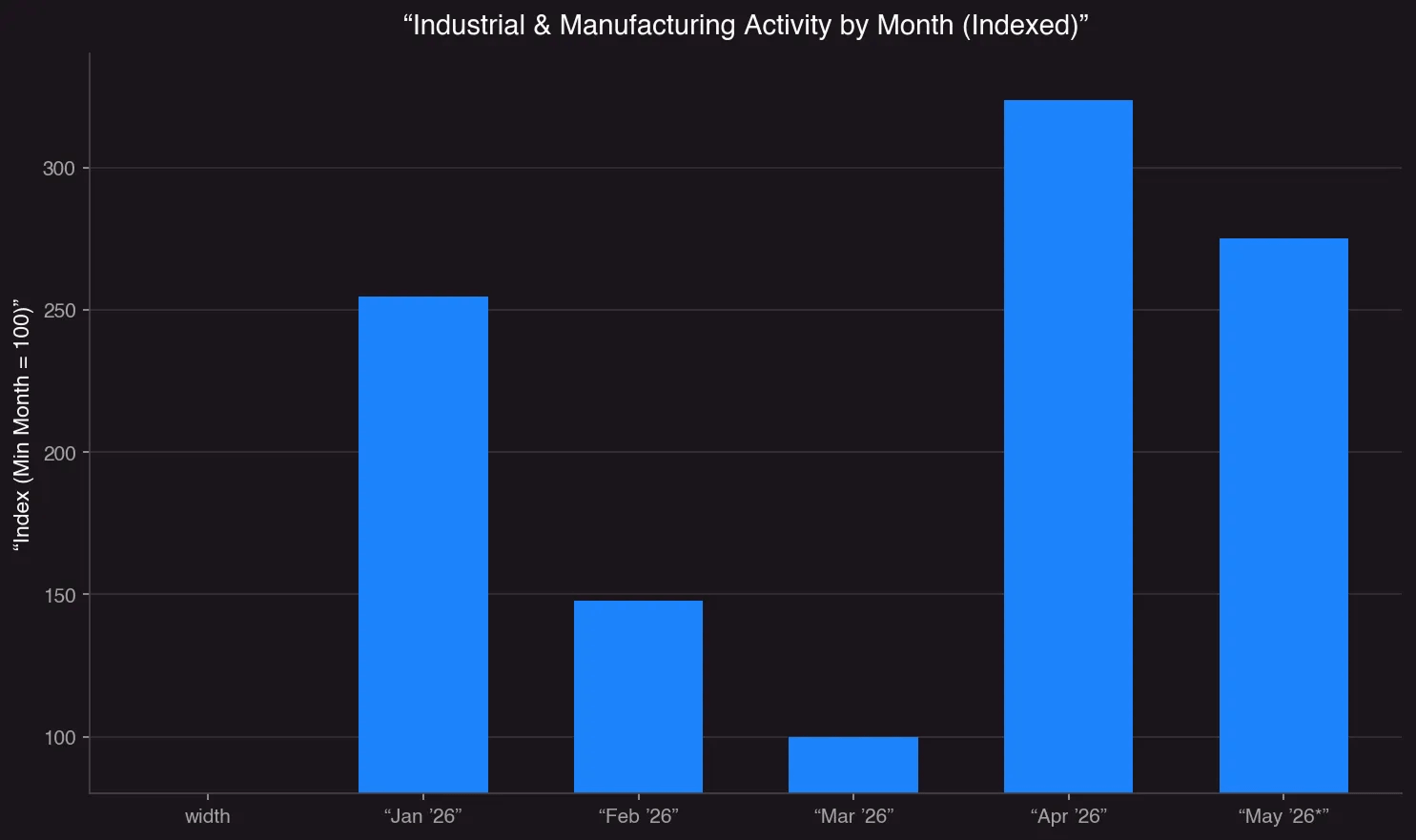
Total verified threat activity by month (Indexed)
Industrial and manufacturing activity eased through the first quarter, falling by roughly 42% from January to February and another 32% from February to March, before reversing sharply in April. April activity rose by about 224% compared to March, marking the clearest surge in the dataset. May is projected to remain elevated, tracking about 15% below April but still approximately 175% above March, indicating that threat pressure has cooled from the April peak but has not returned to the earlier baseline.
This pattern suggests that April was not an isolated anomaly. Even after normalizing May from partial-month activity, the vertical continues to show sustained pressure. The current May projection indicates that attacker interest remains elevated, though the composition of activity matters more than volume alone.
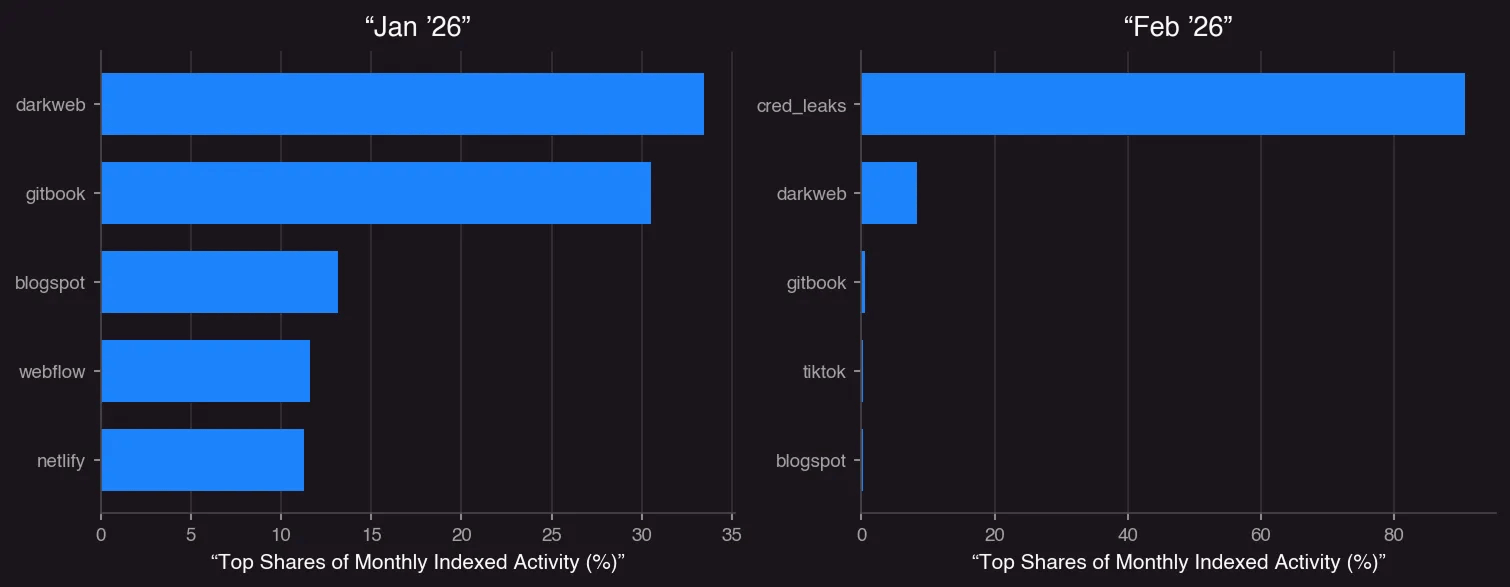
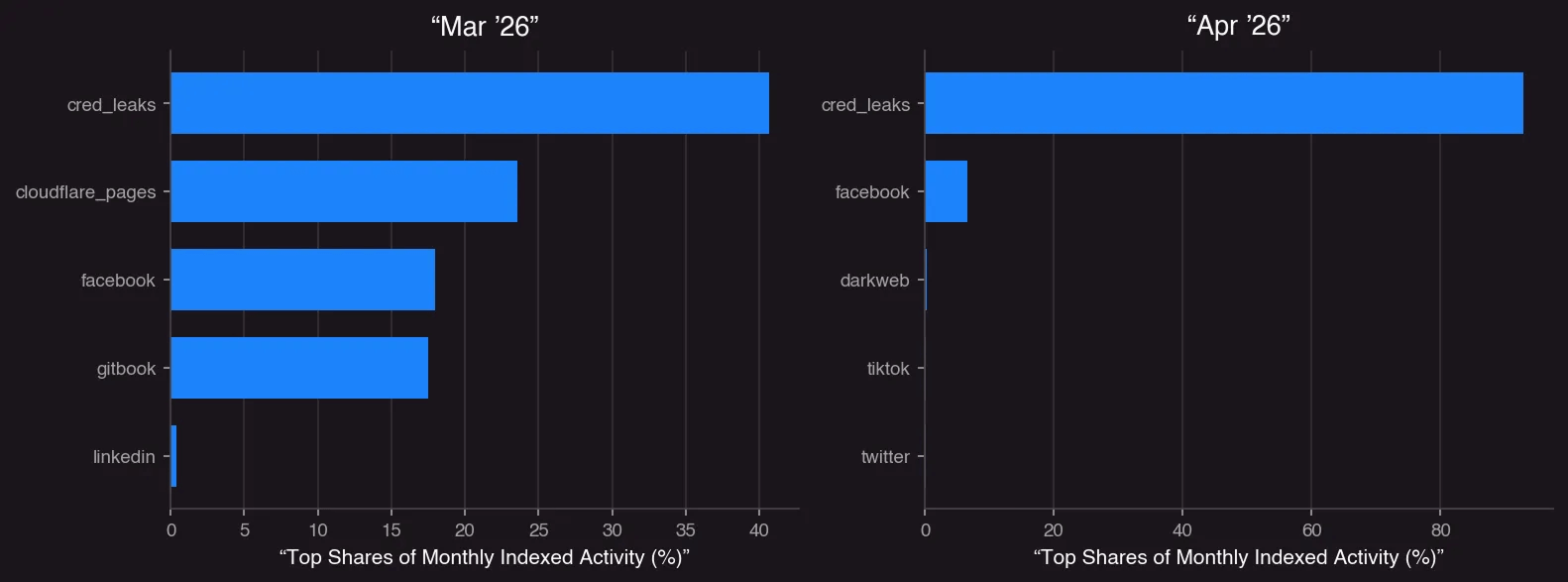
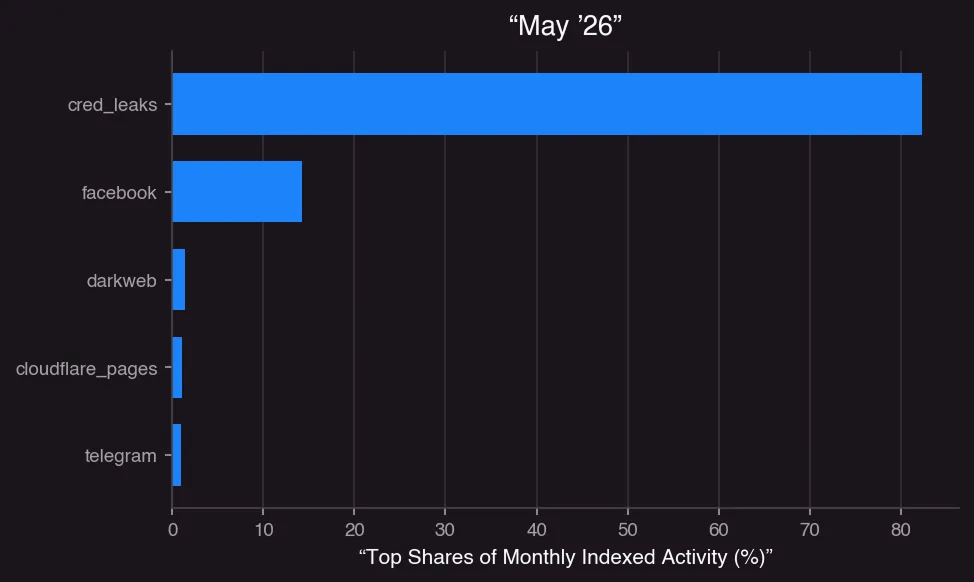
The source mix shows a clear pivot toward credential exposure as the dominant driver of observed threat activity.
Top Sources of threat activity
In January, threat activity was more distributed across dark web sources and free or low-friction hosting platforms. Gitbook, Blogspot, Webflow, and Netlify all appeared among the top sources, suggesting attackers used trusted hosting environments to create lightweight impersonation or phishing infrastructure.
February marked a major shift. Credential leaks accounted for more than 90% of top-source activity, overwhelming all other surfaces. This points to a threat model where exposed accounts and leaked identity material are the primary signals of risk.
March saw a more diverse mix of threat sources. Credential leaks remained the largest category, but Cloudflare Pages, Facebook, and Gitbook became more visible. This suggests a broader blend of identity exposure, hosted infrastructure abuse, and social engineering. The presence of Cloudflare Pages and Gitbook is notable because these platforms can help attackers stand up credible pages quickly while benefiting from trusted platform reputation.
April showed the sharpest concentration in credential leaks, accounting for 92.84% of top-source activity. Facebook also remained visible, indicating that social engineering and brand impersonation continued alongside credential exposure.
May remains heavily credential-driven. Credential leaks on the dark web account for 85.46% of activity, while brand impersonation on Facebook rises to 14.21%. This suggests that manufacturing targeting is not just an access problem, but also a brand and social engineering problem. Attackers may use leaked credentials, fake pages, and impersonation together to support fraud, account takeover, vendor abuse, or follow-on intrusion.
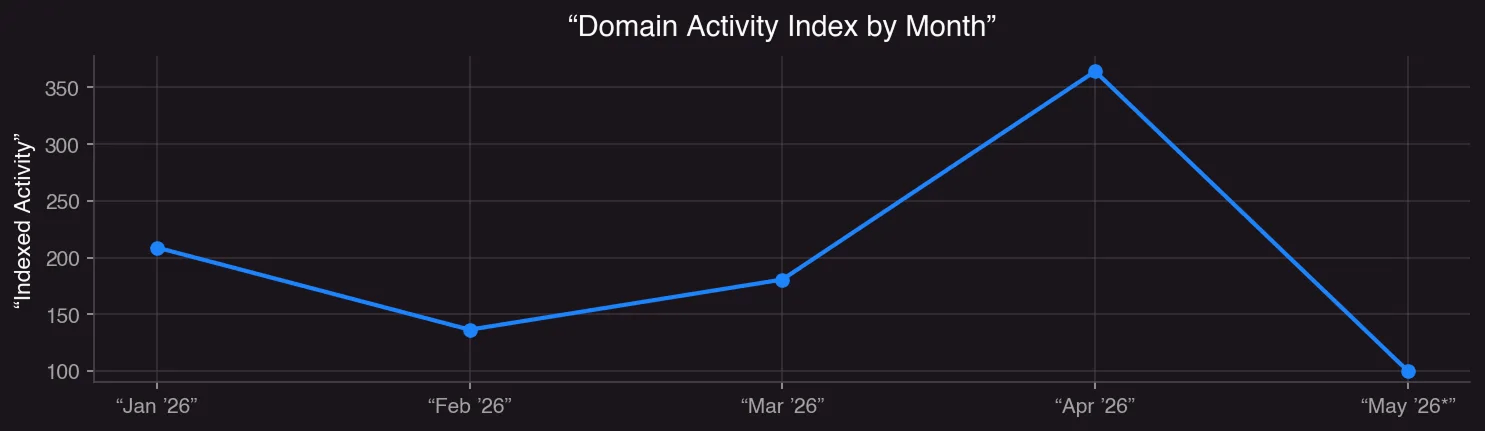
Domain activity follows a different pattern than total threat activity. It peaked in April, then dropped sharply in May.
Domain threat activity by Month
The divergence between total threat activity and domain threat activity is important. Overall activity remains elevated in May, but confirmed malicious domain activity is projected to be the lowest point in the dataset. This indicates that the current threat pressure is not primarily domain-led.
Instead, the broader threat activity appears to be driven by identity exposure, social channels, dark web sources, and platform-hosted infrastructure. Domains remain important because they often serve as conversion infrastructure, but they are not the only or dominant signal in this reporting period.
For manufacturing organizations, this means defenders should avoid treating domain monitoring as the full measure of external risk. Credential leaks, supplier impersonation, fake social profiles, hosted pages, and dark web activity may provide earlier indicators of attacker preparation or campaign development.
The most consistent finding in the broader dataset is the concentration of activity in credential leak sources. Credential leaks dominated February, April, and May, and remained the top source in March.
This matters because leaked credentials can support several manufacturing-specific risk paths:
For manufacturers, this risk is amplified by distributed plants, legacy access patterns, shared third-party workflows, and a large population of vendors and contractors that may not be governed consistently.
Doppel observed a massive spike in mid-April. The week of April 13 generated a 47x increase in dark web alerts from the prior week.
This pattern is consistent with a major credential dump, breach-related exposure, or concentrated dark web release. Even when the spike is tied to one week, it is still important for the vertical-level report because it shows how quickly manufacturing and industrial exposure can concentrate around a single high-volume event.
The dataset shows repeated use of free or trusted hosting platforms, including Gitbook, Webflow, Blogspot, Netlify, and Cloudflare Pages. These platforms are attractive to attackers because they are easy to deploy, inexpensive, trusted by users, and resilient to quick replacement.
For manufacturing brands, hosted platform abuse may appear as:
This is an actionable trend because defenders can build repeatable detection, reporting, and takedown workflows around platform abuse patterns rather than treating each page as an isolated event.
Facebook appears as a meaningful source in March, April, and May, with May showing Facebook at 12.01% of top-source activity. This suggests that attackers continue to use social platforms to reach customers, employees, partners, and job seekers.
For manufacturing brands, Facebook impersonation can support fake customer support, fake hiring, fake dealership or distributor pages, counterfeit product promotions, and redirection to phishing or payment collection pages. Social channels also allow attackers to establish trust before moving victims to messaging apps, hosted pages, or spoofed domains.
Doppel’s findings also align with broader third-party breach reporting. Black Kite reported that 136 major third-party breaches in 2025 affected 719 named companies and an estimated 26,000 additional downstream victims that were never publicly identified. The report also found that the average third-party breach affected 5.28 downstream victims, the highest level Black Kite has recorded.
This is highly relevant to manufacturing because the sector depends on interconnected suppliers, logistics providers, contract manufacturers, distributors, and field-service partners. A single compromised vendor, shared platform, or high-dependency service provider can create exposure across many downstream organizations.
The Black Kite findings also reinforce the importance of Doppel’s credential leak signal. Black Kite reported that 62% of the most critical vendors had corporate credentials appearing in stealer logs, making identity exposure a key supply chain risk indicator. For manufacturers, leaked vendor or partner credentials can create indirect paths into supplier portals, procurement workflows, remote access systems, and shared business applications.
Credential leaks are the strongest signal in the dataset. Leaked accounts can provide attackers with a lower-friction path into enterprise systems, supplier environments, cloud services, and email accounts.
Impact: Account takeover, supplier portal abuse, business email compromise, fraud, unauthorized access, resulting in sensitive IP and data exposure, and increased risk of downstream intrusion.
Attackers are using trusted hosted platforms to create convincing infrastructure quickly. Gitbook, Webflow, Blogspot, Netlify, and Cloudflare Pages can all be used to host pages that appear legitimate enough to support phishing, impersonation, or fraud.
Impact: Faster campaign deployment, improved victim trust, recurring takedown challenges, and reduced attacker cost.
Facebook and other social platforms remain important distribution and engagement channels. Attackers can impersonate manufacturers, distributors, recruiters, support teams, or executives to build trust and redirect victims into malicious workflows.
Impact: Partner fraud, fake hiring scams, and credential theft resulting in customer harm and reputational damage.
Dark web activity remains a recurring signal, especially in January and during the mid-April spike. These findings may include leaked credentials, exposed sensitive data, access listings, or actor discussions related to manufacturers and their brands.
Impact: Increased risk of account takeover, targeted phishing, access brokering, extortion, and follow-on compromise.
Manufacturing risk often extends beyond the manufacturer itself. Suppliers, distributors, logistics partners, contract manufacturers, and field-service providers can all become indirect paths into the organization or vehicles for impersonation.
Impact: Supplier fraud, invoice redirection, unauthorized access, business disruption, and loss of trust across the partner ecosystem.
The dataset suggests a shift from infrastructure-first threat activity toward identity-first threat activity.
In January, threat activity was more evenly distributed across dark web sources and hosting platforms. By February, credential leaks became the dominant source. March introduced a more mixed pattern, combining credential leaks on the dark web, Cloudflare Pages, Facebook, and Gitbook. April and May returned to a credential-heavy pattern, with Facebook remaining a meaningful secondary source.
This progression shows that attackers are not relying on a single channel. Instead, they appear to be combining exposed credentials, trusted hosting platforms, social channels, and dark web activity to support broader campaign workflows.
A likely attack flow is:
This matters for manufacturing because operational disruption does not always begin inside OT. It can begin with business identity, supplier access, email compromise, or third-party impersonation that later creates production, logistics, financial, or reputational impact.
Manufacturing threat pressure is increasingly shaped by identity exposure, external infrastructure abuse, and attacker interest in operational leverage.
The most important finding in this dataset is the dominance of credential leak activity. While domains and hosted infrastructure remain important, the broader field of view shows that attackers are likely using exposed credentials and dark web data as core inputs for fraud, impersonation, and access enablement.
May is projected to remain elevated, even though confirmed malicious domain activity is lower than in prior months. This suggests that the current risk is not primarily domain-led. It is identity-led and ecosystem-driven.
For manufacturing organizations, the defensive priority should be broader than brand takedown alone. Effective disruption requires connecting credential exposure, dark web signals, social impersonation, hosted platform abuse, supplier risk, and domain infrastructure into a single external threat view.
One platform. Complete threat visibility.
Modern attacks don't start and stop in one place — they unfold across channels, infrastructure, and people. Doppel unifies this approach to detect, disrupt, and prevent threats across channels before they scale, while strengthening human risk management through insights that help employees recognize and respond to real-world threats.
Channels in Scope:
| Channel | Description |
|---|---|
| Domains | Doppel Vision continuously monitors domain registrations, SSL certificates, website content, phishing kits, and visual signals (OCR) to detect malicious domains in real time. Once identified, threats are automatically triaged and taken down with high confidence. 24/7 global support ensures rapid response and consistent coverage across all channels. |
| Social Media | Doppel Vision uses AI, native platform integrations, and OCR to continuously scan social media for fake accounts, impersonators, and malicious content. Automated enforcement and strong platform relationships enable fast, scalable takedowns. |
| Paid Ads | Doppel Vision monitors paid advertising channels—including Google, Meta, TikTok, and others—for impersonation, fraud, and brand abuse. By analyzing ad creatives, accounts, and landing pages, Doppel detects and disrupts malicious campaigns that siphon revenue, mislead customers, or damage brand trust. |
| Doppel Vision uses honeypots and automated phishing inboxes to detect phishing campaigns before they reach employees. This early visibility helps prevent credential theft, account takeover, and brand abuse. | |
| Applications | Doppel Vision monitors the Apple App Store, Google Play, APK sites, and third-party marketplaces to identify fake mobile apps, malicious APKs, and browser extensions. Through native integrations, detected threats are quickly taken down to protect users and preserve trust in your brand. |
| Telecom/Vishing/Smishing | When scam calls or texts are reported, Doppel Vision turns those signals into action. Reports are validated and escalated directly to telecom providers to disrupt and take down fraudulent campaigns, protecting your customers and brand reputation. |
| E-commerce | Doppel Vision automatically detects and removes counterfeit listings across global e-commerce marketplaces. Continuous monitoring helps protect revenue, maintain brand integrity, and reduce customer exposure to fraudulent products. |
| Crypto/NFT | Doppel Vision detects and removes scam tokens and NFTs impersonating your brand across centralized and decentralized ecosystems. Malicious wallet-enabled sites are reported to major wallet providers (e.g. MetaMask, Phantom, Coinbase Wallet) to block access within minutes, limiting user exposure and fraud. |
| Dark Web | Doppel Vision monitors the dark web for PII Exposure, credential dumps, and data leaks associated with your organization. Early detection enables proactive response, reducing the risk of downstream fraud and account compromise. |
| Code Repositories | Doppel Vision scans public and private code repositories for exposed secrets, API keys, credentials, and sensitive data. Combining LLMs with security expertise, it helps identify and remediate developer-introduced risks before they can be exploited. |
Doppel protects individuals and brands from AI-powered impersonation, phishing, fraud, and social engineering by dismantling attacker infrastructure and building resilience through training and simulation.
Doppel's comprehensive Digital Risk Protection solution detects threats across multiple channels, links alerts into a real-time threat graph, and offers AI-driven infrastructure disruption. These threats inform phishing simulation campaigns and security awareness training to offer robust Human Risk Management capabilities that strengthen employee defenses through next-generation training and testing.
Doppel's mission is to protect the world from social engineering attacks every day. Founded in 2022, Doppel is an AI-native platform designed for social engineering defense.
Median Takedown Time Domains, Social Media, Paid Ads
<10h
Faster takedowns on emerging threat vectors than our competitors.
Indicators Analyzed Daily
+1B
Faster takedowns on emerging threat vectors than our competitors.
Trusted Customers
200+







Prepared by Doppel SECR - Social Engineering Counterintelligence & Research