
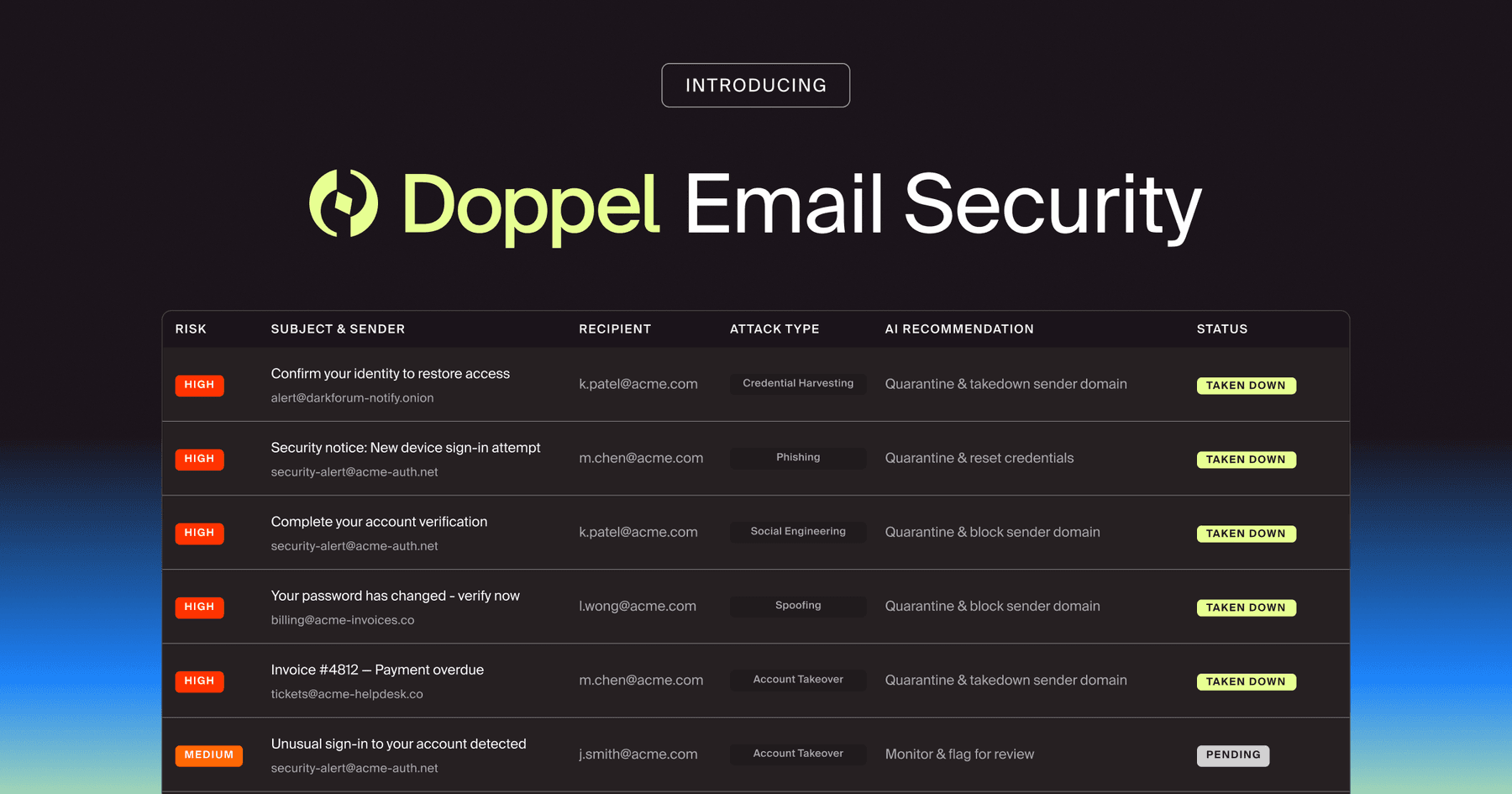
Doppel Email Security is now generally available
The agentic email security solution that empowers you to fight back against social engineering attacks. Detection isn't enough. Disruption is the difference.
Whaling in cybersecurity targets executives with AI-powered, multi-channel phishing. Learn how these attacks unfold and which defenses actually stop them.

by Doppel Team
Whaling is phishing aimed at one named executive, customized to their role, their relationships, and the way they actually communicate. Where standard phishing chases volume, whaling concentrates weeks of reconnaissance and impersonation work on a single decision-maker whose authority makes the payoff worth the effort. Voice cloning, deepfake video, and AI-generated lures have lowered the cost of running these campaigns and raised their fidelity, with reported losses from emergency-style executive scams reaching $2.77 billion (opens in new tab) in 2024.
The attacks move across channels by design. A wire-transfer email lands in finance, a voice call from a cloned CFO confirms the details, a Teams message from a fake colleague applies pressure, and a signing page on a lookalike domain closes the loop. Defending against any one of those touchpoints in isolation leaves the rest of the campaign intact.
This article covers what whaling is, how a modern campaign unfolds across five stages, why traditional anti-phishing tools miss it, and what executive protection requires when attackers operate across the full social engineering attack chain.
Whaling is a targeted phishing attack aimed at a single, high-authority individual, always a senior executive, with every element of the lure customized to their role, relationships, and recent activity.
Where standard phishing is a volume game, whaling is a precision game. Attackers invest in reconnaissance, impersonation infrastructure, and multi-channel delivery to extract money, credentials, or access from one specific person whose role makes the payoff worth weeks of preparation. Lures reference real information, such as vendors, deals in flight, travel schedules, and the cadence of how the executive actually communicates.
Whaling sits inside a family of related techniques. It's the high-value subset of spear phishing which targets specific individuals, not necessarily senior ones, and is often the most damaging form of business email compromise (BEC), the broader category of fraud that impersonates or compromises corporate email accounts. All whaling is spear phishing, much of it shows up as BEC, but only attacks aimed at senior executives rise to whaling, and that distinction matters because whaling demands defenses tuned to the executive's specific exposure.
Executives are the highest-value phishing targets in any organization. They sit at the intersection of authority, access, and visibility, and each of those attributes is exploitable on its own. Together, they make whaling the highest-ROI play in the social engineering attack playbook.
Executives approve wire transfers, override controls, and direct financial transactions, often without the multi-party verification required of lower-level employees. A request from the CFO to expedite a vendor payment carries more weight than a junior accountant's request, and finance teams act on that authority quickly.
An executive's account carries entitlements across financial systems, HR platforms, board portals, and sensitive document stores. Where compromising a junior employee gives an attacker a foothold that requires weeks of lateral movement, compromising an executive delivers target data, signing authority, or financial access in a single step.
Executives are public figures by job description. Their LinkedIn profiles, earnings calls, press releases, podcast appearances, and conference recordings give attackers the raw material for deep reconnaissance without ever touching the corporate network. That public exposure feeds two parallel attack patterns: the executive as victim, lured into clicking, signing, or handing over credentials, and the executive as vector, where attackers hijack or impersonate their identity so instructions to finance teams, assistants, or vendors carry the authority of the real person.
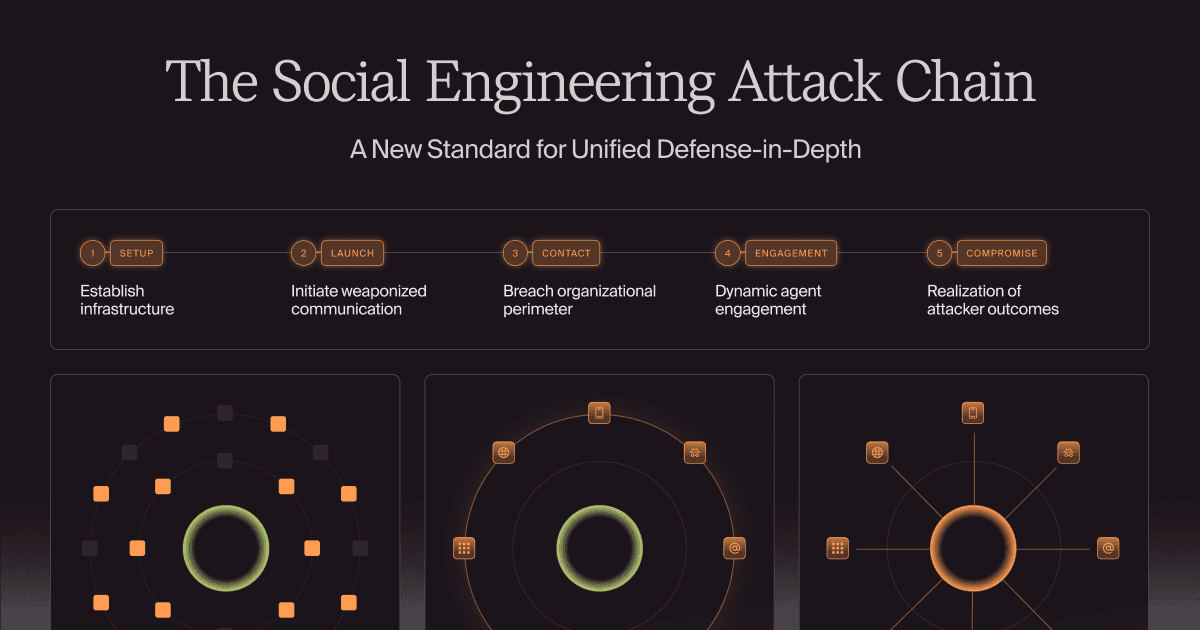
Whaling unfolds as a multi-stage campaign that maps onto the broader social engineering attack chain: setup, launch, contact, engagement, and compromise. Each stage feeds the next, and by the time the executive or their team encounters the lure, the attacker has spent weeks building the infrastructure behind it.
In setup, the attacker assembles the targeting package and impersonation infrastructure that the rest of the campaign will run on. Reconnaissance starts in public sources. LinkedIn profiles reveal reporting structures and vendor relationships. SEC filings and earnings call transcripts expose personnel involved in financial operations. Conference recordings and podcast appearances do double duty: they reveal communication style for pretext construction and provide the audio attackers use to clone the executive's voice from short samples.
Reconnaissance also extends underground, where attackers purchase executive PII and credentials from data broker databases and dark web marketplaces. That intel feeds infrastructure construction. Agentic AI lets attackers spin up high-fidelity assets at speed: lookalike domains registered with valid SPF and DKIM records so messages pass authentication checks, fake LinkedIn profiles that duplicate the executive's connections, and real-time voice replicas capable of holding dynamic conversations.
What this looks like: spoofed executive domains, synthetic voice models, deepfake video personas, and fraudulent social profiles built around the executive and the people closest to them.
With the infrastructure in place, the attacker turns it on. Launch is the moment weaponized communication moves outward across whichever channels the executive and their team actually use, with each touchpoint coordinated to reinforce the others. Attackers commonly pair email and vishing for initial outreach, and the channel mix has expanded as enterprises have adopted new collaboration tools.
What this looks like: spoofed-domain emails to finance and legal teams, SMS lures impersonating the executive, voice calls driven by cloned audio, paid social ads, and LinkedIn DMs from fake colleagues.
Contact is the moment the lure clears the perimeter and surfaces inside the executive's working environment. The phishing email lands in the inbox, the vishing call rings through, or the Teams message pops up from what appears to be a trusted colleague. The campaign has become something the target now has to act on.
The contact point is also the stage at which targets most often catch attackers. Skepticism at contact is the most common reason whaling attempts collapse, which is why modern campaigns push past it.
What this looks like: a wire-transfer request sitting in a CFO's inbox, an urgent SMS that appears to come from the CEO mid-travel, or a Teams ping to an executive's assistant.
Engagement is where modern whaling diverges from older phishing attacks. Once the target has the lure in front of them, the attacker shifts from broadcasting a static message to running a live, adaptive exchange. Real-time voice clones, conversational AI, deepfake video, and synchronized cross-channel touchpoints push the target past initial doubt and toward the action the attacker wants taken.
The Arup attack (opens in new tab) is the textbook example. A video conference populated with AI-generated colleagues, including a synthetic CFO, overcame the employee's email-stage skepticism. By the time the call was underway, the verification channel the employee would normally use to double-check the request had become the channel that sold them on it.
What this looks like: deepfake video calls with multiple synthetic participants, voice-cloned phone confirmations, real-time chat that mirrors the executive's tone, and live coaching toward spoofed signing pages or MFA intercept flows.
Compromise is the moment the attacker's objective lands. The target initiates the wire, enters credentials into a spoofed portal, or hands over a session token.
Outcomes extend well beyond a single fraudulent payment. Attackers pursue credential theft and persistent access alongside money movement. After the breach, they often create inbox rules that suppress security alerts and extend dwell time, allowing additional fraud or data exfiltration to run before anyone notices.
What this looks like: wire transfers routed to attacker-controlled accounts, harvested credentials, exfiltrated corporate data, and inbox rules that bury the evidence.
Whaling slips past the traditional security defenses because the lure is targeted, the infrastructure is convincing, and the channel mix outruns any single-tool defense.
Vendors built secure email gateways to detect bulk, payload-bearing attacks through signature matching and reputation scoring. Whaling attacks often carry no malicious payload to inspect: a BEC message impersonating an executive may contain a wire transfer instruction in plain text, with no malware and no suspicious link. When the attack originates from a compromised legitimate account, every authentication signal looks valid, including clean domain reputation and passing DMARC, SPF, and DKIM.
Evidence on annual security awareness training is mixed, whereas ongoing, continuous training more consistently lowers phishing click rates. The problem compounds at the executive level, where training participation often varies, and executives receive different formats than other employees. The result is a gap: the employees most likely to be targeted in a whaling attack are often the least prepared for it.
Whaling campaigns span LinkedIn, voice, Teams, and email because attackers coordinate lures across channels. An email gateway doesn't see the LinkedIn message, the vishing call, or the Teams ping that precedes or accompanies the whaling email. Defense has to cover the entire campaign, or most of the attack will remain untouched.
Executive protection against whaling means operating across the full campaign lifecycle. Each phase opens a different intervention window, and skipping any stages leaves the attacker enough room to land the campaign. In practice, that lifecycle work breaks down into two intentional actions.
Every data broker listing, every leaked credential, and every indexed personal detail is raw material for the next whaling campaign. Systematic PII removal, dark web credential monitoring, and proactive data minimization reduce what attackers find and weaponize. The work extends to family members, because attacker reconnaissance often starts with easier-to-find family data and works inward toward the executive.
Detection without enforcement leaves the attacker in place. Lookalike domains, fake social profiles, cloned voice content, and spoofed ads have to come down across social media, messaging apps, dark web forums, domain registrars, social platforms, ad networks, and telcos. The shift is toward an integrated system that automatically initiates dismantlement everywhere at once, while the infrastructure is still being assembled and before the lure reaches its target.
Executing on that lifecycle model in practice is what Doppel was built for. Doppel is an AI-native Social Engineering Defense (SED) platform that unifies Digital Risk Protection (DRP) and Human Risk Management (HRM) and powers its Executive Protection product, mapping each capability to the lifecycle stages a whaling campaign moves through.
On the DRP side, continuous PII removal runs across hundreds of data broker sites with automated takedown requests, and coverage extends to family members by default, closing the family reconnaissance vector that feeds so many whaling pretexts. Dark web and credential monitoring surfaces leaked executive data before attackers weaponize it, while deepfake detection identifies synthetic voice, image, or video content tied to named leaders. Doppel's agentic AI correlates, prioritizes, and executes takedowns at scale, leaving analysts to handle complex escalations.
That external dismantlement work then feeds directly into the HRM side. When Doppel takes down a lookalike domain or cloned voice asset targeting a named executive, that signal flows into the same platform that drives internal phishing simulations and targeted training, so the people most exposed to a real campaign rehearse against pretexts modeled on it. Doppel Threat Graph connects the discrete signals, from fake profiles to lookalike domains to simulation results, into a single campaign view, so coordinated action disrupts the connected campaign and raises the attacker's cost of rebuilding.
ARK Invest, whose high-profile leadership prompted hundreds of phone calls and emails every year from people who had spotted a fake account or fallen for a scam, reported strong takedown outcomes and rapid domain resolution with Doppel.
Whaling campaigns are accelerating in sophistication, fueled by voice cloning tools that work from short audio samples, deepfake-as-a-service platforms proliferating on the dark web, and AI that generates convincing lures at near-zero cost. The most exposed executives are those whose digital footprint nobody actively manages.
The strategic shift for security leaders is clear: dismantle the infrastructure attackers use to reach your executives before the request lands. When every impersonation domain, fake profile, and cloned asset comes down faster than attackers can rebuild them, the cost of targeting your leadership exceeds the return.
Request a demo to learn more about how Doppel unifies Digital Risk Protection and Human Risk Management to stop whaling.

BLOG
Modern social engineering is a relentless, AI-orchestrated lifecycle. Learn how to map the five-stage attack chain—from setup to contact—and why a unified defense platform is the only way to outpace AI-driven social engineering attacks.



by Bobby Ford, Rahul Madduluri, and Alvin Lin