Pretexting is the trust-building layer behind nearly every modern social engineering attack, and probably the one your security stack is least equipped to see. While firewalls, spam filters, and MFA inspect packets and credentials, they never inspect the fabricated context that convinces an employee to hand them over.
Instead of writing exploit code or breaking through MFA, an attacker only has to convince an employee or a vendor that they are someone the target already trusts. Once the target believes the story, they hand over credentials, approve a wire, or share sensitive documents on their own.
This guide covers what pretexting is, why attackers rely on it, how a pretexting attack unfolds, who attackers target, why legacy defenses fail, and how to build a defense that matches the threat.
Key Takeaways
- Pretexting is a fabricated identity or scenario that attackers use to earn trust before the real payload (phishing, Business Email Compromise (BEC), helpdesk manipulation, deepfake fraud) ever runs.
- Attackers invest in pretexts because the alternatives, brute-forcing credentials or exploiting technical controls, have become slower, noisier, and more expensive than convincing a person to open the door.
- Attackers tailor pretexts to three target groups: executives, internal teams, and external vendors and partners.
- Stopping pretexting requires dismantling the attacker infrastructure behind it by mapping role-specific pretexts, monitoring attacker infrastructure across channels, correlating signals into campaigns, executing coordinated takedowns, and training employees against the lures actually in circulation.
What Is Pretexting?
Pretexting is a social engineering technique in which an attacker invents a false identity, role, or scenario to manipulate a target into taking an action they would not otherwise take.
The fabricated context, the "pretext," makes the request feel legitimate to the recipient. Every downstream attack type, from phishing to business email compromise or helpdesk manipulation, relies on a pretext to clear the path.
Pretexting vs. Phishing
Phishing delivers a malicious link, a credential-harvesting page, or a weaponized attachment in a social engineering attack. Pretexting creates the trust conditions that make the delivery of that malicious link, page, or attachment succeed.
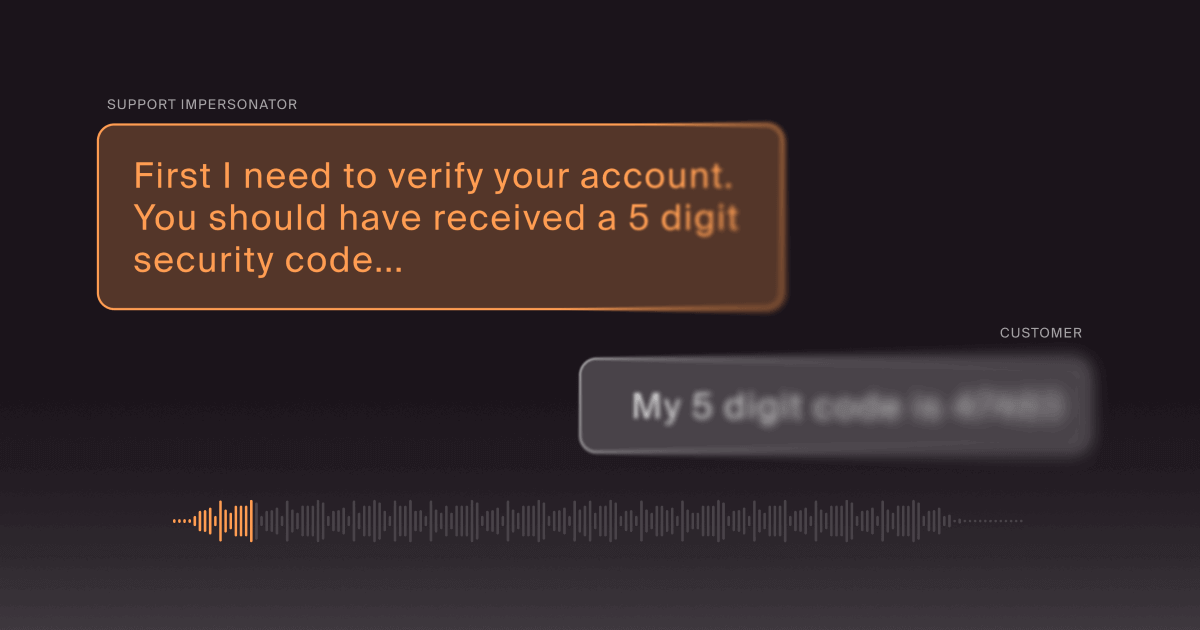
Recipients ignore a phishing email from a stranger, but they'll click the same email when it arrives as a follow-up to a phone call from "IT support" that references a real internal system and a real maintenance window. The pretext is what turns a suspicious cold contact into a trusted communication.
What Makes a Pretext Convincing
Pretext quality tracks directly with reconnaissance quality. Attackers harvest employee names, titles, reporting structures, internal tools and vendors, project timelines, and scheduled events to construct their scenarios. AI tools now scan and scrape the web for company information, building employee profiles that make lures more convincing. Voice clones require only a small amount of recorded audio, making any executive with a public-speaking appearance a viable target for impersonation.
Why Attackers Rely on Pretexting
Pretexting is the staging layer that makes social engineering attacks easier to execute.
1. Pretexts Slip Past Technical Controls
A well-constructed pretext produces an authenticated session, an approved wire, or a reset MFA token. None of those events trigger malware signatures, anomaly detection, or perimeter controls, because a real user with real credentials performs the actions, and the workflow looks routine.
2. AI Has Made It Cheaper to Create Pretexts
The reconnaissance work for building a profile that used to take weeks now takes minutes. Public profiles, recorded keynotes, job postings, and SEC filings give attackers more raw material than they can use, and generative AI assembles that material into convincing voice clones, written messages, and video personas at near-zero marginal cost.
3. Multi-Channel Pretexts Exploit Uneven Skepticism
Email, voice, SMS, chat, social platforms, and collaboration tools all carry pretexts. A target who treats email with skepticism may extend full trust to a chat message or a phone call. Attackers reinforce the same story across channels the target trusts most, so each touchpoint validates the last.
How a Pretexting Attack Unfolds
Pretexting unfolds in a staged lifecycle, from reconnaissance to payload execution, once the attacker establishes trust.
Reconnaissance Builds the Story
Attackers profile targets using AI-augmented reconnaissance across every public source available. LinkedIn surfaces reporting structures and job functions, earnings calls and conference recordings supply voice samples, and job postings expose the internal technology stack.
Partnership announcements and SEC filings round out the picture with project timelines and vendor relationships. Each data point becomes raw material for a scenario tailored to a specific person, role, and moment.
The Pretext Goes Live Across Channels
That reconnaissance feeds the lookalike domains, spoofed caller IDs, cloned social profiles, and fake login pages that attackers build to impersonate trusted identities.
The dominant 2024 campaign pattern combined spam bombing (opens in new tab) (flooding an inbox to manufacture a "problem") with a follow-up vishing call from "IT support" offering to fix it. Attackers also route conversations through collaboration platforms, banking on the implicit trust employees place in messages that appear to come from within the company.
Execution Runs on Earned Trust
Once the attacker establishes trust, they move fast. Threat actors can move from initial access to domain administrator in minutes using only built-in tools and social pretexts. Yet security teams still took an average of 254 days (opens in new tab) to identify and contain phishing-initiated breaches in 2025. With no malware to register as abnormal, the intrusion runs through authenticated, apparently legitimate channels.
Who Do Pretexting Attacks Target?
Attackers design pretexts around the trust relationships that already exist in and around an organization. Every pretext exploits the same expectation, that the person on the other end is who they claim to be.
1. Executives
Executives include the C-suite, public-facing leaders, and any senior employee with the authority to override a normal approval workflow.
Attackers target them because keynotes, earnings calls, and press footage put their voices and faces in public view as ideal raw material for deepfake calls (opens in new tab) and voice clones, and because their authority compresses the verification step on the receiving end. Business email compromise scams built on executive pretexts caused $2.77 billion (opens in new tab) in reported losses in 2024.
2. Internal Teams
Internal teams include IT and helpdesk staff, finance and accounts payable, HR, payroll, and shared-service agents.
Attackers target them because they sit on the workflows attackers actually want, including credential and MFA resets, wire approvals, vendor onboarding, and direct-deposit changes. Attackers can go so far as to chain rapport-building conversations across multiple internal help desks to reroute paychecks without touching a single technical system. A single successful interaction can translate into either authenticated access or a fraudulent payment, leaving no malware signal for the security team to chase.
3. Vendors and Third-Party Partners
Pretexting targets vendors and third-party partners, including MSPs, outsourced help desks, contractors, and any external providers with privileged access to the company's environment.
Attackers target them because they often have the same access as an internal employee, but with weaker identity verification, fewer monitoring controls, and less exposure to the customer's security training. Breaches then arrive through a trusted partner, indistinguishable from legitimate traffic.
Why Legacy Solutions Can't Stop Pretexting
Pretexting attacks succeed against organizations with mature security programs because the architects of those programs never designed the controls to evaluate trust.
Authentication and Trust Operate on Different Signals
A firewall evaluates packet headers, and an MFA system evaluates whether the user presented the correct credentials. Neither evaluates whether the request reflects a genuine business need or a fabricated scenario.
When an attacker calls a helpdesk, convincingly impersonates an employee, and talks the agent into resetting MFA, the authentication system records a clean pass, and the deception slips past every downstream technical control.
Static Training Fails Under Pressure
People overlook security cues under cognitive workload, because security is almost always the secondary task.
Companies deliver annual training as a low-pressure compliance module. However, pretexting attacks execute under real-time pressure with competing demands, and behavioral responses learned in the first context do not reliably transfer to the second. Generic training that treats all employees identically also fails to address the specific pretexts each role actually faces.
Legacy DRP Misses the Full Campaign
Traditional digital risk protection tools flag individual lookalike domains, fake profiles, or spoofed numbers as isolated alerts.
Pretexting campaigns operate as a coordinated infrastructure. The setup of a single attacker can typically span dozens of domains, social profiles, and phone numbers coordinated against the same target. Taking down one asset leaves the rest of the campaign intact, and the attacker simply rotates to the next prepared lure.
How to Defend Against Pretexting
Defending against pretexting requires treating the attacker's staging layer as the surface to protect, alongside the payload itself.
Map the Pretexts That Target Your Roles
Inventory the trust relationships attackers can exploit, including helpdesk reset workflows, vendor access, finance approval chains, payroll changes, and executive impersonation surfaces. For each, document the pretexts security teams have observed in the wild and the channels through which they arrive.
Monitor for Attacker Infrastructure Across Channels
Lookalike domains, cloned social profiles, spoofed caller IDs, and fake apps are the visible artifacts attackers leave as they prepare a pretexting campaign. Continuous monitoring across registrars, social platforms, telcos, app stores, and ad networks is the only way to spot a campaign before it goes live.
Correlate Signals Into Full Campaigns
A single domain takedown does not stop a campaign. Correlate domains, profiles, ads, and messages by the infrastructure, language, and targeting patterns they share, and treat the campaign as the unit of response.
Execute Takedowns at the Source
Coordinated takedowns across registrars, hosting providers, social platforms, telcos, and ad networks strip the attacker's working assets faster than they can rebuild them. The economics shift when rebuilding costs more than the next attack returns.
Train Employees Against the Pretexts They Will Actually See
Replace generic annual modules with role-specific simulations drawn from live campaigns. A helpdesk agent should train against the helpdesk pretexts in circulation this quarter. A finance approver should train against the executive impersonation pretexts hitting their industry. Repetition under realistic conditions is what carries behavior into the moment of attack.
How Doppel Stops Pretexting at the Source
Doppel is an AI-native Social Engineering Defense platform that brings Digital Risk Protection and Human Risk Management together into a single intelligence layer. It delivers the five steps above as a single connected workflow to stop pretexting at the source.
The Doppel Threat Graph correlates spoofed domains, fake profiles, scam ads, and malicious messaging into full attacker campaigns rather than isolated signals, then executes takedowns across registrars, social platforms, telcos, and ad networks simultaneously to neutralize the campaign at the source. When the Threat Graph identifies a live campaign targeting a brand, security teams can convert the same lures and landing pages into role-specific employee simulations with one click through threat-to-simulation conversion, across email, voice, SMS, chat, and collaboration tools.
Doppel's agentic AI prioritizes and executes takedowns at scale, so analysts can focus on the complex escalations that require human judgment. The teams that outpace pretexting will be the ones that stop treating it as an awareness problem and start treating it as an infrastructure problem. The attackers crossed that line years ago.
Request a demo to see how Doppel detects and dismantles the attacker infrastructure behind pretexting campaigns.
Frequently Asked Questions About Pretexting
What Is Pretexting?
Pretexting is a form of social engineering in which someone fabricates an identity, role, or backstory to convince another person to share information, grant access, or carry out an action they normally wouldn't. The invented context, the "pretext," gives the request its credibility.
What Is Pretexting in Cybersecurity?
In a cybersecurity context, pretexting is the practice of using a fabricated scenario to manipulate employees, contractors, or customers into taking actions that compromise security, such as resetting credentials, approving a payment, sharing sensitive data, or installing software.
What Is an Example of Pretexting?
A common example involves an attacker calling a company's IT helpdesk while posing as a locked-out employee. The caller knows the employee's name, manager, department, and the company's internal tools, all of which were gathered from LinkedIn and public sources. Because every detail checks out, the helpdesk agent resets the password and MFA, handing the attacker authenticated access to the employee's accounts.
What Is the Difference Between Pretexting and Phishing?
Phishing is the delivery mechanism, typically a fraudulent email, text, or web page designed to capture credentials, install malware, or trick the recipient into clicking something harmful. Pretexting is the storyline that makes that delivery believable. A random phishing email tends to fail, but the same message arriving after a phone call from someone posing as an internal IT technician is far more likely to succeed.