
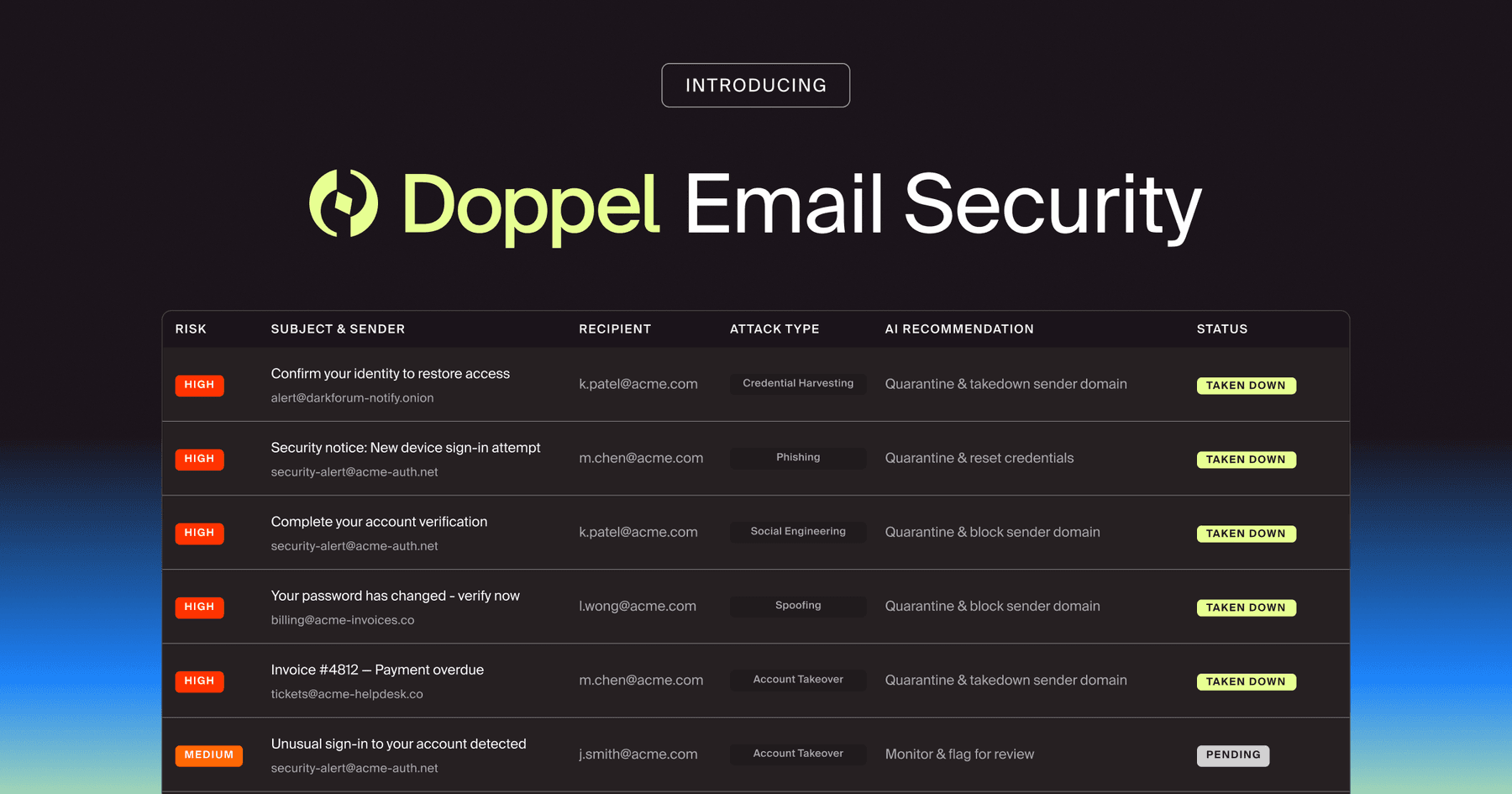
Doppel Email Security is now generally available
The agentic email security solution that empowers you to fight back against social engineering attacks. Detection isn't enough. Disruption is the difference.
Brand attacks don’t arrive in neat, isolated alerts. They show up as lookalike domains, spoofed social profiles, fake support numbers, fraudulent ads, cloned login pages, and phishing lures that borrow a trusted name to steal money and customer trust. By the time many teams recognize the pattern, the campaign has already spread across channels.
The right tools help security, fraud, and brand protection teams detect external attacker infrastructure early, connect related assets into campaigns, and respond before isolated incidents turn into larger fraud problems. For teams focused on human risk management, those same signals can also power more realistic simulations that test how analysts, investigators, and cross-functional responders perform under pressure.
Cyber threat tools help security, fraud, and brand protection teams identify and respond to external threats targeting a company’s name and customers. In the context of brand attacks, this includes monitoring suspicious domains, phishing infrastructure, impersonation websites, fake social accounts, scam support flows, malicious ads, and other attacker-controlled assets tied to fraud.
For teams focused on human risk management, these tools do more than improve visibility; they provide realistic inputs for attack simulation. Instead of relying on abstract awareness exercises, teams can model the same tactics and channels that attackers are using right now, making red teaming more relevant, investigations more accurate, and response workflows easier to pressure-test and improve.
In the brand attack context, cyber threat tools are the technologies and workflows teams use to detect, investigate, and disrupt external impersonation and fraud before they escalate into customer harm, fraud loss, or reputational damage, which means looking beyond internal telemetry and into the attacker's infrastructure operating across public channels.
These tools are not limited to traditional threat feeds or malware analysis. For brand-facing risk, they need to surface indicators tied to impersonation and deception. That includes domain registrations that mimic a company name, fraudulent login pages, fake customer support numbers, scam social accounts, malicious SMS campaigns, and paid ads designed to reroute victims into attacker funnels.
When teams evaluate cyber threat tools for this use case, the real question is simple. Can the tool help them understand how an external campaign is built, where it is spreading, and how quickly they can disrupt it?
Traditional security tools are often not enough because most are built to monitor internal environments, not customer-facing abuse on the public internet. Traditional tools may be very good at endpoint detection, email filtering, SIEM correlation, or access control, but are usually far less effective at catching a fake promo site, a spoofed executive account on social media, or a cloned support portal targeting customers.
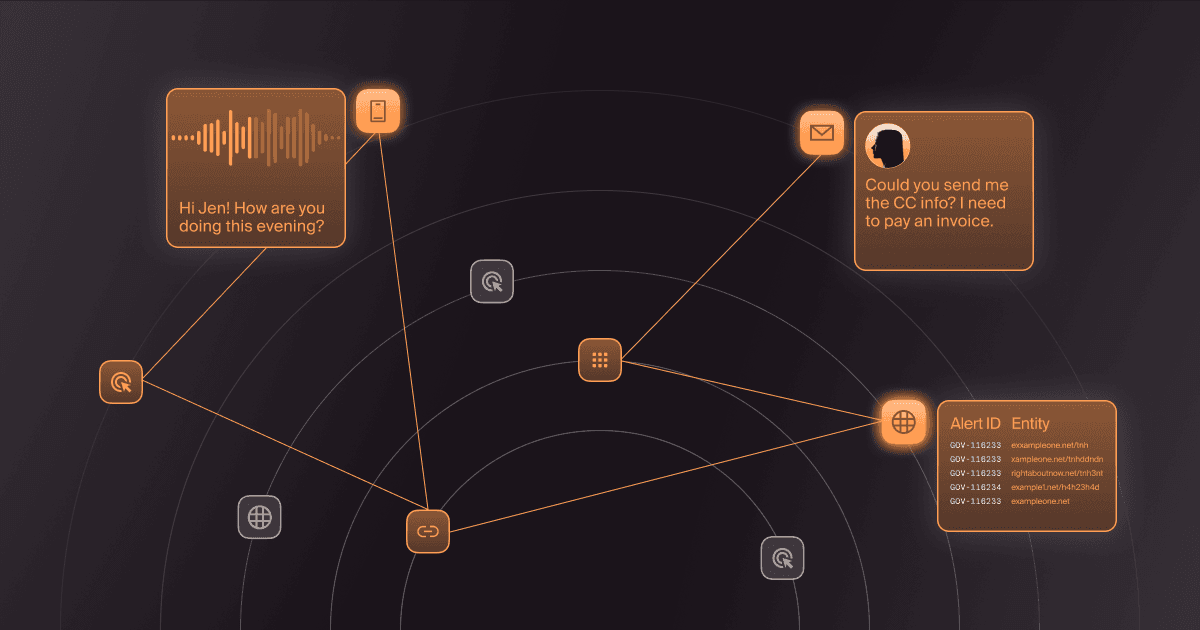
That gap is relevant to modern fraud campaigns, which don’t stay within a single channel. An attacker may register lookalike domains, launch social media impersonation, run search or social ads, spin up messaging accounts, and route victims to a callback scam or a credential-harvesting flow. Each piece may look small on its own. Together, they form a campaign.
When tools can’t connect the dots, defenders are forced to react to isolated artifacts rather than coordinated campaigns. Analysts, fraud investigators, support teams, and trust leaders need enough context to decide what matters, what is connected, and what action should happen next.
Cyber threat tools support real-time brand attack simulation by giving teams current attacker behaviors to model against detection and response workflows. That shifts an exercise away from generic phishing awareness, and toward the messy, multi-channel conditions defenders actually face during impersonation and fraud campaigns.
A realistic simulation shouldn’t ask whether someone can identify an obvious phishing email in isolation, but test whether teams can spot and investigate a multi-channel impersonation campaign while the details are still messy. That may include conflicting indicators, incomplete evidence, customer pressure, and the need to coordinate across functions.
The first test is whether defenders recognize that an external campaign is taking shape. Strong cyber threat tools surface early indicators such as suspicious domains, cloned brand content, newly created impersonation profiles, fake support flows, and malicious brand terms appearing in search or paid ads.
Those signals can become realistic red team inputs. Instead of inventing a scenario from scratch, teams can simulate what happens when analysts receive ambiguous but credible warning signs tied to their brand.
The second test is whether teams can investigate fast enough to understand scope and intent, which means connecting domains, pages, accounts, messaging lures, and other infrastructure that belong to the same campaign.
The investigation phase is where many programs break down. Teams may identify a single page but fail to map the broader infrastructure that supports it. In a simulation, that weakness shows up quickly. Defenders either broaden the picture or stay trapped in a single artifact at a time.
The third test is whether the organization can act quickly and coordinate to reduce harm. That includes:
If the exercise ends when someone spots the threat, it is not much of a test. Real-world brand defense depends on how the organization responds under pressure after detection.
Teams should look for capabilities that help them detect coordinated abuse, connect related infrastructure, and support fast operational response. Useful signals, campaign context, and actionability are the goals.
The tool should show what attackers are doing outside your perimeter, including suspicious domains, impersonation sites, fake social profiles, scam content, malicious ads, and other public-facing abuse tied to your brand.
The tool should help teams understand related assets, not just single URLs. Fraud campaigns are resilient because attackers rotate domains, accounts, and content quickly. If your team only sees one object at a time, it will always be behind.
The tool should help defenders determine which threats are noise and which are likely to produce customer impact. Not every mention of a brand is malicious. Not every suspicious page is active fraud. Teams need prioritization that reflects risk, not just volume.
The tool should support action. That includes evidence collection, case management, takedown workflows, escalation support, and enough campaign context for different teams to make decisions without redoing the same investigation.
Cyber threat tools matter for human risk management because brand attacks are often won or lost in the gap between signal and action. The tooling matters, but so do the people who validate a threat, widen an investigation, escalate the case, coordinate with adjacent teams, and decide how quickly the organization responds.
A program can document playbooks and escalation paths on paper. A threat-informed exercise shows whether those processes actually hold up when defenders face incomplete information, conflicting signals, and pressure to move quickly.
Human risk in this context isn’t limited to employees clicking on bad links; it includes analysts missing escalation cues, support teams failing to recognize impersonation patterns, investigators focusing too narrowly, and decision-makers waiting too long to act. Those are the kinds of gaps that realistic simulations expose.
In practice, this is where tools that support brand protection go beyond mere monitoring systems. They become inputs for testing detection, response, and coordination under realistic conditions.
Teams should use these tools to build simulations around real attacker tradecraft. The more the exercise reflects the way external campaigns actually unfold, the more useful the outcome will be.
Use recent attacker behaviors as the basis for the exercise. For example, a lookalike domain cluster, a fake support scam, a fraudulent ad flow, or a social impersonation campaign. Start with something plausible enough that defenders can’t dismiss it as training theater.
External monitoring and digital risk protection workflows can strengthen the scenario. The exercise should be an extension of real operational work, not a disconnected training event.
Brand attacks rarely belong to one team. Security may spot the signal, fraud may understand the abuse pattern, legal may support enforcement, and customer-facing teams may deal with the fallout. A strong exercise tests how those groups share context and move together.
Fast response matters, but bad escalation isn’t a win. Teams should assess whether defenders correctly assessed severity, widened the investigation when needed, and took action to reduce customer exposure. The lesson is whether the team made good decisions with imperfect information.
High-maturity programs treat cyber threat tools as part of an operating system for brand defense, not a passive monitoring layer. They don’t stop at detection. They build workflows for campaign analysis, infrastructure mapping, prioritization, takedowns, and feedback loops to improve future responses.
They also understand that the human layer is part of the control surface. A threat feed by itself doesn’t stop fraud. A dashboard doesn’t escalate itself. A detection without context can create confusion just as easily as it can create urgency.
Mature teams often connect external threat visibility with simulation-driven testing. They use current signals to challenge assumptions, validate playbooks, and expose the places where response still depends too much on tribal knowledge or manual heroics.
High-maturity programs connect external threat visibility with simulation-driven testing. They use live attacker behaviors to challenge assumptions, validate response workflows, and expose where outcomes still depend too much on manual heroics or tribal knowledge. That is where platforms like Doppel become especially relevant. Doppel’s Brand Protection capabilities help teams identify and connect impersonation infrastructure across channels, while Doppel Simulation helps organizations test how people and processes respond to realistic social engineering pressure.
Teams should start by asking whether their current cyber threat tools reflect how brand attacks actually unfold across public channels. If the answer is no, they are probably detecting the wrong signals and rehearsing the wrong response scenarios.
The next step is to connect external threat visibility with investigation workflows and realistic human-centered testing. When teams can see how attacker infrastructure is built, they can simulate those attacks more accurately. When they can simulate those attacks more accurately, they can find the operational gaps that matter before attackers exploit them.
Doppel helps organizations identify external impersonation threats, connect related infrastructure into campaigns, and pressure-test how defenders respond through more realistic simulations. Explore Doppel Brand Protection and Doppel Simulation to see how that approach supports faster, smarter responses.