

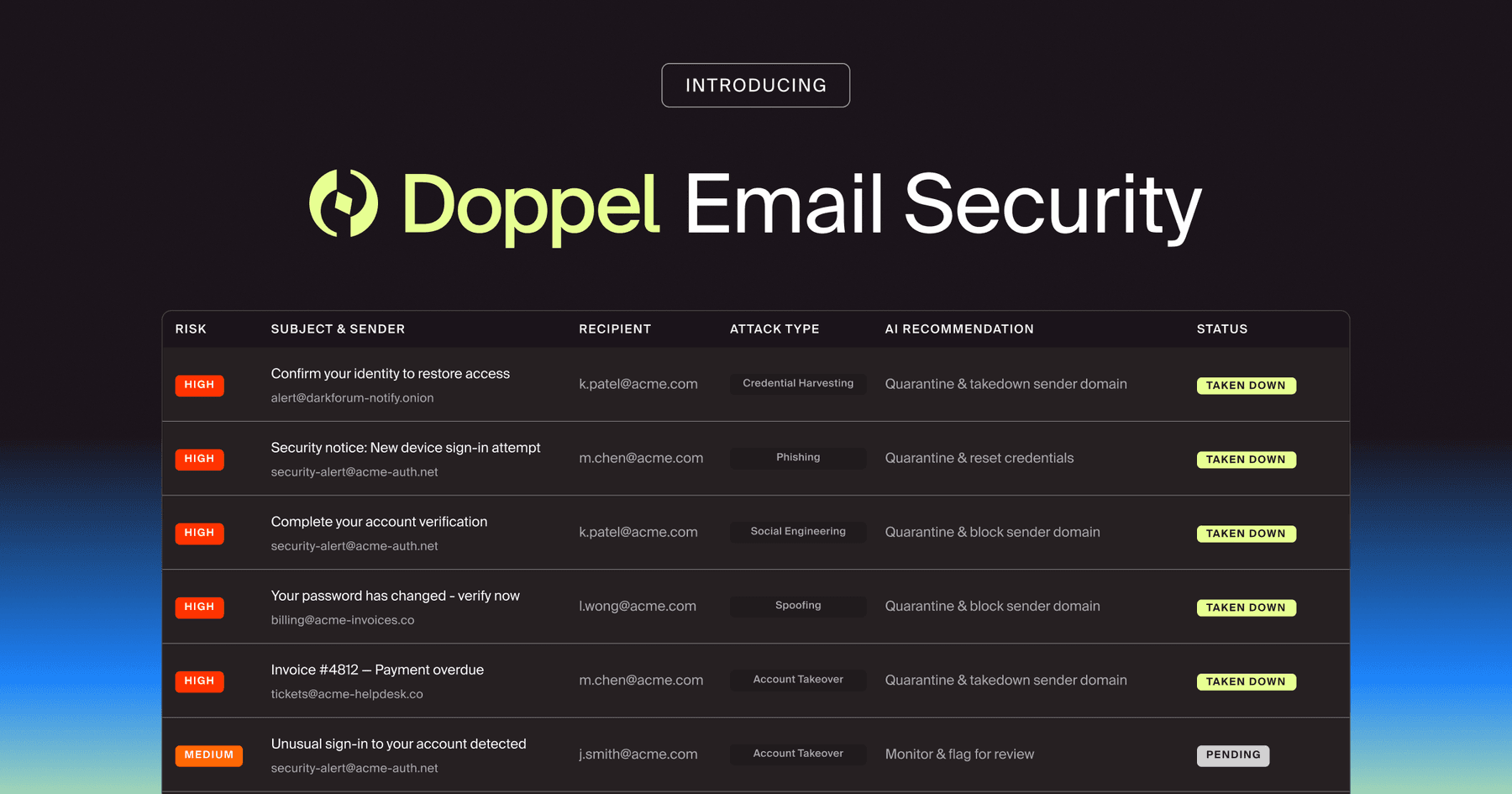
Doppel Email Security is now generally available
The agentic email security solution that empowers you to fight back against social engineering attacks. Detection isn't enough. Disruption is the difference.
See how red team exercises expose human workflow gaps that basic simulations miss across channels, teams, and brand touchpoints.
Security teams have gotten better at testing technical controls. Human-layer testing still lags behind. Many organizations run phishing exercises, log completion rates, and assume they've meaningfully measured risk. They haven't. Attackers do not operate in neat program boundaries, and they do not care whether a company labels something awareness, fraud prevention, brand protection, or incident response.
That gap matters more now because social engineering is more operational, more multichannel, and more convincing than most programs are built to handle. A fake email may be the start, not the whole attack. The real compromise may happen when an employee moves from inbox to a collaboration platform, from text to phone, or from an internal process to an external site that looks close enough to a trusted brand to win cooperation. For organizations focused on brand protection and threat monitoring, that is the point. The human layer breaks down where pressure, trust, and workflow collide.
Red team exercises help organizations understand how real attacks move through people, processes, and systems. For the human layer, that means testing more than whether someone clicked a link. It means evaluating how employees respond to urgency, impersonation, channel switching, approval requests, customer-facing scams, and breakdowns in escalation paths.
Most programs miss that broader picture. They treat human risk as a training metric instead of an operational problem. A stronger approach uses realistic, multichannel testing to expose where decisions fail, where handoffs collapse, and where attackers can exploit trust in the brand or the business process itself.
Red team exercises are authorized adversarial simulations designed to test how well an organization detects, resists, and responds to realistic attack behavior. In traditional security programs, which can include technical controls, access paths, lateral movement, and incident response playbooks. In a human risk management context, the focus is narrower and more practical. It is about testing how people, workflows, and escalation paths hold up when attacks look credible, urgent, and tied to normal business activity.
That distinction matters. A human-layer red team exercise is not just a harder phishing test, nor is it necessarily a full-spectrum technical red team engagement. It is a structured way to evaluate how employees, contractors, support teams, executives, and other stakeholders respond when attackers imitate trusted identities, exploit process gaps, or manipulate normal workflows.
A meaningful exercise may involve email, SMS, collaboration tools, voice, fake portals, spoofed domains, or impersonated social accounts. It should test whether staff verify requests appropriately, escalate quickly, recognize suspicious context shifts, and help the organization connect scattered signals into a coherent response.
Most programs miss the human layer because they reduce it to a narrow awareness outcome. They ask whether a user clicked, reported, or passed a module. That may produce useful data, but it does not reflect how social engineering actually works.
Real attacks are rarely single-touch events. They create familiarity over time. They exploit job function, hierarchy, timing, and trust. They also exploit the fact that different teams own different parts of the risk. Security may own phishing. Fraud may own customer scams. Brand teams may monitor impersonation. Support teams may be the first to see the signs of abuse. No one owns the entire human attack path.
That fragmentation creates blind spots. A program may score well on phishing reporting rates while still missing impersonation-driven payment fraud, employee credential capture through fake login pages, or customer scam campaigns that damage brand trust. When organizations test one channel at a time, they often miss the workflow failures that happen between channels.
Social-engineering-only tests are not enough because they isolate a single tactic rather than testing the full path to compromise. Attackers do not think in program categories. They think in sequences.
A phishing email may be followed by a phone call that references the message. A fake executive request may move from email to text. A fraudulent support interaction may direct an employee or customer to a spoofed login page, a fake support number, or an impersonated brand asset that appears credible enough to bypass suspicion. Each step reinforces the next.
Basic simulations also tend to test user suspicion in a vacuum. Real risk often emerges from competing priorities. People are busy. They are working across too many tools. They are responding to leaders, customers, partners, and vendors. Under those conditions, even well-trained employees can make bad decisions if workflows are unclear or escalation routes are slow.
That is why effective social engineering defense cannot stop at awareness content or single-channel simulation. It has to account for how attacks gain credibility across touchpoints and how operational friction increases exposure.
Human-layer red teaming should test whether the organization can recognize and interrupt realistic attack behavior before it becomes an incident. That means going beyond click rates and examining the full set of decisions surrounding trust, urgency, and escalation.
Attackers often move between channels because each new touchpoint adds legitimacy. An email that seems questionable may feel more real when followed by a Teams message or a phone call. Exercises should test whether teams notice that shift and whether internal reporting mechanisms keep pace.
Different employees face different kinds of manipulation. Finance teams may face payment urgency. HR may face document requests. Support teams may face account reset scams. Executives may face impersonation built around personal authority. Red team exercises should reflect those realities instead of sending everyone the same bait.
The real question is often not whether someone recognized an attack. It's whether the business process gave them a safe and fast way to respond. If escalation is confusing, if ownership is unclear, or if reporting feels too slow, attackers gain room to operate.
For many organizations, the human layer includes external abuse. Customers, partners, applicants, and prospects can all be targeted through brand impersonation. Testing internal teams without accounting for external impersonation leaves a major part of the attack surface unmeasured. That is why impersonation monitoring, infrastructure mapping, reporting, and enforcement belong in the same risk conversation as simulations and awareness.
Red team exercises expose workflow gaps by showing where people hesitate, misroute, over-trust, or fail to coordinate. Those failures are often invisible in standard awareness reporting.
An employee may recognize that a message feels off but still comply because the request appears tied to an active project. A support agent may spot suspicious behavior but lack a clear playbook for escalation. A fraud analyst may identify a spoofed domain while the brand team has not yet mapped related infrastructure. A security team may respond to one artifact without realizing the same campaign is already hitting customers through another channel.
Those are not awareness failures alone. They are coordination failures. They show where the organization lacks shared visibility and where an attacker can exploit process seams. Human risk management is stronger when exercises are designed to intentionally reveal those seams.
That is also why data from vibe phishing simulations should be treated as one signal, not the whole picture. If the exercise only measures user response to one message, it cannot tell leadership how attacks move through broader business operations.
Teams should measure success based on whether the organization reduced attack opportunities, improved response speed, and clarified ownership. Click data may be part of that picture, but it is nowhere near enough.
Useful measures include report rate, time to report, time to triage, escalation accuracy, cross-team coordination, detection of related attacker infrastructure, and the ability to identify impersonation patterns across channels. Teams should also assess whether the exercise triggered the appropriate operational response. Did the right team act? Did they act quickly? Did they contain the problem at the source, or only react to one symptom?
For mature programs, another important metric is repeatable improvement. After an exercise, can the organization redesign workflows, tighten approval paths, improve identity verification, and strengthen playbooks to reduce future exposure? If not, the exercise may generate activity without generating resilience.
This is where attack simulation testing becomes more valuable than one-off training events. The purpose is not to embarrass employees. It is to surface the real conditions that allow manipulation to succeed.
A strong program looks operational, current, and aligned with how attackers are actually targeting the organization. It does not separate human risk from brand abuse, fraud pressure, or external impersonation activity.
Exercises should mirror the campaigns the organization is likely to face. That includes executive impersonation, payment fraud setup, fake support outreach, credential harvesting, hiring scams, and customer-facing impersonation tied to the brand.
Internal employees are not the only human targets that matter. Customers and partners are often attacked through fake domains, social profiles, support numbers, and impersonated communications. Programs that ignore those threats are evaluating only part of the human layer.
The output should not be a slide about who clicked. It should be a set of decisions about process improvement, escalation logic, detection priorities, and enforcement actions. If the exercise shows that attackers rely on fake domains or spoofed identities, the response should include faster takedown and infrastructure investigation, not just refresher training.
Doppel fits where human-layer testing meets the real-world risk of impersonation. Many organizations already know how to run awareness campaigns. The harder problem is understanding how attacks actually manifest around the brand and how they pressure human decision-making across teams and channels.
That is where a modern program needs more than a narrow simulation mindset. It needs multi-channel testing, visibility into impersonation activity, and a way to connect scattered attack signals to operational response. Doppel helps organizations close that gap by combining human risk management (HRM) with vibe phishing simulations and security awareness training, and digital risk protection, so teams can test realistic attack paths and act on what they uncover.
Red team exercises are most useful when they reflect how attacks really unfold. That means less checkbox testing and more pressure-testing of the decisions, channels, and workflows attackers exploit every day.
If your program still treats human risk as a training metric, it is probably missing where real exposure lives. Doppel helps teams test realistic attack behavior, uncover workflow gaps, track impersonation activity, and strengthen defenses across the channels attackers actually use.