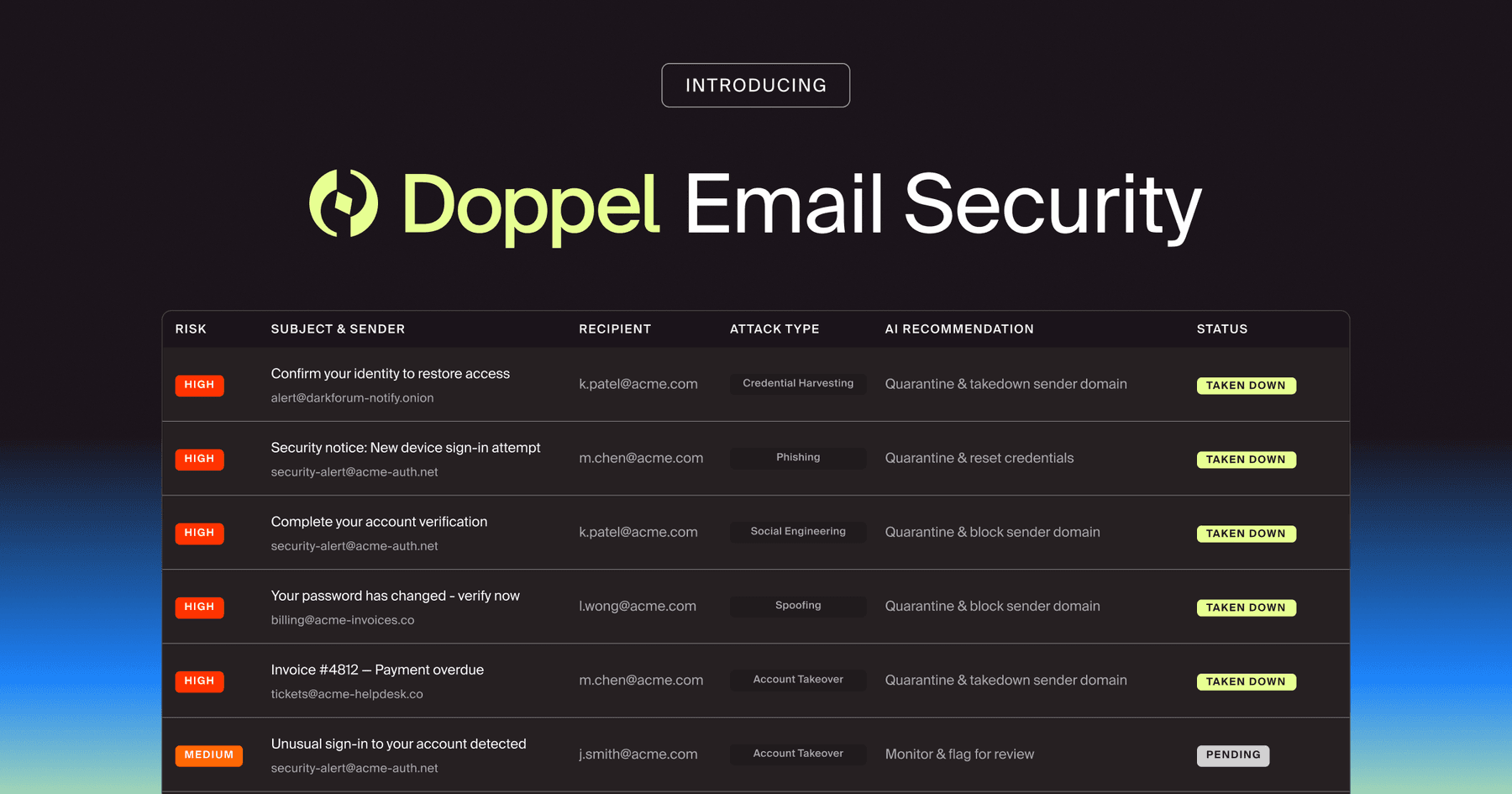
Doppel Email Security is now generally available
The agentic email security solution that empowers you to fight back against social engineering attacks. Detection isn't enough. Disruption is the difference.
Brand fraud rarely presents as a single, clean incident. It shows up as a mess. A fake domain that looks good enough to fool a rushed customer. A cloned support page with a phone number that does not belong to your team. A paid ad that hijacks your brand name and routes victims into a fake verification flow that ends with a drained bank account. Then, the complaints start trickling in, and by the time the pattern is obvious, the attacker has already rotated infrastructure and moved on to the next variant.
That’s the part most teams hate, because brand fraud is designed to waste time in practice. It scatters evidence across channels. It creates just enough ambiguity to slow takedowns. It forces internal handoffs between security, fraud, legal, support, and brand teams, and every handoff is an opportunity to lose context and momentum.
A brand fraud investigation has to be more than “we found a fake domain.” The point is to uncover the method: How is the attacker acquiring victims? How are they building trust? Where is the conversion happening? What infrastructure is reused across assets? When you can answer those questions quickly, remediation stops being a reactive cleanup exercise and becomes a source of disruption. You can remove the right things in the right order, and you can reduce the odds that the same campaign pops back up next week with a new domain and the same scam script.
This is where effective brand protection programs separate signal from noise. They monitor for abuse across the channels where fraud appears, connect related assets into campaign views, and move from detection to takedown quickly with evidence that holds up when it matters.
This article outlines how we approach brand fraud investigations when the incident is actually a tangled campaign. It walks through how to confirm what you’re looking at, trace the victim path end-to-end, and connect related assets so remediation is based on evidence rather than guesswork. You’ll see what evidence actually drives takedowns, why removing a single domain rarely finishes the job, and how to measure success by response time and repeat suppression rather than raw takedown counts. It also covers where programs usually stall, especially during cross-team handoffs, and how to build a repeatable workflow that keeps attackers from relaunching the same scam with a fresh URL and the same script.
Brand fraud, often driven by brand impersonation, is any attempt to misuse your brand to steal money, credentials, access, or trust. Investigation matters when you suspect it’s not a one-off asset. It’s a repeatable playbook that can be redeployed with small edits, new infrastructure, and the same underlying script.
In practice, brand fraud includes everything from fake support portals and billing scams to spoofed executive outreach and counterfeit storefronts. What makes it investigation-worthy is not the asset type, but the operational pattern behind it. If the same lure appears across channels or the same infrastructure supports multiple assets, you are not dealing with a nuisance. You are looking at an organized fraud operation that will keep taking swings until it’s disrupted.
Signals that it’s investigation-worthy:
The goal is to identify attacker methods and supporting infrastructure so you can prioritize actions that reduce harm quickly.
Finding is easier than finishing, and most teams are structurally set up to find because traditional digital risk protection (DRP) approaches emphasize discovery over remediation. They have monitoring. They have alerts. They have a shared inbox with screenshots. What they often lack is an end-to-end workflow that turns findings into decisions and decisions into takedowns.
A single domain can be many different things. That’s where teams get trapped. They treat the domain as the whole story when it might be just the doorway to a larger flow.
A fake domain can be:
If you treat every domain like the same problem, you’ll most likely remediate slowly and measure success poorly. Investigation is the part that answers what the domain is doing, what it is connected to, and what to remove first to break the attacker’s economics.
Start by capturing the minimum facts that prevent you from chasing ghosts, then use those facts to reconstruct the full victim path safely. Messy alerts are normal. Brand fraud usually enters through the edges of your organization, including customer complaints, a sales rep receiving an unusual email, or an executive assistant flagging a suspicious message.
The minimum facts that matter:
Then reproduce the path safely. Many investigations fail because the team may not see the full flow. They see a screenshot of step one, and they may assume they understand step five. Attackers build these flows to feel credible at each step. You need to see the transitions. Redirect chains. “Call now” handoffs. Fake chat scripts. Fake ticket numbers. That’s where the method becomes obvious.
Look for reuse. Attackers love reuse because it can scale fast. They don’t want to reinvent the scam for every target. They want to swap logos, rotate domains, and run the same playbook across multiple brands.
Fast campaign indicators:
If you can connect two assets with credible evidence, treat it as a campaign. That changes how you remediate. You stop removing symptoms and start dismantling the system that generates them.
Build guardrails into the workflow, and treat investigation as evidence handling, not as web browsing. The irony is that brand fraud investigation often becomes riskier as teams become more curious. Curiosity is good. Curiosity without controls is how people end up downloading something they shouldn’t.
Practical guardrails that hold up in real life:
You don’t need to become a malware analyst to do this well. You need a repeatable process that captures what matters, limits exposure, and preserves evidence so remediation can move quickly.
Triage based on harm and leverage. The fastest teams don’t remediate in the order they discovered things. They remediate in the order that stops victim impact and breaks the attacker’s ability to scale.
High-harm targets are those that directly enable theft or compromise. High-leverage targets are those that, when removed, collapse multiple parts of the campaign at once.
High-harm, high-leverage targets often include:
This is also why speed comes from linkage. If you can connect assets into a campaign view, you can prioritize actions that take out the core mechanics instead of just trimming branches.
In practice, speed depends on whether teams can link assets fast enough to act on the cluster, not the alert. When domains, ads, social accounts, and phone numbers are tied to a single campaign record, it becomes easier to prioritize takedowns that collapse the operation rather than trimming one branch at a time. In our platform, we focus on connecting suspicious assets into campaigns so you can act on the cluster, not just the loudest single alert. That’s how you get to takedown quickly without spending a week proving what is already obvious.
Evidence that tells a clear story in one read. If the reviewer has to guess what they’re looking at, you are going to lose time. If your request reads like “trust us,” you will lose time. If your evidence shows clear abuse and clear victim harm, you move faster.
For domains and sites, strong evidence usually includes:
Good evidence also makes your internal alignment easier. Legal sees brand misuse. Security sees credential capture. Fraud sees payment collection. Support sees customer harm. One package can serve all of them, reducing coordination drag.
Remove the enablers, not just the wrapper. A domain takedown helps, but many brand fraud operations are designed to survive it. Attackers expect domains to die. They build campaigns to keep the conversion channel intact.
Remediation beyond the domain typically targets:
This is why we talk about disruption, not cleanup. Cleanup is the process of removing what you can see right now. Disruption increases attacker costs, reduces their ability to scale, and shortens the lifespan of future variants.
That usually falls within a real brand protection program, not as an ad hoc “someone should handle that” responsibility.
Remediation means stopping the victim impact and preventing recurrence. Remediation is not just getting a domain removed. It is reducing the number of people who fall into the trap and the time the trap remains active.
In practical terms, remediation means:
Remediation also includes internal adjustments that reduce victim flow. Sometimes your support team needs a script update. Sometimes your website needs a short advisory about fake support numbers. Sometimes your brand team needs a pinned social post warning customers about a specific lure. The best remediation is internal resilience.
Measure time, scope, and recurrence, not volume. Counting takedowns alone can be misleading because it rewards activity rather than impact. If you took down 40 domains but the call center number stayed live, you didn’t win.
Metrics that map to outcomes:
A strong program should show two trends over time. Faster confirmation and faster takedown. Then, fewer repeats of the same method, or at least faster suppression when the attacker tries again.
Brand fraud workflows often break down at handoff points. The investigation itself is rarely the hardest part. The hardest part is when work must move across teams, and context is lost.
Common breakpoints:
This is where centralizing the view helps. When investigation outputs are connected to remediation actions within a single workflow, it reduces handoffs, eliminates duplication, and makes it easier to determine the next step.
Codify the playbook attackers are using, then automate what you can. Repeatability comes from treating brand fraud like an operational problem, not a series of surprising events.
A repeatable program typically includes:
This is also where it connects naturally to social engineering defense. Brand fraud is persuasion plus infrastructure. If you only address the infrastructure, the persuasion tactics adapt. If you only address the persuasion angle, the infrastructure keeps scaling. You need both.
If your team is spending cycles chasing single assets, a campaign-based workflow helps shorten time to confirmation, speed takedowns, and reduce relaunches. If you want to see how Doppel connects related assets and packages evidence for faster remediation, talk with us about Brand Protection.