Most phishing campaigns are visible long before anyone receives a lure. New lookalike domains appear. A login page is cloned. A certificate is issued for a suspicious host. We watch those moves upstream so customers never have to see the trap. Our monitoring platform detects and scores these threats before phishing kits go live, ensuring faster containment.
Our job is brand protection at the source. Instead of waiting for reports to trickle in, we track the infrastructure attackers rely on. That is how we cut campaigns off early and keep trust intact.
Why This Matters Now
Phishing is no longer a single bad email. It is an assembly line. One kit. Many domains. Rotating hosts. Fresh certificates. The scale is the problem. The speed is the threat. This is where digital risk protection earns its keep. It monitors brand exposure outside the perimeter so you can act upstream. That external lens is how we prevent fraud before it becomes a customer-facing incident.
Attackers Build Infrastructure. Not Just Emails.
Campaigns often start with a handful of domains that look close to the real thing. Think swapped letters, added verbs, or regional variants. The site design is scraped. The login flow is copied. The whole thing can stand up in hours. If you only monitor the inbox, you never see the first half of the movie.
Inbox-Only Defenses Arrive Too Late
User reports help, but they lag reality. By the time a message is flagged, victims may have already entered credentials or card data. External monitoring buys time. We see the buildout, not just the blast. That time window is where takedowns work best.
What External Monitoring Actually Tracks
We focus on signals that reveal preparation and execution. The goal is simple. Catch the setup. Block the launch.
Lookalike Domains and DNS Signals
We monitor newly registered domains, DNS changes, and patterns that mirror brand naming. Homoglyph tricks, such as using “rn” for “m,” are common. So are subdomains that imply support or billing. When clusters appear around a brand or product name, we raise the flag early.
TLS, Hosting, and Kit Fingerprints
Certificates tell a story. So do hosting providers and repeated page assets. Phishing kits reuse code. Fonts, images, and JavaScript are often consistent across campaigns. When those fingerprints line up with a new domain, it is a strong indicator of staging. We score that risk. Then we move fast.
From Signal to Action
Catching the domain is step one. Turning that insight into a result is what matters. The real value comes from linking technical evidence to operational response. Our process turns early indicators, like domain fingerprints and certificate anomalies, into concrete enforcement steps that remove the threat before it reaches users.
Risk Scoring and Prioritization
Noise is real. Not every weird domain is malicious. We combine naming patterns, hosting history, certificate metadata, and page behavior to separate signal from curiosity. High-confidence findings are prioritized for immediate action. Lower-confidence items are watched until they cross a threshold.
Fast Takedowns and Partner Notifications
Once evidence is solid, we act. Abuse notices to registrars and hosting providers. Certificate revocation requests when appropriate. Coordination with brand, legal, and support to deliver consistent messaging. When a customer-facing path is at risk, speed changes outcomes.
For reporting workflows and evidence packaging, see our guidance on online brand impersonation reporting. It explains how we turn signals into takedown-ready submissions and where to place proof for the fastest response.
Beyond Email. Protect the Brand Everywhere
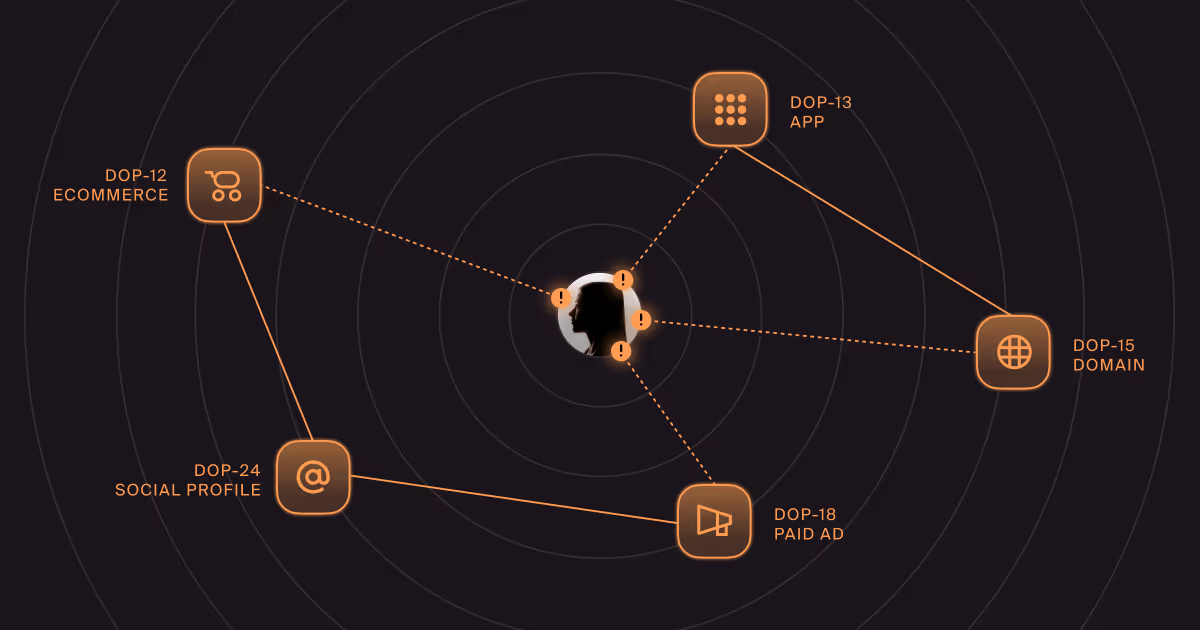
Phishing infrastructure rarely lives alone. The same actors may run fake support accounts, ad campaigns, or storefronts using the very domains we find.
Fake Sites and Support Profiles
Cloned portals and bogus “help” pages drain trust quickly. When we find a convincing clone, we assume there will be social profiles or chat handles attached to it. We hunt those as part of the same case and remove the whole set. Read more about our approach to brand impersonation fraud removal.
Ad Abuse and Counterfeit Storefronts
Paid ads can funnel victims to fake domains at scale. External monitoring surfaces the destination first. That makes ad takedowns faster because enforcement teams can point to the underlying site and not just the creative. The same applies to marketplace listings that route to off-platform checkouts.
Teams that run external digital risk testing spot the destination domains behind ads and listings early, which accelerates enforcement.
Program Design Essentials
Effective monitoring depends on structure and accountability. Clear ownership, defined evidence standards, and repeatable processes turn tools into outcomes. Treat this like an operational program, not a side task. Define who decides, how fast you act, what “enough evidence” means, and how you measure success. Write it down. Run it every week.
1) Ownership and Scope
- Assign a single program owner who is accountable for results. Security usually leads.
- Define a RACI for each step. Security investigates. Legal handles notices. Brand manages public messaging. Support fields customer questions.
- Set the scope up front. Domains. Social handles. Paid ads. Marketplaces. Decide what is in and what is out so you do not debate mid-incident.
2) Intake and Triage
- Create one intake path for all suspected phishing assets. Use a form or queue rather than ad hoc messages.
- Classify items as high, medium, or watchlist based on risk factors. Example. Live credential harvest is high. Parked domain is on the watchlist.
- Enrich new items on intake. Pull DNS, hosting, TLS details, screenshots, and first-seen timestamps automatically.
- Our Brand AbuseBox centralizes evidence, enriches each submission, and turns the abuse inbox into a structured takedown queue.
3) Evidence Standards
- Define the minimum evidence bundle required to unlock action. For example. Domain registration, live page capture, code hash match to a known kit, and hosting metadata.
- Store artifacts consistently. Screenshot of the phishing page. HAR file. HTML source. WHOIS record. Certificate chain.
- Use file-naming conventions with the date, actor cluster, and case ID to speed legal review.
4) Takedown Workflow
- Map the fastest enforcement path for each platform type. Registrar. Host. CDN. Certificate authority. Social network. Marketplace.
- Maintain a contact book with abuse addresses, web forms, and template language per provider. Update quarterly.
- Prebuild notice templates. Include brand rights language, clear violation details, the evidence bundle list, and a requested action with a deadline.
- Track status in a shared case record. Submitted. Acknowledged. Removed. Rejected. Escalated.
5) SLAs and Escalation
- Tie response times to risk. Examples. Live credential theft in minutes. Payment collection in one hour. Parked or inactive assets in twenty-four hours.
- Define who approves emergency actions outside normal hours. Keep a small on-call list.
- Escalate after the first provider response window passes. Send a second notice that references the initial ticket number and adds new evidence.
6) Cross-Team Communication
- Use short internal briefs during incidents. One paragraph that states what was found, the impact, the action taken, and the next step.
- Give Support and Social a prewritten customer response for common scenarios. Keep it plain and direct.
- After removal, publish a quiet status update to stakeholders. Show the exposure window and any follow-on monitoring.
- Automate enrichment and risk scoring. Pull DNS, TLS, hosting ASN, and historical screenshots without manual effort.
- Use rules to flag clusters. Same registrar. Same IP range. Same JavaScript hash.
- A graph-first view, similar to our Threat Graph, links spoofed domains, fake profiles, and ads so responders can dismantle the full campaign.
- Push high-confidence items into the takedown queue automatically. Keep humans focused on review and exceptions.
8) Post-Incident Review
- Hold a fifteen-minute review for any case that meets high severity. Capture what worked, what slowed you down, and which rules need tuning.
- Update playbooks and templates the same day. If a new naming pattern was used, add it to detection rules.
- Record actor indicators that can help next time. Domains, IPs, kit hashes, path structures, and form field names.
9) Metrics That Matter
- Time to detect. From the first external signal to triage.
- Time to remove. From takedown submission to confirmation.
- Exposure window. From domain live to removal.
- Repeat rate by registrar or host. Shows where to focus pressure.
- Case quality. Percentage of submissions accepted on first pass.
- Downstream impact. Trend of customer complaints, fraud tickets, and refund volume.
10) Governance and Audits
- Review the program monthly. Confirm SLAs are realistic and met. Examine a random sample of cases for evidence completeness.
- Keep an auditable log of decisions. Who approved, what was submitted, and when it was removed.
- Refresh provider contacts and legal templates each quarter. Providers change forms often.
11) Vendor and Partner Alignment
- Share your evidence standards with any external partner so submissions look the same whether they come from you or them.
- Agree on ticket ownership. One case. One owner. No duplicate notices that confuse providers.
- Set a joint reporting cadence. Weekly summaries. Monthly trendlines. Quarterly strategy shifts.
12) Team Enablement
- Train new responders with five recorded real cases. Show the raw signals, the triage notes, and the final submission.
- Keep a short glossary of the tricks you see most. Homoglyphs, subdomain bait, fast-flux hosting, redirect chains.
- Run a tabletop every quarter. Simulate a high-velocity campaign and time each step.
13) Budget and Resourcing
- Plan for burst capacity. Campaigns arrive in waves. Have a bench you can activate within a day.
- Fund automation before headcount. Every saved minute on enrichment multiplies during a spike.
- Tie budget asks to metrics. Shorter exposure windows and higher first-pass takedown rates justify spend.
14) Privacy and Legal Considerations
- Document what you collect, why you collect it, and retention periods.
- Store evidence in approved systems with access controls.
- Confirm that monitoring covers publicly available signals and provider terms. Involve counsel on any gray areas.
15) Continuous Improvement Loop
- Feed new indicators back into detection rules.
- Retire noisy signals that never correlate with real abuse.
- Publish a monthly “what changed” note. New TLDs. New kit styles. New registrar response times. Keep the team current.
Use this as a checklist. If you can answer who owns each step, how fast you act at each severity level, what your evidence looks like, and how you prove improvement, you have a program. If not, start here and build the muscle one case at a time.
Internal link: external cyber threat intelligence → https://www.doppel.com/doppel-pedia/what-external-cyber-threat-intelligence-cti
Case-Style Scenarios
Real patterns make the approach concrete. Here are two we see often. These examples illustrate our upstream detection advantage.
Pre-Launch Domain Cluster Stopped
A financial services brand identifies five newly registered domains with a pattern similar to prior scams. Certificates appear within an hour. Two hosts share IP space with a known kit operator. We flag the cluster, confirm a cloned login on one domain, and trigger enforcement. Three domains are suspended on the same day. Two never serve content. No customer traffic is recorded.
Post-Incident Hardening
A retailer receives customer complaints about order confirmations that they never sent. Watch for the file upload scam technique where attackers plant PDFs with fake support numbers on trusted sites that then funnel victims to lookalike domains. The investigation ties the emails to a redirect chain that ends at a convincing checkout page on a lookalike domain. We collect artifacts, remove the site, and pivot to the rest of the infrastructure. That pivot uncovers a second domain built for password resets. The team updates monitoring rules to catch that naming style next time. Repeat rate from the same actor drops the following month.
How This Reduces Cost and Noise
Every minute a fake site stays up, losses increase. Early detection shortens that window. Customer service spends less time on fraud tickets. Payment risk teams see fewer bad orders. Security spends more time on prevention and less on incident clean-up. Legal teams receive stronger evidence bundles, improving takedown success rates. Leadership gets simple charts that show exposure time trending down.
For deeper dives into domain-level enforcement, see fake domain impersonation removal for practical steps that complement the monitoring work.
Internal link: fake domain impersonation removal → https://www.doppel.com/blog/fake-domain-impersonation-removal/
Key Takeaways
- External monitoring reveals phishing infrastructure before it reaches the inbox.
- Combine naming patterns, hosting history, TLS details, and page behavior to focus on real risk.
- Clear owners and SLAs shrink exposure windows and raise takedown success.
- The same infrastructure powers fake sites, ads, and profiles across the web.
Ready to Get Ahead of the Next Phish?
If you can see the attacker’s setup, you can stop the campaign. That is the value of external phishing threat monitoring. We track the infrastructure that imitates your brand. We escalate fast. We remove what should not exist. If you want help building or tuning this workflow, reach out, and we will compare notes on your current process and goals.
If you want help building or tuning this workflow, reach out. We’ll benchmark your program and share proven improvements from similar cases.