One afternoon, a loyal customer receives a text message that appears to be from your brand.
There’s a compelling message, accompanied by your logo: “Your recent order payment has failed. Click here to verify your account details to avoid cancellation.”
The customer clicks, lands on a perfect clone of your brand’s website, and enters their credit card information.
Just like that, your hard-won brand trust is weaponized against the very people you’re trying to serve. Your customer is a victim, and your brand reputation is collateral damage.
What you’re looking at is an attack on customer experience. While most companies test employees with phishing simulations, few are prepared for this external threat.
Customer impersonation simulation, a new and critical practice in brand protection, comes in here. It’s the only way to safely test your brand’s resilience against these attacks.
As a leader in this emerging field, Doppel is pioneering how brands use threat-informed simulations to build a stronger, more resilient defense.
The New Reality of Customer Impersonation Attacks
A customer impersonation attack is a malicious campaign in which criminals pretend to be your brand to deceive your customers.
Customer impersonation attacks differ from internal phishing or business email compromise (BEC), which are the primary focus of most security teams. The target is your customer, not your employees. Whereas internal phishing or BEC’s goal is to breach your network, a customer impersonation attack aims to steal customer data, commit fraud, and destroy the trust your brand has been building.
Today’s attackers use a multi-channel approach, leveraging AI to scale their deception. These attacks are visible across a wide array of digital surfaces, including:
- Fake social media accounts and personas
- Fraudulent paid ads on search and social platforms
- Spoofed domains and lookalike websites
- Scam text messages (smishing) and voice (vishing) attacks
- Malicious app store listings
- Impersonating on messaging apps, such as WhatsApp and Telegram
The rise of AI has made these threats more sophisticated and harder to detect. Traditional, reactive takedown services can’t keep up. By the time one fake site is removed, three more have appeared.
How Attackers Clone Your Brand to Exploit Trust
Defending against customer impersonation attacks begins with understanding how they work both technically and psychologically.
The sophistication of cloned assets — from websites to chatbots — has reached a point where they’re nearly indistinguishable from the real thing, making detection difficult for the average person.
Social engineering defense platforms like Doppel, however, use agentic AI automation to extend far beyond simple keyword matches. Doppel actively crawls domains, social media, app stores, and the dark web to identify and correlate signals of an impending attack, finding sophisticated clones that manual analysis routinely misses.
Common Cloning Techniques
Attackers possess a vast arsenal, often augmented by generative AI, to create highly convincing deepfakes.
Common techniques include:
- Lookalike Domains: Using typosquatting (“https://www.google.com/search?q=yourbrnad.com (opens in new tab)”) or combosquatting (“https://www.google.com/search?q=yourbrand-support.com (opens in new tab)”) to fool users.
- Counterfeit Landing Pages: Pixel-perfect copies of your login or payment pages designed to harvest credentials.
- Spoofed Social Ads: Using your brand’s logos and messaging in paid ad campaigns that link to fraudulent websites.
- Deepfake Videos: Creating realistic but fake videos of executives or influencers to build false authority.
- Fraudulent App Listings: Publishing fake versions of your app on official or third-party app stores to distribute malware.
- Chatbot Clones: Replicating your customer support chatbot on a fake site to steal personal information in real time.
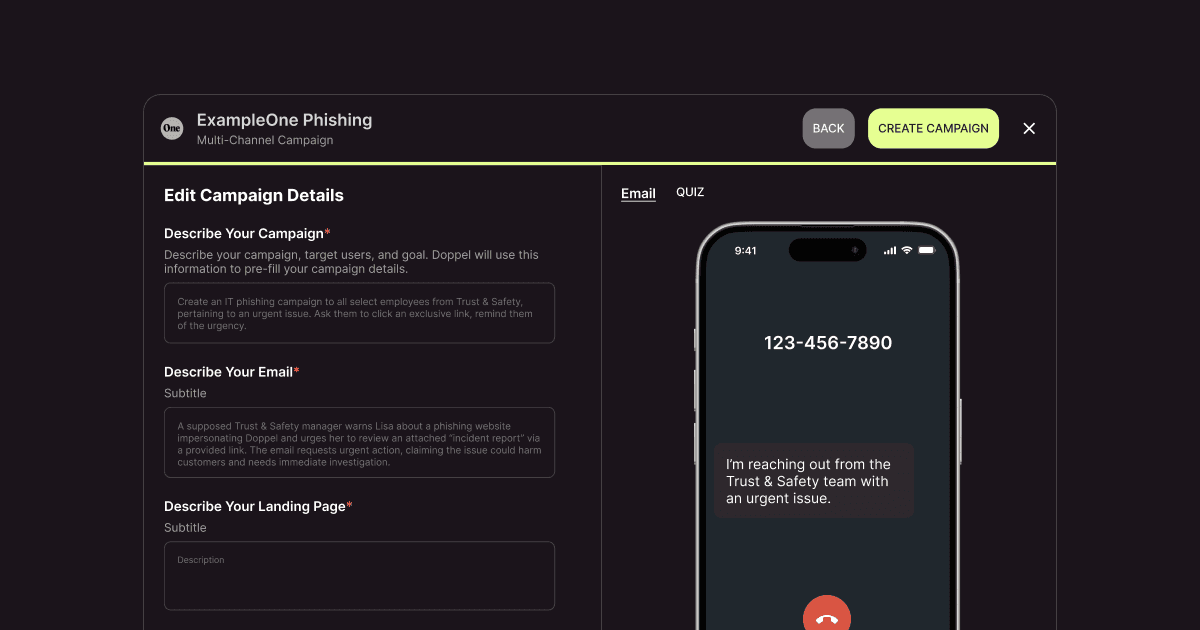
An effective defense must be able to test against these same multi-channel threats. Doppel’s simulation platform, for instance, replicates these exact scenarios to provide a realistic assessment of your brand’s resilience.
Psychological Triggers Behind Customer Deception
Customer impersonation attacks work because they exploit powerful psychological triggers tied to your brand’s authority, so technology is only half the equation.
Here’s how attackers leverage several psychological triggers:
- Urgency: “Your payment failed. Verify now or your account will be suspended.”
- Authority: “Using your official logo and a professional tone to imply legitimacy.”
- Scarcity: “Only 2 left! Click here to claim your exclusive discount.”
- Trust: Simply relying on the fact that the customer already trusts your brand and is less likely to be suspicious.
You gain invaluable insights into customer behavioral responses by simulating these scenarios, allowing you to refine customer education strategies.
Why Customer Impersonation Simulation Matters
A customer impersonation simulation is a controlled, safe test that replicates a real-world brand-cloning campaign to see how customers (or a test group) would respond.
Unlike an employee phishing test, which measures internal security awareness, a customer-facing simulation provides benefits directly tied to brand integrity and digital risk:
- Uncover Hidden Vulnerabilities: Discover which brand assets, customer journeys, or communication channels are most easily exploited.
- Stress-Test Brand Security: See how quickly your current detection and response systems identify a sophisticated, multi-channel attack.
- Improve Customer Communication: Use the findings to build better, more effective educational content and warning messages for your customers.
It’s a significant shift from traditional digital risk protection (DRP), which is reactive. Instead of waiting to find and take down threats, you’re actively testing your defenses.
An advanced, AI-rooted solution like Doppel Simulation becomes critical here. It’s not a generic testing tool. As an integrated component of the Doppel Vision platform, this means the simulations are built from reality, derived from live campaigns and attacker playbooks identified by Doppel’s real-time threat graph.
With Doppel, you’re bridging the gap between awareness and actual readiness.
Executing an Effective Customer Impersonation Simulation
Successful simulations demand more than just sending a fake email. You need realism, intelligence-driven design, and measurable outcomes.
Often, this process requires collaboration between marketing, security, and legal teams to ensure the test is safe, ethical, and valuable. However, the most critical piece is the intelligence used to design the test.
Doppel uses existing, live threat intelligence to guide and automate this process, ensuring maximum realism and impact.
Plan & Design Realistic Scenarios
Think like an attacker. Map your brand’s digital assets — domains, social media accounts, apps, executive profiles, and more — and identify the most likely impersonation targets.
From there, the simulation scenarios must be based on verified threat intelligence. Generic templates won’t work; an effective simulation uses data from real-world attacks targeting your industry or brand.
Doppel Simulation excels here by designing data-driven scenarios that mirror the multi-channel tactics attackers are actually using, as mapped by Doppel’s own threat intelligence engine.
Measure Results & Feed Into Defense
As a simulation runs, track key metrics: What percentage of users clicked the link? How many entered data? How long did it take for the activity to be reported or detected?
But these metrics are just the beginning. The real value is in how these findings are fed back into your overall brand protection strategy.
The results should inform:
- Takedown Prioritization: If 30% of the users fell for a fake social ad, you know that channel needs to be your top priority for monitoring and automated takedowns.
- Incident Response Playbooks: You can build more effective, faster playbooks for a real attack.
- Customer Education: You can create targeted content that addresses the specific tactics your customers were most vulnerable to.
With a fully integrated platform like Doppel Vision, these simulation insights are directly linked to your live monitoring and takedown workflows, creating a powerful feedback loop.
From Simulation to Protection: Closing the Loop with Doppel
Simulation isn’t a one-time event. It’s part of a continuous, closed-loop cycle: simulate, detect, respond, and improve.
Here’s how that aligns with Doppel’s entire platform:
- Detect & Graph: Doppel’s AI ingests signals and maps out a real attack campaign.
- Act: Automated takedowns disrupt the live attack.
- Reduce Risk: Insights from the real attack are used to assemble a simulation built on reality, testing resilience against a similar future attack.
The simulation findings are immediately actionable, feeding back into live brand monitoring and takedowns. An attack simulation might reveal a vulnerability in your mobile presence, which in turn allows your team to tighten automated detection rules for fraudulent app store listings.
What does this look like in action? Check out this walkthrough of LooksRare’s experience combating brand impersonation.
Customer Impersonation Simulation: A Critical Step for Modern Brands
Attackers are weaponizing your brand’s trust against your customers, and the only way to fight back is to be proactive.
Customer impersonation simulation is the missing layer in brand protection. It’s the only way to safely and realistically test your defenses against the sophisticated, multi-channel attacks you’ll inevitably face.
The payoff is clear: stronger customer trust, faster detection of real-world threats, and a scalable, resilient brand protection strategy that can adapt as quickly as your adversaries. Simulation is becoming the new benchmark for digital-first brands serious about protecting their customers and reputation.
Ready to uncover how attackers see your customers? Book a demo and test your brand’s real-world resilience with Doppel.