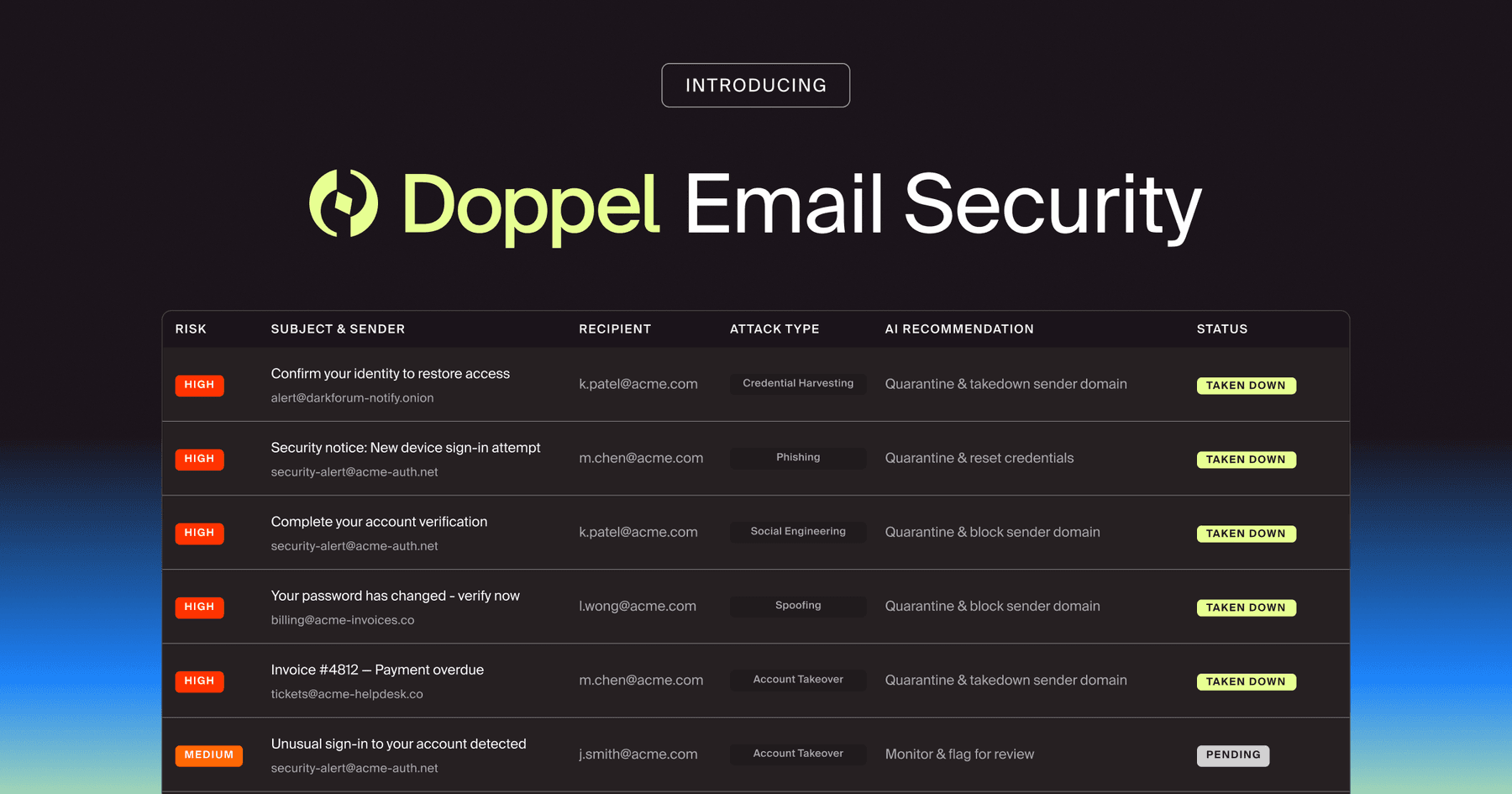
Doppel Email Security is now generally available
The agentic email security solution that empowers you to fight back against social engineering attacks. Detection isn't enough. Disruption is the difference.
If someone can fake a “pay your bill” page in minutes, they will. In healthcare, those minutes can turn into a week of angry calls, missed appointments, and patients handing over credentials, card numbers, or one-time passcodes.
Healthcare brand scam detection focuses on finding and disrupting external impersonation assets (domains, ads, accounts, apps, and calls) early, prioritizing setup and distribution signals over the final phishing page. Healthcare is targeted due to urgent workflows, complex brand ecosystems, and third-party handoffs, enabling short, high-velocity funnels that capture credentials, OTPs, payments, or personal data. Effective programs treat incidents as campaigns, track attacker infrastructure, triage quickly with shared definitions, and prioritize high-risk, widely distributed lures. Success is measured by reduced exposure time and faster detection and disruption, supported by pre-decided takedown procedures and tools like Doppel to map and remove campaigns across channels.
Healthcare brand scam detection is the process of identifying fraudulent websites, ads, accounts, apps, and phone scams that impersonate a trusted provider and trick patients into taking unsafe actions. The goal is simple. Find the scam assets early, connect them to the broader campaign, and disrupt them to reduce exposure time. It functions as a practical layer of brand protection and digital risk protection by monitoring external misuse across the open web, ads, social, apps, and phone, and acting quickly.
This is not a traditional fraud analytics problem where everything happens within a portal controlled by the organization. The scam happens in public, on disposable attacker infrastructure. That changes how detection has to work.
Healthcare is attractive because the attacker’s conversion rate is often high compared with many other consumer scam categories. Patients are already stressed, already in motion, and already used to receiving messages that feel urgent. Billing. Lab results. Appointment confirmations. Prior authorizations. Prescription refills.
Add a few realities, and it gets worse:
Provider impersonation scams usually play out as a short funnel built to convert quickly, then disappear. The attacker does not need a long con. They need one believable touchpoint, one rushed click, and one action that turns trust into access or money.
A typical flow looks like this:
Two details matter for detection. First, the scam often includes “verification” steps (OTP, “confirm your identity,” “secure message”) because it raises urgency while harvesting better data. Second, the distribution channel often leaves its mark. The ad copy, the sender pattern, the phone number, or the domain cluster is often the earliest place to catch the campaign before patients reach the final page.
Attackers tend to stick with messages that already exist in the patient’s life:
The “win” is rarely sophisticated. It is one of these:
It breaks down when teams treat impersonation as a ticket rather than a campaign. The result is predictable. Everyone is busy, nothing is connected, and the same scam keeps respawning with minor changes. This is where disciplined brand protection platforms help connect assets and speed removal.
Three specific failure modes show up over and over:
“We Only Look When Someone Reports It”
Patient reports are valuable, but they are late. By the time the call center gets the complaint, the scam has already converted. Detection has to start before the first angry phone call.
“We Track Incidents, Not Infrastructure”
If the team only logs “fake site” as a single item, it misses the supporting assets. The ad that drove traffic. The lookalike domain family. The cloned social profiles. The phone numbers. That is the difference between whack-a-mole and removal.
“We Have Data, But No Triage”
Raw alerts are not a program. Without routing, prioritization, and ownership, detection becomes noise. Noise gets ignored. Scams do not.
The most useful signals are those that show the attacker's setup and distribution. The final phishing page matters, but it is often the last step in a chain.
High-signal programs typically prioritize:
At this point in the workflow, it helps to have shared definitions inside the organization. For example, what counts as “patient risk” versus “brand risk.” Same scam, different impact lens. Digital risk protection platforms can surface these setup and distribution signals early.
Triage works when it’s boring and consistent. The goal is to move fast with enough confidence, not to hold a courtroom trial for every sketchy domain.
A practical triage model:
If the team needs a shared vocabulary for these categories, standardized definitions for brand impersonation and social engineering make triage faster and more consistent.
The channels causing the most patient harm are those that combine reach with credibility. Attackers go where patients already expect official messages to appear, and they use the same rhythms that healthcare teams rely on. Appointment reminders. Billing notices. “Your results are ready.” That is why the worst campaigns are rarely single-channel. They start with one nudge, then reinforce it elsewhere to make it feel legitimate. A text plus a call. A search ad plus a cloned portal page. A fake social profile that confirms the link is real. Patients do not analyze channel integrity. They pattern-match. If it looks like the last message from their provider, they move fast. Digital risk protection helps teams continuously monitor these channels, reducing alerts and avoiding manual reporting.
The other reason harm is spiking in these channels is speed. Distribution can happen in minutes, and the infrastructure can rotate just as quickly. So the channel question is not academic. It determines which signals the team can see early and whether detection happens before the scam is shared in family group chats and neighborhood Facebook threads.
Text-based scams work because they feel transactional and personal. If the team is seeing “appointment confirmation” or “bill due” texts, the patterns typically overlap with smishing and broader customer impersonation fraud.
Voice scams have gotten more effective, not because callers suddenly became charming, but because scripts and spoofing are cheap and scalable. When a call is paired with a follow-up link, it becomes a conversion machine.
Attackers buy attention. Patients search “pay my bill” and click the first thing that looks right. The ad does not need to be clever. It just needs to be early. If the team is not watching ad-driven scam distribution, malvertising is the concept to anchor on.
Fake apps are the sneakiest version of “looks official.” Patients often assume the app store did the vetting. Attackers bet on that assumption. If mobile impersonation is in scope, fake app detection is worth aligning on internally.
Takedowns work when the process is pre-decided. Who approves? What evidence is required? Which reporting paths are used? What the call center says if patients ask. Teams that improvise in the middle of a live scam usually end up debating policy while patients keep clicking. Brand protection playbooks keep these steps explicit and repeatable.
Two operational tips that reduce drama:
It is working when patient harm and response time go down, even as scam volume stays annoying.
Metrics that are actually useful:
If reporting only tracks takedown counts, it misses the point. The point is reducing exposure time. In short, these are brand protection metrics focused on minimizing digital risk.
Doppel focuses on the external side of the house. Detecting impersonation assets across channels, mapping scam infrastructure into campaigns, and driving faster reporting and removal so teams are not stuck chasing single URLs all day. That’s the practical backbone of healthcare brand scam detection when the scams are not happening on systems the organization controls. In practice, this gives brand protection and security teams digital risk protection coverage without adding busywork.
If the current process depends on patients reporting scams first, or if triage is mostly tribal knowledge, that’s where a platform approach earns its keep.
If provider impersonation scams are landing in the call center, the problem is already in a late stage. Doppel helps healthcare teams detect impersonation campaigns earlier, prioritize high-risk assets, and streamline reporting and removal to reduce patient exposure time.
Want to see what attackers are using to impersonate your brand today? As a Social Engineering Defense Platform, Doppel surfaces active campaigns across domains, ads, social, and messaging, then helps your team prioritize and disrupt the highest-risk assets. Request a demo.